
Frameless and torque motors
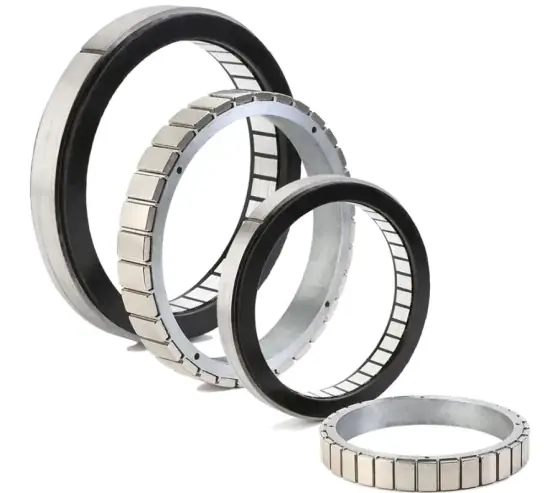
Rotor and stator kits built directly into the machine, removing couplings and gearing from the axis. Tell us the application and we'll specify the right product, and the parts around it, for your machine.
Pricing and availability
Get help selecting and sourcing frameless and torque motors
Send us a part number, or tell us what the machine needs to do. Our UK engineers will come back with the right product, pricing, lead time and delivery, whether that is the original part, a checked alternative or a complete axis.
- Original parts or a checked alternative
- Pricing, lead time and delivery in one reply
- Components, complete axes and ongoing support
No obligation. Add what you know and an engineer will help with the rest. Prefer to configure it? Build a specification.
Spec builder
Specify frameless and torque motors
Select every part you need and answer the questions an applications engineer would ask. Our engineers use your specification to come back with the right products, pricing and lead times. You see your summary before we ask for any details.
Already know the part number? Send it to us directly.
- 1Products
- 2Performance
- 3Environment
- 4Volumes
- 5Your spec
What are you specifying?
Select everything you need. A motor, drive and gearbox can be specified together as one axis.
What frameless and torque motors are
A frameless motor is a brushless motor without the parts that make it a stand-alone product. You get a wound stator and a magnet rotor. The housing, shaft, bearings, feedback and cooling are yours. The stator is bonded or clamped into a bore in your structure, and the rotor goes onto the shaft you are driving.
That is the point of them. Removing the motor’s own housing, bearings and coupling shortens the axis, saves mass and puts the torque directly where it is needed. Kollmorgen notes that a direct-drive axis has no mechanical compliance, backlash or lost motion between motor and load (Kollmorgen). Large-diameter kits usually leave a big through-bore for cables, slip rings, optics or a coaxial brake.
Typical uses are robot and cobot joints, gimbals and stabilised platforms, rotary and index tables, medical devices, semiconductor stages and spindle-like axes. Bus voltages run from 48 VDC or less up to around 680 VDC, and continuous torque from fractions of a newton metre to several thousand.
Types compared
| Type | What you get | Best for | Trade-offs |
|---|---|---|---|
| Frameless kit (slotted) | Rotor and stator only | Robot joints, compact axes, highest torque per mass | You design bearings, housing, cooling and feedback |
| Frameless kit (slotless/ironless) | Rotor and stator, no cogging | Gimbals, optics, metrology, very smooth low speed | Lower torque density |
| Housed direct-drive (torque) motor | Complete motor with bearings and encoder | Rotary tables and indexers without gearing | Larger and heavier than a kit |
| Linear motor (iron-core or ironless) | Forcer and magnet track | Direct-drive linear stages, gantries | Open magnet track, needs linear encoder and guides |
| Gear-integrated actuator | Motor, strain-wave gear and encoder in one unit | Joints and positioners where integration time matters | Gear compliance and lost motion return |
Frameless kits
Kits are offered by diameter and stack length, in several windings for different bus voltages. Akribis ADR-F covers small 48 VDC kits for compact joints; Akribis ADR-P covers larger high-voltage kits with big through-bores.
Housed direct-drive motors
Housed torque motors bring their own bearing and encoder and bolt straight to a table or fixture. Examples include Akribis AXD, the absolute-encoder AXD-ERA, and the ironless, zero-cogging ACD for very smooth low-speed motion.
Linear motors, briefly
The linear equivalent is a forcer moving over a magnet track. Iron-core types such as Akribis AKM give high force; ironless U-channel types such as Akribis AUM remove cogging for smooth scanning. Tubular motors such as LinMot P10-54 package the magnets inside a sealed rod.
Gear-integrated actuators
Where a joint needs a ratio, motor and strain-wave gear can be bought as one unit, for example the hollow-shaft Harmonic Drive FHA-C. This saves integration time at the cost of design freedom.
Frameless vs housed vs geared: when to use which
- Frameless kit when axial length, mass and through-bore drive the design, and you have the mechanical and thermal engineering capacity to integrate it.
- Housed direct drive when you want gearless stiffness and accuracy on a table or indexer without designing bearings and encoder mounts.
- Frameless plus strain-wave gear for most robot joints, where torque per kilogram matters and a small amount of gear compliance is acceptable. A 100:1 gear reduces reflected load inertia by 10,000 times.
- Housed servo plus gearbox when cost and lead time beat integration. See servo and stepper motors and gearboxes.
How to size a frameless motor
1. Torque and speed at the joint
Work out the peak and RMS torque from the move profile, payload, arm or table inertia and gravity. If the joint is geared, divide by the ratio and efficiency to get motor torque, and multiply speed by the ratio.
2. Use the motor constant
The motor constant Km = Kt / √R (Nm/√W) tells you how much torque you get per watt of heat. Allient notes that Km rises faster with diameter than with length, so the largest diameter and shortest stack that meets the Km target is usually the most efficient choice (Allient). Copper loss at a given torque is (T / Km)². Datasheets do not always quote Km; you can calculate it from Kt and resistance.
3. Model the thermal path
This is the step that catches most designs out. Kollmorgen’s TBM ratings, for instance, assume 25 °C ambient and a specified heat sink, with hot parameters quoted at a 155 °C winding temperature (Kollmorgen TBM guide). Your housing may be smaller, enclosed or near other heat sources. Kollmorgen recommends steel or aluminium housings with at least 4–6 mm wall thickness and warns that stainless steel conducts heat poorly. Allient adds that a power-off brake adds heat while the joint is moving. Build a thermal model per joint and expect to derate.
Also consider what the heat reaches. A winding running near its limit can damage bearing grease, gear lubricant and encoder electronics nearby.
4. Choose feedback and temperature sensing
Absolute encoders give commutation and position at power-up, removing separate Hall sensors; Kollmorgen suggests 18-bit or higher for high-repeatability axes, with resolvers (typically 12–16 bits) for high shock. In geared joints, Allient and TQ both describe a second encoder on the output to measure true joint position. For temperature, a linear sensor such as a PT1000 helps characterise the motor during prototyping; a PTC gives a simple trip.
5. Cogging and smoothness
Slotted designs give the most torque but have some cogging. Kollmorgen’s TBM data quotes peak-to-peak cogging per model, from about 0.01 Nm on small frames to around 0.3 Nm on the largest. For gimbals and scanning optics, choose slotless or ironless designs, or ask for cogging data and compensation options. Allient notes that higher-frequency cogging is generally easier to tune out than low-frequency cogging.
Integration and common mistakes
- Trusting datasheet continuous torque. It is only valid for the test heat sink and ambient.
- Stainless or thin housings. These trap heat; increase wall section or use aluminium.
- Poor concentricity. Follow the manufacturer’s tolerances for rotor and stator alignment; an uneven air gap causes torque ripple and unbalanced magnetic pull.
- Unsafe assembly. Rotor magnets pull hard on the stator and on steel tools. Plan fixtures for insertion.
- Bearings sized for the motor, not the load. The machine’s bearings carry everything, and should be serviceable if radial loads are high.
- No brake plan. Fit the brake on the primary driven shaft and include its heat in the budget.
- Encoder mounted on a compliant path. Mount it rigidly to the rotor or output it measures.
For robot joints in particular, the frameless motor sizing guide for robot joints works through a full example, and robotics and cobots covers the wider system.
What to send an engineer for a quote
- Peak and RMS torque, maximum speed, and the move profile
- Available envelope: maximum OD, minimum ID (through-bore), axial length
- Bus voltage and drive current limits
- Housing material, wall section, ambient temperature and any cooling
- Feedback type and resolution, and whether you need an output-side encoder
- Gear ratio and type if geared
- Brake, smoothness or cogging limits, and any vacuum, cleanroom or radiation requirements
- Expected volumes, since custom windings and stack lengths are often possible
Send these through the spec builder below and our engineers will shortlist kits or housed units to suit.
Guides
Where frameless and torque motors are used
What we need to know to specify frameless and torque motors
These are the questions an applications engineer works through first. Approximate answers are fine: ranges narrow the options quickly, and we confirm the details with you.
- Outer diameter: Under 50 mm, 50–100 mm, 100–200 mm, Over 200 mm
- Peak torque: Under 2 Nm, 2–20 Nm, 20–200 Nm, Over 200 Nm
- Use: Robot joint, Gimbal / pan-tilt, Rotary table, Spindle
- Hollow shaft: Yes, No
We also ask about the environment (washdown, outdoor, subsea, ATEX, vacuum, shock and EMC), annual quantities and timescale, because these decide whether a standard, modified or custom design is the best fit.
39 series compared
Series from 18 manufacturers, grouped by type. Figures are the highest published for each series. Open a series for the full specification and, for brands outside our supply network, the alternatives that meet or exceed it.
Frameless torque motor (25)
| Brand | Series | Continuous torque | Peak torque | Speed |
|---|---|---|---|---|
| Akribis Systems | ADR-F | 3.75 Nm | 11.22 Nm | 3,000 rpm |
| Akribis Systems | ADR-P | 365 Nm | 985.5 Nm | — |
| Motion Control Products | TI Series In-Runner Frameless Direct Drive Torque Motors | 70 Nm | — | — |
| WITTENSTEIN alpha | cyber torque motor | — | 1,700 Nm | — |
| Kollmorgen | KBM / KBMS | 54.6 Nm | 218 Nm | — |
| Kollmorgen | TBM2G | 6.03 Nm | — | — |
| maxon | EC frameless DT / HT | 2.84 Nm | — | — |
| CubeMars | RI Series | — | 4.95 Nm | — |
| CubeMars | RO Series | — | 12 Nm | — |
| HIWIN | TM-2 / IM-2 torque motors | 3,375 Nm | 6,000 Nm | 5,450 rpm |
| Allient | MegaFlux frameless torque motors | 181 Nm | — | — |
| Allient | KinetiMax HPD frameless motors | — | — | — |
| Allient | HT frameless torque motors | 9.2 Nm | — | 14,500 rpm |
| Schaeffler | RKI torque motors (IDAM) | 11,864 Nm | 17,670 Nm | 3,000 rpm |
| Schaeffler | RIB torque motors (IDAM) | — | 40,000 Nm | — |
| ETEL | TMB+ | 22,300 Nm | 42,900 Nm | 4,590 rpm |
| ETEL | TMKi | 11,600 Nm | 20,600 Nm | 5,200 rpm |
| ETEL | TMM | 1,170 Nm | 4,990 Nm | 4,400 rpm |
| Tecnotion | QTL torque motors | 907 Nm | 1,789 Nm | — |
| Tecnotion | QTR torque motors | 103.9 Nm | 155.3 Nm | — |
| TQ-RoboDrive | ILM Servo-Kits | 3.9 Nm | 12.7 Nm | 22,378 rpm |
| TQ-RoboDrive | ILM-E Servo-Kits | 3.3 Nm | 10.6 Nm | 6,422 rpm |
| Nanotec | DKA frameless BLDC motors | — | 7.8 Nm | 10,000 rpm |
| Lin Engineering | PCT frameless BLDC motors | — | — | 7,800 rpm |
| Lin Engineering | XCT frameless BLDC motors | — | — | 3,645 rpm |
Housed direct-drive motor (14)
| Brand | Series | Continuous torque | Peak torque | Speed |
|---|---|---|---|---|
| Akribis Systems | ADR-A | 407.2 Nm | 1,017.9 Nm | 2,000 rpm |
| Akribis Systems | ADR-B | — | — | 2,000 rpm |
| Akribis Systems | AXD | 250.6 Nm | 648.9 Nm | 3,000 rpm |
| Akribis Systems | AXD-ERA | 250.6 Nm | 648.9 Nm | 2,000 rpm |
| Akribis Systems | ACD | 9.22 Nm | 32.25 Nm | 1,200 rpm |
| Akribis Systems | ACW | 7.4 Nm | 35.9 Nm | 400 rpm |
| Kollmorgen | Cartridge DDR | — | — | — |
| Yaskawa | SGM7D / SGM7E / SGM7F direct drive | — | 600 Nm | 600 rpm |
| Yaskawa | SGMCS / SGMCV direct drive | — | 600 Nm | 500 rpm |
| Baumüller | DST2 high-torque motors | — | 31,600 Nm | 2,000 rpm |
| NSK | Megatorque Motor PS series | — | 90 Nm | 600 rpm |
| NSK | Megatorque Motor PN series | — | 180 Nm | 180 rpm |
| NSK | Megatorque Motor PB series | — | 60 Nm | 600 rpm |
| SCHUNK | ERD rotary module | — | 3.6 Nm | 600 rpm |
Summarised from manufacturers' published data. Always confirm against the current datasheet; an engineer will check the fit before recommending anything.
Brands
Engineer support
Talk to an engineer about frameless and torque motors
Tell us the part or application, quantity and timing. Our UK engineers will come back with the right product, pricing, lead time and delivery.
- Reviewed by an engineer, not an autoresponder
- Like-for-like and better-fit alternatives
- Standard, modified and custom options
Prefer to configure it? Use the spec builder.
From component to working requirement
Applications and engineering services
Explore selection questions, replacement routes and complete motion packages. Keep the application requirements alongside the product specifications.
Custom and modified motion control components
A standard component with the right options may solve the problem. Establish that route before committing to a modified or fully custom design.
Motors, encoders and slip rings for gimbals
Smooth low-speed motion, payload balance, disturbance rejection and cable routing can matter more than a headline peak torque figure.
Hollow-shaft absolute encoder selection
A usable bore, a high bit count and an absolute position output do not by themselves establish a suitable encoder. Check the installed mechanical and electrical arrangement.
Servo motion for rotary indexing tables
Indexing performance depends on the complete move and settle cycle. Table diameter or payload alone cannot establish motor torque or gearbox suitability.
How it works
From enquiry to delivery
Send a part number or describe the application. Our engineers take it from there: the right product, a clear quotation, and delivery and support arranged.
- 01Tell us what you needSend a part number, or configure the application, quantities and timing.
- 02An engineer reviews itWe check the specification and find the original part, a checked equivalent or a complete axis.
- 03Receive your quotationProducts, pricing, lead time and compatibility notes in one reply.
- 04Order and deliveryWhen you are happy, the order is placed and delivery and after-sales support are arranged.