
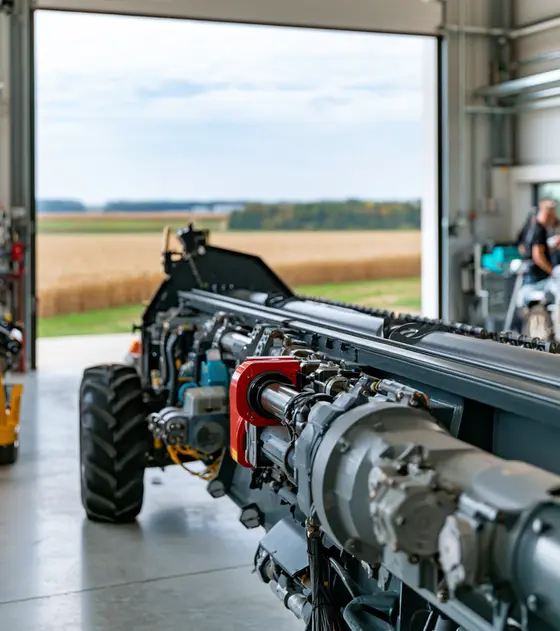
In short:Agricultural machinery is going electric one function at a time: a modern combine can carry more than a dozen electric linear actuators for spreaders, sieves and chutes, implements talk ISOBUS, and field robots run on battery-powered servo drives. Specify for a 12/24 V supply, IP69K washdown, dust, vibration and cold starts, with safety-related functions assessed to ISO 25119.
Typical requirements
| Electric actuators per combine (published example) | Up to 13 on a New Holland combine, depending on model |
|---|---|
| Combine actuator rating (published example) | 6,800 N, 160 mm/s, 100–1,200 mm stroke, IP66 dynamic / IP69K static (LINAK LA36) |
| Off-highway actuator temperature range | −40 to +85 °C (Thomson Electrak HD published data) |
| Supply and control | 12 or 24 V DC; CAN bus, analogue or switched control |
| Tractor–implement network | ISOBUS (ISO 11783), CAN-based, derived from SAE J1939 |
| Functional safety | ISO 25119 AgPL, set by a type-C standard or the manufacturer |
| Robotic transplanter drive (published example) | 24 grippers at 22 mm minimum spacing on brushless motors with EtherCAT control |
Machinery we specify motion for
- Combine harvesters
- Forage harvesters
- Tractors and implements
- Sprayers and spreaders
- Seedling transplanters
- Agricultural field robots
- Automated farm equipment
- Agriculture and turf equipment subsystems
What agricultural machinery demands from motion components
Farm machinery works outdoors in dust, chaff, mud, rain and fertiliser, is jet-washed at the end of the day, sits in an unheated shed through the winter, and then has to work flat out for a few weeks at harvest. The supply is a 12 or 24 V vehicle battery, and the operator expects to change settings from the cab without climbing down. That combination is why electric actuators have spread across combines and implements, and why agritech robots are built around low-voltage servo drives.
The shift is well documented. LINAK reports up to 13 electric actuators on a New Holland combine, setting the straw spreader discs and adjusting the sieves for hillside harvesting, and argues that electric positioning avoids the leakage risk and the feedback complexity of hydraulics. Thomson lists combine and tractor makers among its actuator customers.
Where each motion component sits
| Machine | Function | Usual component |
|---|---|---|
| Combine harvester | Spreader, sieve, concave, chute and hood adjustment | 12/24 V linear actuators with feedback |
| Forage harvester | Spout and chute direction | Fast IP69K actuators with CAN or analogue control |
| Tractors and implements | Cab-set depth, angle, section and valve settings | Linear actuators, small gearmotors |
| Sprayers and spreaders | Boom, valve and rotary head control | Actuators, motors, slip rings on rotating heads |
| Seedling transplanters | Gripper and placement axes | Brushless motors, planetary gearheads, motion controller |
| Field robots | Drive wheels, steering, tool and arm axes | Low-voltage servo motors, drives, gearboxes, encoders |
Combines and forage harvesters
A published combine actuator, the LINAK LA36, is rated at 6,800 N, 160 mm/s and 100–1,200 mm stroke, IP66 dynamic and IP69K static. On forage harvesters, BIBUS describes 12 or 24 V spout and chute actuators that adjust crop discharge direction on the move, replacing cable or hydraulic systems, with IP66/IP69K sealing, integrated limit switches and CAN, analogue or switch control. Those figures are a good template for any agricultural actuator enquiry. Our GD Geared Linear Actuator (300–2,000 N across five ratios, −20 to +65 °C) and GT44 (6,000 N push) cover the lighter and mid-range adjustment duties; see linear actuators.
Tractors, implements and ISOBUS
Implements increasingly take their settings from the tractor terminal through ISOBUS, the ISO 11783 network derived from SAE J1939 and running on CAN. The Virtual Terminal (ISO 11783-6) lets one display run implements from several brands, and the Task Controller (ISO 11783-10) exchanges task data with farm management software, with basic, section and geo-based sub-protocols. The AEF, set up in 2008 to fix incompatible interpretations of the standard, runs conformance testing. An actuator rarely talks ISOBUS itself; it talks CAN or analogue to the implement’s ECU.
Sprayers, spreaders and dosing
Sprayers and fertiliser spreaders turn rate commands into motion: valves, section shut-offs, boom height and spreader vane or disc settings. Electric metering drives replace ground-wheel drives so that rate can follow a prescription map through the Task Controller. For these axes the important figures are low-speed smoothness, repeatable position or speed, and resistance to corrosive product. A closed-loop stepper with an IP65 option, such as the CS-M, or a low-voltage servo motor suits metering and section-control axes. Where a sprayer head or spinner rotates continuously and carries sensors, a sealed slip ring such as the Waterproof Slip Ring range (IP64 to IP68) carries power and signals across the axis. Choose stainless or coated hardware, because fertiliser and crop-protection products attack aluminium and plain steel.
Transplanters and field robots
FAULHABER supplied the drives for gripper handling on the Da Ros TP-24 robotic transplanter: brushless motors with integrated feedback, planetary gearheads and an EtherCAT motion controller, compact enough for a 22 mm minimum gripper spacing and 24 grippers. Kollmorgen stresses torque matched to continuous and peak demand, thermal performance over long duty cycles and frameless motors with large bores for field robots. For battery buses, look at low-voltage servo motors such as the ELVM with drives such as the ELD2 (24–70 V DC, up to 60 A continuous). Wheel-hub gearboxes such as the GL/GLS let a drive wheel mount directly on the gearbox housing.
Turf, municipal and other off-road equipment
Mowers, turf machines, street sweepers and other municipal vehicles use the same building blocks: 12/24 V actuators for decks, brushes, hoppers and chutes, and low-voltage servo drives on electric versions. ISO 25119 can also be applied to mobile municipal equipment such as street sweepers, so the same safety approach carries across. The main difference is duty: municipal machines often run every day of the year, so actuator duty cycle and seal life deserve more attention than on a harvest-only machine.
How to specify motion components for agriculture
- Supply. State 12 or 24 V, the harness length and the cranking dip. Size cables for stall current.
- Duty cycle. Most DC actuators are rated for intermittent duty, around 10–25%. Continuous closed-loop correction needs a servo actuator or a higher-duty design.
- Temperature, including storage. Check the published minimum. Some light-duty actuators are rated only to about −5 °C; rugged off-highway designs such as Thomson’s Electrak HD are published at −40 to +85 °C.
- Ingress and chemicals. IP69K for washing, plus resistance to fertiliser, crop acids and cleaning products. Specify the connector as carefully as the actuator.
- Feedback and control. Hall, potentiometer or CAN position feedback; decide whether the cab needs to know position or just end-of-stroke.
- Functional safety. If the function is safety-related, it falls under ISO 25119. The standard defines AgPL but leaves the level to a machine-specific standard or the manufacturer’s risk assessment.
- EMC. Agricultural machines have their own EMC standard, ISO 14982. Brushed DC actuators and PWM drives both need checking.
Worked example: a sieve adjuster on a 12 V combine
The function needs 1.5 kN worst-case (including chaff build-up), 100 mm stroke, 10 mm/s, moved a few times an hour, on 12 V.
- Mechanical power: 1,500 N × 0.010 m/s = 15 W.
- Electrical power: with an acme screw and gearing at about 35% and motor efficiency around 70% (rule-of-thumb figures), input is about 15 / (0.35 × 0.7) ≈ 61 W, or about 5 A at 12 V. At 10 V during heavy load or a weak battery, about 6 A, and the actuator also slows.
- Margin: choose a rated load of at least 1.5 times the worst case, so a 2–3 kN class actuator. The acme screw holds the sieve against vibration when unpowered.
- Duty: a few moves an hour at 10 s each is well inside a 10% rating.
- Feedback and sealing: potentiometer or Hall feedback so the cab display shows the setting, IP69K static and IP66 dynamic, sealed connector, −30 °C storage.
A 2,000 N, 12 V geared actuator with feedback fits. If the customer later wants automatic adjustment from a grain-loss sensor, duty rises and the choice moves to a higher-duty or servo design.
Typical pitfalls
- Choosing an indoor-rated actuator because force and stroke match. Temperature and sealing decide life on a farm.
- Ignoring duty cycle when a function becomes automatic.
- Unsealed connectors on an IP69K actuator.
- Optical encoders on robot axes that get muddy.
- No plan for the safety assessment under ISO 25119 when an axis can move people or tools unexpectedly.
Send us the machine, function, loads, supply and environment, and our specialist engineering and supply partners will propose actuators, motors, drives and feedback to suit.
Actuators for agricultural machinery
Electric linear actuators adjust spreaders, sieves, chutes, spouts, concaves, hoods and implement settings from the cab, replacing cables, levers and small hydraulic cylinders. Specify force including crop and dirt build-up, stroke, speed, 12 or 24 V supply, duty cycle, position feedback (Hall, potentiometer or CAN), IP69K for washing, and the real temperature range: some light-duty actuators are rated only to about −5 °C, which rules them out for winter storage or early-season work. Self-locking acme screws hold position when the machine vibrates; ball screws need a brake.
- Combine harvesters: straw spreader and sieve adjustment
- Forage harvesters: spout and chute direction
- Implements: depth, angle and section settings from the cab
- Sprayers: valve, boom and hood adjustment
Available through our supply network
All linear actuators →Specify linear actuators for agriculture and agritech →
Motors for agricultural robots and dosing systems
Field robots, robotic transplanters, weeders and dosing units use low-voltage brushless servo motors or closed-loop steppers on a 24–48 V battery bus. Specify continuous and peak torque, speed, voltage, IP65 or better with a shaft seal, holding brake, encoder type and operating temperature. Dosing and metering axes value smooth low-speed control and accurate position; drive wheels and arms need torque density and sealing. Plan for mud, fertiliser dust and cleaning chemicals, which attack seals and connectors before the motor itself.
- Field robots: wheel, steering and tool axes
- Robotic transplanters: gripper and placement axes
- Seed and fertiliser metering: speed-controlled dosing
- Weeding robots: tool positioning
Available through our supply network
All servo and stepper motors →Specify servo and stepper motors for agriculture and agritech →
Low-voltage servo drives for farm robots and implements
Battery-powered machines need servo drives that accept a wide DC input, survive vibration and temperature, and talk CANopen or EtherCAT to the robot or implement controller. Compact drives can be mounted next to the motor to shorten high-current cables. Specify bus voltage range, continuous and peak current, feedback type, safe torque off, fieldbus and environmental rating. On implements, the drive usually sits behind an ISOBUS electronic control unit rather than on the ISOBUS network itself. Check how the drive behaves when the battery is disconnected under load, and whether it needs a separate logic supply to keep position data.
- Field robots: wheel and arm servo control
- Implements: electric metering and section control
- Transplanters: multi-axis gripper drives
Available through our supply network
All servo drives →Specify servo drives for agriculture and agritech →
Gearboxes for agricultural robots
Robot drive wheels, steering axes and arms use planetary gearboxes to turn fast, small servo motors into wheel or joint torque. Wheel-hub planetary units with a rotating housing let the wheel mount directly on the gearbox. Specify output torque including slope and soft-ground rolling resistance, radial load from the wheel, IP65 sealing, backlash where the axis positions a tool, and lubricant for the temperature range. Strain-wave gears suit compact robot arms for harvesting and handling. Ask for the gearbox life at your real load spectrum, because field robots spend long hours at moderate torque rather than short bursts at peak.
- Field robots: drive wheel reduction
- Steering axes: low-backlash positioning
- Harvesting arms: compact joint gearing
Available through our supply network
All gearboxes and harmonic drives →Specify gearboxes and harmonic drives for agriculture and agritech →
Encoders for implement position feedback
Implement and robot axes need position feedback that ignores dust, mud, condensation and vibration. Non-contact inductive and capacitive encoders have no optics to foul and tolerate loose mechanical mounting. Specify absolute or incremental, angle or linear, interface, IP67 sealing, temperature range and the accuracy needed at the implement. Absolute feedback avoids re-homing in the field after a power interruption. Route encoder cables away from motor and alternator wiring, and use screened cable with sealed M12 or similar connectors so a muddy harness does not become a source of noise.
- Steering axes: absolute wheel angle
- Implement linkages: height and angle feedback
- Robot arms: joint angle
- Linear axes: tool position on gantry robots
Available through our supply network
All encoders and feedback →Specify encoders and feedback for agriculture and agritech →
Slip rings for rotating implements and booms
Any implement that rotates continuously, such as rotary sprayer heads, turntables on robots, rotating screens and some spreader mechanisms, needs a slip ring to carry power, sensor signals and CAN across the axis. Specify circuits, current, voltage, speed, bore, sealing against water and fertiliser, and corrosion-resistant materials. Through-bore units leave room for hoses or a rotary union. Ask for brush and ring materials that tolerate long idle periods in damp storage, because contacts that sit unused through the winter can corrode and give noisy signals at the start of the season.
- Rotary sprayer heads: power and sensor signals
- Robot turntables: power and CAN across rotation
- Rotating screens and drums: sensor feedback
Available through our supply network
All slip rings →Specify slip rings for agriculture and agritech →
Standards to have in view
- ISO 25119 series (tractors and machinery for agriculture and forestry: safety-related parts of control systems)
- ISO 11783 series (ISOBUS: serial control and communications data network)
- SAE J1939 (vehicle CAN network)
- ISO 14982 (agricultural and forestry machinery: electromagnetic compatibility)
- ISO 12100 (safety of machinery: risk assessment)
- IEC 60529 and ISO 20653 (IP codes, including IP69K)
Which standards apply depends on the end product and its market. Your engineer will confirm what the component itself needs to meet.
Frequently asked questions
What IP rating does an actuator on a tractor or combine need?
For anything that gets pressure-washed, specify IP69K, which covers close-range high-pressure, high-temperature water jets, alongside IP66 or IP67. Published combine actuators are rated IP66 dynamic and IP69K static. Ask whether ratings are static or dynamic, check the cable entry and connector are sealed to the same level, and confirm the rating survives the cleaning chemicals used on the farm.
Can an electric actuator run on a 12 V tractor supply?
Yes. Most agricultural actuators come in 12 and 24 V versions. Allow for voltage drop along long harnesses and during cranking, and size wiring and fuses for stall current. Check the duty cycle: many DC actuators are rated around 10–25%, which is fine for occasional adjustment but not for continuous closed-loop correction. Choose CAN control if the actuator must report position to the cab.
What is ISOBUS and does my actuator need it?
ISOBUS is the ISO 11783 network that lets tractors, terminals and implements from different makers work together. It runs on CAN and was derived from SAE J1939, adding functions such as the Virtual Terminal and Task Controller. The AEF runs conformance testing. Individual actuators rarely sit on ISOBUS directly; they connect to the implement's control unit, which does.
Which functional safety standard applies to agricultural machinery?
ISO 25119 covers safety-related parts of control systems on tractors, self-propelled ride-on machines and mounted, semi-mounted and trailed implements, and can also apply to municipal equipment such as street sweepers. It defines agricultural performance levels (AgPL) but does not set them for particular machines: a machine-specific standard does, or the manufacturer decides through risk assessment.
How many electric actuators are on a combine harvester?
It varies by maker and model. LINAK reports up to 13 actuators on a New Holland combine, used for functions such as setting the straw spreader discs and adjusting the sieves for hillside harvesting. Other uses across the industry include spout and chute direction on forage harvesters and cab-controlled implement settings, replacing cables and small hydraulic cylinders.
What should I send for an agricultural motion enquiry?
Send the machine and function, force or torque, stroke or angle, speed, duty cycle, supply voltage, control interface (switch, analogue, CAN or ISOBUS via the ECU), feedback needed, IP rating and washdown, temperature range including storage, vibration level, AgPL if the function is safety-related, mounting envelope and annual volume.
Sources
- LINAK: New Holland combine harvester case story
- BIBUS: Electric actuators for spout and chute control
- Automation.com: Thomson introduces Electrak HD linear actuators
- Thomson: Industry applications (combines, tractors)
- CSS Electronics: ISOBUS (ISO 11783) explained
- Genorma: EN ISO 25119-1:2023 scope
- IEN Europe: How modern seedling transplanting works (FAULHABER drives in the Da Ros TP-24)
- Unmanned Systems Technology: Kollmorgen motors maximise field robot uptime and performance
Figures are summarised from the sources above and from manufacturers' published data on the date shown. Always confirm against the current datasheet for your exact part.