
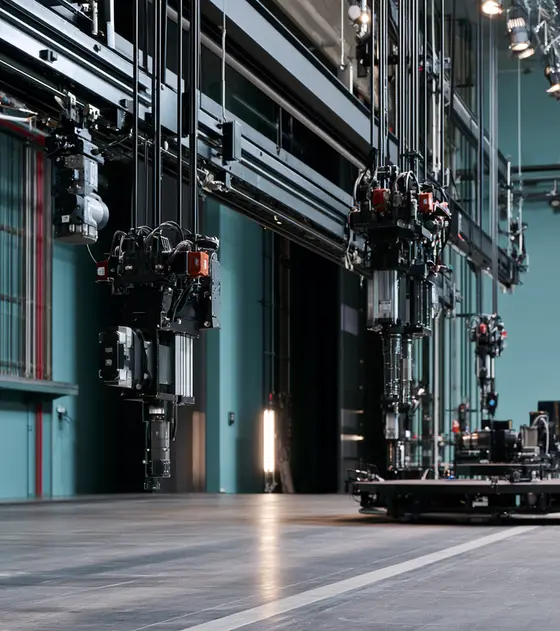
In short:Stage machinery is ordinary motion control built to a higher safety standard: point hoists, revolves, lifts and wagons use servo motors, gearboxes, dual brakes, redundant absolute encoders and slip rings, all designed under EN 17206 to be either twice as strong as they need to be or duplicated. Size each axis for the cue speed and load, then add the redundancy that its Use-Case demands.
Typical requirements
| Point hoist load and speed (example) | 250 kg at up to 1.2 m/s, 20 m travel (ASM TrackPoint P 250) |
|---|---|
| Speed threshold for the lowest hoist Use-Cases | Under 0.2 m/s with nobody in the hazard zone (EN 17206 UC1/UC2) |
| Brakes on a hoist over people | Two independent brakes |
| Design factor (intrinsic safety route) | Working coefficient doubled: a 1,000 kg industrial hoist may suspend 500 kg over people |
| Position feedback | Two absolute encoders (SSI) for safety plus one incremental for the speed loop, on a published hoist |
| Show control scale | Up to 255 synchronised axes on one PC-based controller (Beckhoff) |
| Revolve services | Power plus DMX, Ethernet, CAN or Profibus, and fibre for video |
Machinery we specify motion for
- Point hoists and fly bar winches
- Performer flying systems
- Stage revolves and turntables
- Stage lifts, traps and wagons
- Moving LED screens and kinetic installations
- Rising props and scenery effects
- Moving-head lights and projectors
- Dynamic motion seating
- Camera cranes, tracks and robotic camera heads
What makes stage machinery different from industrial motion
Stage machinery uses familiar parts: servo motors, gearboxes, brakes, encoders, slip rings and linear actuators. What changes is the safety case. Loads hang over audiences and performers, cues change every night, and some machines move people. In Europe the main design reference is EN 17206:2020, which covers machinery, installations and control systems in places of assembly. It includes machinery that is excluded from the Machinery Directive, such as equipment intended to move performers during a performance. It replaced CWA 15902-1.
According to ESTA’s Protocol, EN 17206 rests on two principles: intrinsic safety (“make it bigger”) or single-fault safety (“use two”). In practice:
- Design factor. A hoist rated for 1,000 kg on a construction site may lift and suspend only 500 kg over people.
- Brakes. Industrial hoists usually have one brake; entertainment hoists usually have two. J.R. Clancy notes that ANSI E1.6-1 also requires two independent means of stopping and holding the load, and that EN 17206 requires calculations for the parts between drum and brakes under normal use, emergency stops and uncontrolled stops.
- Controls. Safety functions such as end-of-travel stopping are duplicated, for example a backup overtravel limit switch.
EN 17206 Use-Cases: how much safety each axis needs
The standard sorts equipment into Use-Cases, and the control system requirements follow from them. For hoists, ESTA summarises them as:
| Use-Case | Situation | What it implies for components |
|---|---|---|
| UC1 / UC2 | Nobody in the hazard zone, speed under 0.2 m/s | Simplest controls; UC1 single load, UC2 statically indeterminate load |
| UC3 / UC4 | Persons in the hazard zone (single or multiple axes) | Redundant brakes, position and overload monitoring |
| UC5 / UC6 | Moving suspended persons (performer flying) | Highest integrity; redundant feedback and safety-rated drives |
Lower stage machinery has its own categories, from UC-LSL1 (a simple compensator lift) to UC-LSL6 (several large platforms lifting a common load at speed with people in the hazard zone), and from UC-LSH1 (a single revolve) to UC-LSH6 (several wagons moving a common load). ESTA’s point is worth repeating to any buyer: the answer is not “all functions at SIL 3”. The functions and their levels come from the Use-Case and a risk assessment.
Where each motion component sits
| Machine | Motion | Typical components |
|---|---|---|
| Point hoist, fly bar winch | Vertical lift, synchronised groups | Servo or asynchronous motor, gearbox, two brakes, two absolute encoders, load cell |
| Performer flying | 2D or 3D moves of a person | Several synchronised winches, safety-rated drives and controller |
| Revolve or turntable | Continuous rotation | Gearmotor or direct drive, slip ring at the centre, absolute encoder |
| Stage lift, trap | Vertical platform | Screw jacks or spiral lifts, gearmotors, absolute position |
| Wagon | Horizontal traverse | Friction or rack drive, absolute linear scale, cable reel or rail power |
| Props and effects | Short strokes | Electric rod actuators or small integrated steppers |
| Camera crane or head | Pan, tilt, track | Direct-drive or geared servo axes, HD video slip ring |
A published example shows what a modern point hoist contains. The ASM TrackPoint P 250 is rated at 250 kg on a steel band, 20 m travel and 1.2 m/s maximum speed. It has a 3 kW asynchronous motor, a worm gearbox (i = 19.67) rated for twice nominal torque, two independent theatre brakes, a four-track limit switch with two operational and two absolute limits, two SSI absolute encoders for the SIL 3 channels plus one incremental encoder for closed-loop control, a SIL 3 load cell and slack-band detection. It is built to DGUV V 17 and EN 17206, and its noise level is up to about 48 dBA.
The J.R. Clancy paper lists the monitoring that makes this hardware useful: continuous drum torque against limits (overload stops travel; underload flags slack line), drum speed against command to catch snags, and brake open/close status checked on every move.
Revolves, wagons and rotating scenery
A revolve needs power and data on the turntable. Conductix-Wampfler lists slip ring assemblies carrying power plus DMX, Ethernet, Profibus and CAN bus, with curved conductor rails and inductive power transfer as alternatives. SPINNER supplies fibre optic rotary joints for rotating stages where video and recording signals cross the axis. Because revolves turn slowly, contact wear is rarely the limit; the real work is circuit count, a bore big enough for the centre column, and separating data rings from power. See slip rings for stage and entertainment, through-bore slip rings, large-diameter slip rings and the Ethernet through slip rings guide.
Props, effects and kinetic installations
Tolomatic lists positioning of lights, cameras and props, animated structures, theatre motion seating and a lamp post rising through a stage floor among its entertainment uses, and points out that venues with repetitive shows are high-duty-cycle applications. Electric actuators win over pneumatics when moves must be quiet, stop mid-stroke or change speed. Read how to size a linear actuator and, for heavier lifts, ball screw vs roller screw.
Kinetic installations multiply the axis count. Beckhoff quotes up to 255 motion axes on a single PC-based controller with EtherCAT cycle times well below 1 ms, and TwinSAFE components up to SIL 3. Smaller pieces run happily on a CODESYS EtherCAT controller.
Worked example: sizing a servo point hoist
Take a hoist for 250 kg at 1.0 m/s on a 150 mm rope drum (radius 0.075 m), with 1 m/s² acceleration and people in the hazard zone.
- Static drum torque: 250 × 9.81 × 0.075 = 184 Nm.
- Acceleration torque: 250 × 1.0 × 0.075 = 19 Nm, so about 203 Nm peak (ignoring drum inertia for now).
- Drum speed: 1.0 ÷ (π × 0.15) = 2.1 rev/s, or 127 rpm.
- Gear ratio: a 20:1 two-stage planetary takes a 3,000 rpm motor to 150 rpm at the drum, about 1.18 m/s, leaving headroom.
- Motor torque: 203 ÷ 20 ÷ 0.95 (efficiency) ≈ 10.7 Nm peak, about 9.7 Nm while lifting at speed. Lifting power is 250 × 9.81 × 1.0 ≈ 2.5 kW, so a 3 kW class servo motor is the starting point.
- “Make it bigger”: design the drum, shaft and gearbox for at least twice the characteristic load, and check the gearbox’s emergency-stop rating against the torque spike of a brake-stop at full speed.
- “Use two”: two independent brakes. Static torque at the motor shaft is 184 ÷ 20 ≈ 9.2 Nm; as a rule of thumb size each brake to hold the load alone with margin, around 2× (about 18 Nm here), and confirm against the stopping distance your risk assessment allows.
- Feedback: two absolute encoders for the safety channels, one for the speed loop.
Treat these numbers as an illustration. Rope layers change the effective drum radius, and a real design adds drum inertia, rope mass and dynamic factors.
Typical pitfalls
- Using an industrial hoist rating over people without halving it or proving single-fault safety.
- Specifying SIL 3 everywhere instead of the functions each Use-Case actually needs.
- Ignoring noise. A gearbox or fan that is fine in a factory can be heard in a quiet scene.
- Mixing data and power rings badly in a revolve slip ring, so DMX or Ethernet errors appear when dimmers or motors load up.
- Forgetting touring conditions: vibration in trucks, unstable supplies, cold get-ins and rain on outdoor stages.
- Relying on a worm gear to hold the load instead of proper brakes.
What to send an engineer
Send the load and rigging, travel or rotation, cue speed and acceleration, cues per show and shows per week, the EN 17206 Use-Case, how many axes move together, the show control system and fieldbus, supply voltage, noise limit, venue or touring environment and the envelope. Our specialist engineering and supply partners can then propose matched motors, gearboxes, encoders, drives and slip rings for each axis.
Hoist and winch motors for stage machinery
Point hoists, fly bar winches, wagons and revolves are mostly driven by AC servo motors through a gearbox, because cues need smooth, variable speed and accurate stopping positions. Size the motor from the drum torque and cue speed, then check RMS torque over a full show; theatre duty is intermittent but acceleration is high when several axes move together. Specify the bus voltage, the encoder the safety system needs (multi-turn absolute is usual), a holding brake input, and noise limits, because a hoist above an audience must be quiet. Integrated steppers suit light scenic effects and small kinetic pieces where open-loop positioning is acceptable.
- Point hoists: rope or band drum drive at up to about 1.2 m/s
- Fly bar winches: synchronised multi-motor lifts of lighting and scenery bars
- Stage wagons: friction or rack-and-pinion traverse drives
- Kinetic installations: many small synchronised axes
- Moving-head lights: pan and tilt drives
Available through our supply network
All servo and stepper motors →Specify servo and stepper motors for stage, theatre and broadcast →
Gearboxes for theatre hoists and revolves
Between a servo motor and a hoist drum or revolve pinion sits a planetary or right-angle gearbox. Under EN 17206's intrinsic safety route the parts between drum and brakes are designed for twice the characteristic load, so choose the gearbox on its emergency-stop and peak ratings, not just the running torque. Planetary units give high efficiency and low backlash for repeatable cue positions; right-angle spiral bevel units keep a hoist compact along a grid. Worm gears are still used and can help hold a load, but they must never be treated as a brake. Ask for output torque, emergency-stop torque, radial load on the drum shaft and noise.
- Point hoists: reduction from servo motor to drum
- Revolves: drive to a pinion on a slewing ring or a friction wheel
- Stage lifts: input reduction to screw jacks or spiral lifts
- Wagons: right-angle drives under low deck heights
Available through our supply network
All gearboxes and harmonic drives →Specify gearboxes and harmonic drives for stage, theatre and broadcast →
Encoders for stage automation and repeatable cues
Stage cues must land in the same place every night, and the safety system must know where each axis is at power-up. Published hoist designs use two absolute encoders for the safety channels and a separate incremental encoder for the drive's speed loop. Multi-turn absolute encoders avoid re-homing after a power cut mid-show. Large hollow-shaft encoders fit around a revolve centre, and absolute linear scales give wagon and lift position without homing runs. Specify the interface the safety controller accepts (SSI or BiSS-C), resolution at the load, and whether the encoder must be safety-rated or the redundancy comes from two independent devices.
- Point hoists: redundant drum position for overtravel and position-deviation monitoring
- Revolves: absolute angle at the centre bearing
- Stage wagons: absolute linear scale along the track
- Camera heads: high-resolution pan and tilt feedback
Available through our supply network
All encoders and feedback →Specify encoders and feedback for stage, theatre and broadcast →
Slip rings for stage revolves and entertainment
A revolve or rotating set piece needs power, control and data on the turntable without cable wrap. Slip rings at the revolve centre carry mains power for lighting and scenery, DMX, Ethernet, CAN or Profibus, and fibre channels for video. Revolves turn slowly, so the design drivers are circuit count, bore size for the centre column, and keeping data clean next to motor and dimmer power. Specify each circuit's voltage and current, every protocol with its data rate, the bore, and the IP rating for touring or outdoor stages. Moving-head lights and robotic camera heads with continuous pan use small capsule or HD video slip rings.
- Stage revolves: lighting power, DMX and Ethernet to the turntable
- Rotating set pieces: power and control for on-board effects
- Moving-head fixtures: continuous pan without cable wrap
- Robotic camera heads: HD-SDI or HDMI video across the pan axis
Available through our supply network
All slip rings →Specify slip rings for stage, theatre and broadcast →
Linear actuators for theatre props and scenery
Electric linear actuators move props, lamp posts rising from the stage floor, trap doors, scenery flaps and motion seats. They replace pneumatic cylinders where a move must be quiet, stop mid-stroke or vary speed through a cue. Size them on force, stroke, speed and the number of cycles per show, then add side-load guidance where the prop is offset from the rod. For heavier lifts and hydraulic replacement, roller-screw actuators carry high thrust for long life. Rodless belt actuators give long, fast strokes for camera tracks and travelling scenery. Ask for audible noise at show speed and the rod-end and mounting options you need.
- Rising props: lamp posts and furniture appearing through the stage floor
- Trap doors and scenery flaps
- Dynamic motion seating in themed theatres
- Camera tracks: long-stroke rodless camera positioning
Available through our supply network
All linear actuators →Specify linear actuators for stage, theatre and broadcast →
Servo drives for stage automation
Stage drives must stop safely as well as move smoothly. Look for Safe Torque Off with a stated SIL or PL, brake control and monitoring, a second encoder input for full closed-loop or position-deviation checks, and EtherCAT or another real-time fieldbus to the show controller. Drives for touring rigs should tolerate unstable venue supplies. EN 17206 Use-Cases decide which safety functions an axis needs, such as stop category, deadman release and position-deviation monitoring, so agree that list before choosing the drive. Low-voltage DC drives suit battery-powered wagons and compact effects.
- Point hoists: STO and brake management per axis
- Revolves: smooth low-speed torque control
- Wagons: DC drives on battery-powered or tethered trucks
Available through our supply network
All servo drives →Specify servo drives for stage, theatre and broadcast →
Motion controllers for show control and kinetic installations
Show control coordinates dozens or hundreds of axes to cues: hoists flying in together, wagons crossing a revolve, LED panels forming shapes. PC-based platforms used in entertainment run up to 255 axes on one controller over EtherCAT with cycle times well below 1 ms. For smaller installations and kinetic art, a CODESYS EtherCAT controller running up to 32 synchronised axes is often enough. Specify the axis count, the cue and timecode interfaces needed, the safety controller it must cooperate with, and how operators will edit cues.
- Kinetic installations: dozens of synchronised winches or actuators
- Moving LED screen formations
- Multi-axis scenery moves synchronised to timecode
Available through our supply network
All controllers and plcs →Specify controllers and plcs for stage, theatre and broadcast →
Direct-drive motors for camera heads and revolves
Robotic camera heads and some precision turntables use direct-drive or frameless torque motors, which remove gear backlash and noise and give smooth movement at very low speed for on-camera moves. A frameless motor builds into the head's own bearings and leaves a large bore for cables or a slip ring. Specify the continuous and peak torque at the load, the lowest speed that must look smooth, the cogging requirement and the bore. Ironless designs give zero cogging for slow pans.
- Robotic camera heads: gearless pan and tilt
- Display turntables: smooth low-speed rotation
- Camera crane heads: compact direct-drive axes
Available through our supply network
All frameless and torque motors →Specify frameless and torque motors for stage, theatre and broadcast →
Standards to have in view
- EN 17206:2020 (entertainment technology: machinery for stages and other production areas, safety requirements and inspections)
- ANSI E1.6-1 (entertainment technology: powered hoist systems)
- BS 7905 (lifting equipment for performance, broadcast and similar applications)
- DIN 56950-1 (entertainment technology: machinery installations)
- DGUV Vorschrift 17 (German accident prevention rule for event and production venues)
- EN ISO 13849-1 (safety-related parts of control systems)
- IEC 61508 and IEC 62061 (functional safety, SIL)
- IEC 60529 (IP codes)
Which standards apply depends on the end product and its market. Your engineer will confirm what the component itself needs to meet.
Frequently asked questions
Which standard covers stage machinery in the UK and Europe?
EN 17206:2020 covers machinery, machinery installations and control systems used in places of assembly, including hoists, lower stage machinery and equipment that moves performers. It replaced CWA 15902-1. Equipment that moves performers during a performance is excluded from the Machinery Directive, so EN 17206 is often the main design reference for it. UK projects may also cite BS 7905, and US work cites ANSI E1.6-1.
Why do theatre hoists have two brakes?
EN 17206 is built on intrinsic safety or single-fault safety. For brakes that usually means two independent brakes, so one failing does not drop the load. ANSI E1.6-1 similarly requires two independent means of stopping and holding the load when the motor is de-energised. The standard does not fix where the brakes sit; on the motor shaft they need far less torque than on the drum.
Does every stage axis need SIL 3?
No. The required safety functions and their integrity level come from the axis's EN 17206 Use-Case and a risk assessment. A hoist moving below 0.2 m/s with nobody in the hazard zone (UC1 or UC2) needs much less than one flying a performer (UC5 or UC6). Specifying SIL 3 for every function adds cost without improving safety where it is not needed.
What slip ring does a stage revolve need?
A through-bore or large-bore slip ring at the revolve centre, carrying mains power for lighting and scenery plus DMX, Ethernet or another fieldbus, and often a fibre channel for video. Revolves turn slowly, so contact wear is low; the challenges are circuit count, data integrity next to dimmer and motor power, and bore size. Alternatives include curved conductor rails and inductive power transfer.
Should a stage prop actuator be electric or pneumatic?
Electric when the move must hit a position repeatably, run quietly, change speed within a cue or be programmed from the show controller. Pneumatic cylinders are cheap and fast for simple end-to-end moves but are noisy, hard to stop mid-stroke and need a compressor. Electric rod actuators such as Tolomatic's ERD are aimed squarely at replacing pneumatic cylinders.
What should I send for a stage machinery enquiry?
Send the load and how it is rigged, travel or rotation, maximum speed and acceleration in a cue, cues per show and shows per week, whether people are under or on the load (the EN 17206 Use-Case), the number of axes that move together, existing show control and fieldbus, supply voltage, noise limits, the ambient conditions on tour or in the venue, and envelope limits.
Sources
- EVS: EN 17206:2020 Entertainment technology, machinery for stages and other production areas
- ESTA Protocol, Winter 2021: EN 17206 Use-Cases and safety principles
- J.R. Clancy (Wenger): theatrical hoists white paper
- ASM: TrackPoint P 250 point hoist technical data
- Beckhoff: entertainment industry
- Tolomatic: arts and entertainment applications
- Conductix-Wampfler: stage technology
- SPINNER: fibre optic rotary joints for stage technology
- FAULHABER: optics market (camera cranes and camera motion)
Figures are summarised from the sources above and from manufacturers' published data on the date shown. Always confirm against the current datasheet for your exact part.