
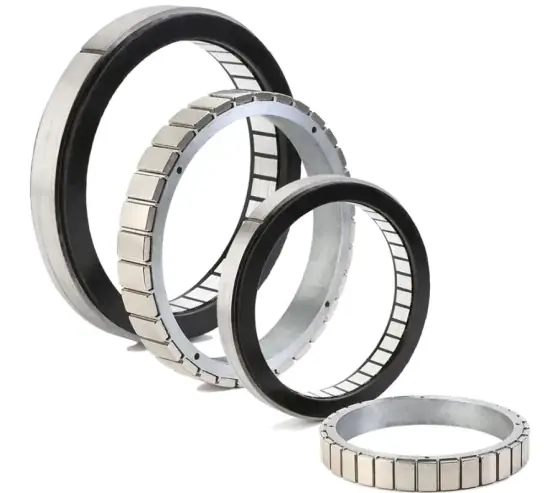
In short:A direct-drive torque motor is a large-diameter, high-pole-count brushless motor bolted straight to the load, with no gearbox or belt. It removes backlash and compliance and tolerates huge inertia mismatches, but the motor must produce the full load torque itself, so it is larger, needs a high-resolution encoder and must be designed around its heat path.
What a direct-drive torque motor is
A torque motor is a permanent-magnet brushless motor designed for high torque at low speed: a large diameter, a high pole count and usually a short axial length. In a direct-drive axis it is mounted straight onto the load, with no gearbox, belt, screw or coupling between them. The motor’s rotor and the load are one rigid body.
Torque is roughly proportional to the air-gap area times its radius, so for a given volume a wide, flat motor makes far more torque than a long, thin one. That is why direct-drive motors look like rings, often with a large through-bore that can carry cables, optics, fluids or a slip ring.
They are used where the transmission is the weak link: rotary indexing tables, semiconductor and inspection stages, metrology and optical positioners, telescopes and antenna pedestals, printing cylinders and robot joints that need very high stiffness.
Housed vs frameless torque motors
Torque motors come in two forms. The motor physics is the same; what differs is who designs the bearings, feedback and heat path.
| Housed direct-drive motor | Frameless kit | |
|---|---|---|
| What you receive | Complete motor: rotor, stator, bearing, encoder, housing, connectors | Rotor and stator only, often with Hall sensors and a thermal sensor |
| Bearings | Built in, often a cross-roller bearing rated for axial and moment load | You design and buy them |
| Encoder | Built in and aligned | You choose and fit it |
| Mounting | Bolt to the machine; couple to the load | Rotor bonded or clamped to your shaft, stator to your housing |
| Design effort | Low | High: air-gap concentricity, bearing preload, sealing, heat path |
| Best for | Rotary tables, indexers, fast time to market | Robot joints, gimbals, compact or weight-critical integrated designs |
Novanta describes a direct-drive kit as only the stator and rotor, supplied “without a housing or other mechanicals such as bearings and strain-wave gears” (Novanta). Kollmorgen’s housed DDR motors, by contrast, are sold so that “all you need is the motor and the mounting bolts” (Kollmorgen DDR).
For a frameless design, our guide on how to select a frameless torque motor covers the step-by-step decisions, and frameless motor sizing for robot joints covers joints with a strain-wave gear.
Why go direct drive: stiffness, backlash and inertia
Removing the transmission changes three things.
No backlash and no transmission compliance. A precision planetary gearbox might have 1 arcmin of backlash, while a housed direct-drive motor can repeat to better than 1 arcsec (Kollmorgen DDR). Belts stretch, couplings wind up and gearboxes have finite stiffness; a direct-drive axis has none of these springs between the motor and the load. The stiffness that remains is the servo loop’s, set by encoder resolution, drive bandwidth and the structure.
Inertia mismatch stops mattering. Geared axes are usually designed to keep reflected load inertia within about 5 to 10 times the motor inertia. With no compliant element between motor and load, a direct-drive axis is not limited that way; Kollmorgen reports DDR applications running at inertia ratios above 11,000:1 (Kollmorgen DDR).
Fewer parts and less maintenance. No gearbox oil, no belt tensioning and fewer wear parts. Kollmorgen also cites audible noise up to 20 dB lower than with mechanical transmissions.
The costs are equally clear. The motor must produce the full load torque, so it is bigger, heavier and needs more current than a geared motor of the same output power. There is no mechanical advantage against shock, no friction to hold a load at power-off, and the encoder must resolve the load directly.
Cogging and torque ripple
Cogging is a position-dependent torque caused by the rotor magnets aligning with the stator teeth. It is present with no current flowing and repeats at a fixed number of cycles per revolution. On a geared motor it is divided by the ratio; on a direct-drive axis it goes straight to the load, so it shows up as velocity ripple at low speed and as a small positioning disturbance the servo has to reject.
| Construction | Cogging | Torque density | Typical use |
|---|---|---|---|
| Slotted iron-core | Low but non-zero | Highest | Indexers, robot joints, heavy tables |
| Slotless | Zero | Lower | Smooth scanning, optics, low-speed metrology |
| Ironless (coreless) | Zero | Lowest; low inductance | Very smooth low-speed motion, small tables |
For scale, Kollmorgen lists cogging of 0.071 to 0.285 Nm peak-to-peak for its TBM 129 frameless frame, which delivers 2.87 to 10.4 Nm continuous stall torque (Kollmorgen TBM). Novanta notes that cogging above 3% of overall torque causes noticeable torque ripple at low speed, and that slotless designs have zero cogging (Novanta).
Cogging is not the only ripple. Commutation errors, encoder interpolation errors and back-EMF harmonics add more, so specify the velocity ripple or speed stability you need at the load, not just “zero cogging”.
Bearings: the part that decides real-world performance
In a direct-drive axis the motor bearing is usually the load bearing as well. It must carry axial load, radial load and tilting moment from the payload, and its runout feeds straight into the position error.
On housed motors, check the published axial, radial and moment ratings against your payload and any process forces. Kollmorgen’s housed DDR motors use a cross-roller bearing, with dynamic axial ratings from 4,500 to 12,700 lbf (about 20 to 56 kN) across its frames (Kollmorgen DDR). Two less obvious limits from the same guide are worth adopting as general rules:
- The bearing is not designed for repetitive small-angle oscillation, under ±13° in Kollmorgen’s case. Small oscillations do not redistribute lubricant and can cause fretting. Dithering scanners and small-angle positioners need a bearing chosen for that duty.
- Do not couple a housed motor rigidly to a load that has its own two-bearing support. Use a flexible coupling, or the two bearing sets fight each other.
On frameless designs you choose the bearing. A cross-roller or four-point contact bearing is common for compact axes; angular contact pairs give higher speed and stiffness. Bearing runout and housing tolerances also set the air gap, so follow the motor maker’s concentricity tolerance.
Encoders for direct drive
With no gear reduction, encoder counts per revolution are counts per load revolution. Two figures matter:
- Resolution sets the smallest step the servo can see, and therefore the positioning stiffness and low-speed smoothness. 23 bits is about 0.15 arcsec per count; 27 bits is about 0.01 arcsec.
- Accuracy sets how close the reported angle is to the true angle. Kollmorgen’s housed DDR motors illustrate the difference: a 27-bit sine encoder with ±26 arcsec accuracy and better than 1 arcsec repeatability, against resolver options with ±135 to ±270 arcsec accuracy (Kollmorgen DDR).
Large-bore ring encoders suit frameless designs because they fit around the through-bore. Mounting eccentricity dominates their accuracy, so the encoder seat must be machined in the same set-up as the bearing seat. See encoder interfaces explained for choosing BiSS-C, EnDat or sin/cos, and absolute vs incremental encoders for power-up behaviour.
Thermal design and continuous torque
A torque motor’s continuous torque is a thermal rating. Copper loss rises with the square of torque:
P_loss = (T / Km)²
where Km is the motor constant in Nm/√W. Novanta defines Km as torque divided by the square root of resistive power loss, and notes that a higher Km gives the same torque running cooler (Novanta). Compare motors by Km, not by peak torque.
Three points from the Kollmorgen data are easy to overlook:
- Ratings assume a heatsink. Kollmorgen’s frameless thermal resistance figures assume the motor is “housed and mounted” to a specified aluminium plate. A stator in a plastic or thin-walled housing cannot reach catalogue continuous torque.
- Km falls when hot. Kollmorgen’s TBM 129 frame drops from 0.443–1.35 Nm/√W at 25 °C to 0.328–1.02 Nm/√W with a 155 °C winding, about a quarter less (Kollmorgen TBM). Use hot values for sizing.
- Ambient matters. Kollmorgen’s housed DDR continuous torque is rated at 40 °C, with a ×1.06 uplift allowed at 25 °C (Kollmorgen DDR).
Heat from the stator also flows into the machine. On a precision table, a few tens of watts can move the structure by microns, so consider the loss at the RMS torque, not just whether the winding survives.
Worked example: direct-drive rotary indexing table
Requirement: Six-station indexing table for an assembly cell. Table plus fixtures 1.2 kg·m². Each 60° index must take 0.25 s, followed by a 0.5 s dwell. Bearing friction about 3 Nm. Station positioning ±0.02 mm at 400 mm radius. Horizontal axis, centre bore for pneumatics.
Kinematics (θ = 60° = 1.047 rad, t = 0.25 s, triangular profile):
- Peak acceleration α = 4θ / t² = 4 × 1.047 / 0.0625 = 67.0 rad/s²
- Peak speed ω = 2θ / t = 8.38 rad/s = 80 rpm
Torque:
- Accelerating: 1.2 × 67.0 + 3 = 83.4 Nm for 0.125 s
- Decelerating: 1.2 × 67.0 − 3 = 77.4 Nm for 0.125 s
- Dwell: near zero for 0.5 s
- RMS = √[(83.4² × 0.125 + 77.4² × 0.125) / 0.75] = 46.5 Nm
So the motor needs about 50–60 Nm continuous with margin at the machine’s ambient, and at least 100 Nm peak to leave headroom for tuning and fixture changes. Speed is only 80 rpm, well within typical torque motor ratings.
Heat: with an illustrative hot Km of 5 Nm/√W, loss at RMS torque is (46.5 / 5)² ≈ 86 W. Check the real Km of the candidate and whether the base can sink that heat without disturbing the station accuracy.
Accuracy: ±0.02 mm at 400 mm is ±5 × 10⁻⁵ rad, about ±10 arcsec. A gearbox with even 1 arcmin of backlash (60 arcsec) would use six times the budget on play alone; this is the case for direct drive. A 23-bit encoder (0.15 arcsec per count) gives ample resolution, but its installed accuracy must be well inside ±10 arcsec, so a housed motor with a factory-fitted encoder, or a load-side encoder at the table rim, is the safer route.
Bearing and duty: 60° indexes are well above the small-oscillation limit. Check the fixture mass and any offset load against the motor bearing’s axial and moment ratings.
Choice: a housed iron-core direct-drive motor with a 23-bit absolute encoder and a centre bore, sized at about 60 Nm continuous. If cycle time later drops, the same motor gives more acceleration with no gearbox to resize.
When a gearbox is still the better answer
Direct drive is not always right. A geared servo usually wins when:
- Torque is high, speed is low, and accuracy needs are modest: a gearbox multiplies the torque of a small, cheap motor.
- The axis sees jams or impacts that a gearbox and torque limiter can absorb.
- The load must hold position without power or a brake is impractical.
- Budget dominates: a large torque motor, high-current drive and precision encoder cost more than a motor and planetary.
See strain-wave vs planetary vs cycloidal for the geared alternatives.
Products in our range to consider
These direct-drive and frameless torque motors are available through our supply network:
- Akribis ADR-A: housed iron-core direct-drive motor with bearings and optical encoder, 110–360 mm frames, up to about 1 kNm peak.
- Akribis AXD-ERA: low-profile housed motor with a 23-bit BiSS-C absolute encoder, up to 250.6 Nm continuous.
- Akribis AXD: low-profile housed motor with large centre holes and incremental encoder, 80–400 mm frames.
- Akribis ACD: ironless housed direct-drive motor with zero cogging for very smooth low-speed rotation.
- Akribis ACW: flat ironless direct-drive motor with large centre hole and high-resolution optical encoder.
- Akribis ADR-P: high-voltage frameless kits from 110 to 360 mm, up to 365 Nm continuous.
- Akribis ADR-F: compact 48 VDC frameless kits in 45–90 mm frames for small tables and robot joints.
- TI Series in-runner frameless torque motors: 65–410 mm stator OD, 8–64 poles, through-holes up to 290 mm.
Checklist
Send these to our engineers, or enter them in the spec builder:
- Housed motor or frameless kit
- Load inertia, move profile (angle, time, dwell) and friction or process torque
- Peak and RMS torque, and maximum speed
- Accuracy, repeatability and velocity ripple required at the load
- Payload mass, offset loads and tilting moment on the bearing
- Oscillation duty: any repeated small-angle moves
- Bore diameter and what passes through it
- Envelope: outside diameter, height, mass
- Mounting and cooling: housing material, heatsink, ambient temperature
- Encoder type, resolution and interface; drive bus voltage
- Holding brake or lock requirement, and the safety function
For the wider family, see our frameless torque motors overview.
Frequently asked questions
What is the difference between a torque motor and a servo motor?
Both are usually permanent-magnet brushless motors. A conventional servo motor is small in diameter, runs at thousands of rpm and drives the load through a gearbox. A torque motor has a large diameter, many poles and a short stack, so it makes high torque at low speed and drives the load directly. Torque scales with rotor diameter, which is why direct-drive motors are flat and wide.
Housed or frameless direct-drive motor: which should I choose?
A housed direct-drive motor arrives with bearings, encoder, housing and connectors, so you bolt it down and wire it up. A frameless kit is only the rotor and stator, built into your machine with your own bearings and encoder. Choose housed for speed of design and guaranteed performance; choose frameless when space, mass, bore size or integration into an existing structure matter more.
Do direct-drive torque motors cog?
Slotted iron-core motors have some cogging, a small torque ripple caused by magnets aligning with stator teeth. Kollmorgen lists 0.071 to 0.285 Nm peak-to-peak for its TBM 129 frameless frame against continuous torques of 2.87 to 10.4 Nm. Slotless and ironless motors have zero cogging but lower torque density. Novanta notes that cogging above 3% of torque becomes noticeable as ripple at low speed.
Why does a direct-drive motor need a high-resolution encoder?
There is no gearbox multiplying the encoder's counts, so the encoder resolution is the load resolution. Positioning stiffness and smooth low-speed velocity both depend on it. A 23-bit encoder gives about 0.15 arcsec per count. Kollmorgen's housed DDR motors pair a 27-bit sine encoder, with ±26 arcsec accuracy, against repeatability better than 1 arcsec.
Can a direct-drive motor hold a load with the power off?
No. There is no gearbox friction or self-locking, so a direct-drive axis will move under any out-of-balance load when the drive is disabled. Vertical or unbalanced axes need a holding brake or a mechanical lock, and the safety function should not rely on the motor alone. Even horizontal tables can drift if they carry an offset load or are pushed by a process.
What limits the continuous torque of a torque motor?
Heat. Copper loss rises with the square of torque, P = (T / Km)², and the continuous rating assumes the motor is mounted on a specified heatsink or housing at a stated ambient. Kollmorgen's frameless ratings assume a 155 °C winding and 25 °C ambient, and its housed DDR ratings are at 40 °C. Mount it differently, or hotter, and the usable continuous torque falls.
Sources
- Kollmorgen: Housed DDR direct drive rotary motors selection guide
- Kollmorgen: TBM frameless motor selection guide
- Novanta (Celera Motion): Robotics and automation FAQs
Figures are summarised from the sources above and from manufacturers' published data on the date shown. Always confirm against the current datasheet for your exact part.