
EtherCAT, PROFINET and EtherNet/IP all carry real-time motion over standard 100 Mbit/s Ethernet cabling, and all three can synchronise dozens of servo axes. The differences that matter to a machine builder are how short a cycle you can run for your axis count, how drives are synchronised, which drive profile they speak, what topology and switches the network needs, and which controllers your customers already have. This guide compares them for motion; for choosing the controller itself, see PLC vs motion controller vs industrial PC.
EtherCAT vs PROFINET vs EtherNet/IP at a glance
| EtherCAT | PROFINET (IRT) | EtherNet/IP (CIP Motion) | |
|---|---|---|---|
| Organisation | EtherCAT Technology Group (ETG) | PROFIBUS & PROFINET International (PI) | ODVA |
| How data moves | One frame passes through every device, which reads and writes its data on the fly | Scheduled IRT time slot each cycle, plus normal RT and TCP/IP traffic | Standard Ethernet frames through switches; timestamped motion data |
| Published cycle times | Design target 100 µs or less | 250 µs standard minimum; down to 31.25 µs with suitable hardware | Not fixed by the standard; design guide cites up to 100 axes in 1 ms as a high-performance target |
| Synchronisation | Distributed clocks, jitter well under 1 µs | IRT clock synchronisation, jitter under 1 µs | CIP Sync (IEEE 1588 PTP), better than 200 ns achievable |
| Drive profile | CiA 402 over CoE; SoE (IEC 61800-7-204) | PROFIdrive (IEC 61800-7) | CIP Motion drive profile |
| Topology | Line, tree, star, daisy chain; ring with a second master port | Line, star, tree, ring; topology configured for IRT | Star and linear; Device Level Ring (DLR) |
| Special hardware | EtherCAT slave controller in each device; master uses a standard Ethernet port | IRT devices and every switch in the path must be Conformance Class C | Switches with 1588 transparent or boundary clocks for precise motion |
| Functional safety | FSoE (to SIL 3) | PROFIsafe | CIP Safety |
Sources: ETG, PI North America, PI, ODVA, Cisco/Rockwell CPwE.
EtherCAT cycle times and distributed clocks
EtherCAT sends one Ethernet frame that travels through every device in turn. Each device reads its outputs and inserts its inputs as the frame passes, then the last device returns it. Because the frame is not stored and forwarded at each node, many axes fit into one short cycle.
The ETG states a design target of 100 µs or less for cycle times and jitter of 1 µs or less for distributed clocks, with achieved jitter “significantly less” than 1 µs, demonstrated over 300 nodes and 120 m of cable (ETG). A segment can hold up to 65,535 devices, nodes can be up to 100 m apart on copper, and cable redundancy recovers in under 15 µs.
For motion: most EtherCAT servo drives implement CiA 402 over CANopen over EtherCAT (CoE). The master only needs a standard Ethernet port, which is one reason EtherCAT dominates PC-based and CODESYS motion controllers.
PROFINET IRT and PROFIdrive
PROFINET runs non-critical data as RT (real-time) and isochronous motion data as IRT. With IRT, the controller calculates a schedule and reserves bandwidth for cyclic motion data in every cycle; other traffic, such as diagnostics or TCP/IP, uses the remainder. PI North America gives a minimum IRT update rate of 250 µs, reducible to 31.25 µs with suitable hardware, and jitter under 1 µs (PI North America).
The constraint is planning: you configure the IRT domain and its topology in the controller, every IRT device and every switch between them must be Conformance Class C certified, and in a ring all ring nodes must be IRT capable.
PROFIdrive is the drive profile, standardised in IEC 61800-7. PI describes application classes from AC1 (speed setpoint, speed loop in the drive) and AC3 (drive as a single-axis positioner) through AC4 and AC5, where the controller closes the position loop or sends position setpoints and clock synchronisation (IRT) is required (PI). Check which application class a drive supports, not just “PROFINET”.
EtherNet/IP with CIP Motion and CIP Sync
EtherNet/IP runs on standard, unmodified Ethernet with full IEEE 802.3 and TCP/IP compliance. ODVA’s CIP Motion profile covers torque, velocity or position control of servo and variable-speed drives, and uses CIP Sync, the IEEE 1588 Precision Time Protocol mapped into CIP, to align every device’s clock. ODVA states clock synchronisation better than 200 ns can be readily achieved, and that jitter under 1 µs is needed for cyclic data (ODVA).
Because each motion message is timestamped, the controller tells a drive where to be and when, rather than relying on frame arrival time. That makes the network tolerant of standard switching, but only if the switches handle time properly. The Cisco and Rockwell design guide says precise motion needs switches with 1588 transparent or boundary clocks and QoS; without them, keep network load under 20% and restrict large packets (CPwE). It cites up to 100 axes in 1 ms as a high-performance target, and Device Level Ring recovery from a single fault typically in under 3 ms on a 50-node ring.
Drive profiles: CiA 402, PROFIdrive and CIP Motion
The drive profile defines the state machine, control and status words and operating modes, so it decides how portable your motion code is.
- CiA 402 defines a finite state machine, control word and status word, and modes for torque, velocity and position control. CiA 402-2 is now IEC 61800-7-201 and CiA 402-3 is IEC 61800-7-301 (CiA). CiA also warns that because many functions are optional, some drives implement only a subset, which limits interchangeability.
- Cyclic synchronous modes are what multi-axis controllers use: in CSP the controller sends target positions and the drive closes all loops, in CSV it sends velocities, in CST torques; the drive interpolates when its loops run faster than the bus (Motion Control Tips).
- PROFIdrive groups behaviour into application classes, as above.
- CIP Motion uses one profile for general-purpose and motion drives.
Practical test: ask for the drive’s supported operating modes and the controller’s supported modes, and make sure they overlap. A drive that “supports EtherCAT” but not CSP will not work with most motion controllers.
Topology, cabling and diagnostics
- EtherCAT suits a daisy chain along a machine: each device has an in and out port, so no switches are needed. Drop lines and junctions give tree and star layouts. Standard Ethernet devices join through a switch port or gateway.
- PROFINET devices usually have a two-port switch built in, so lines are easy; IRT topologies must be defined in the engineering tool.
- EtherNet/IP uses a star through managed switches, or a line or DLR through two-port devices.
Through a slip ring on a rotating axis, all three need a contact set rated for 100BASE-TX. See Ethernet through slip rings.
Ecosystems: which network will your customer accept?
This is often the deciding factor:
- PROFINET is the native network of Siemens controllers, so it is expected in plants standardised on them.
- EtherNet/IP is the native network of Rockwell Automation controllers, common in North American plants.
- EtherCAT is open to any master and widely used by PC-based, CODESYS and many Asian and European controller makers, and by drive makers for low-voltage and embedded drives.
Many OEMs avoid the conflict by running EtherCAT inside the machine and presenting the machine to the plant as a PROFINET or EtherNet/IP device through the controller’s second port or a gateway.
Worked example: a 12-axis case packer for two customer standards
Machine: 12 servo axes (a 3-axis gantry pair, a flighted infeed, carton erector and closer axes) plus 200 I/O points. Fastest axis needs 1 ms in CSP; the gantry pair needs tight synchronisation. Customer A specifies a Siemens line controller and PROFINET; customer B a Rockwell line controller and EtherNet/IP.
Option 1: native network per customer. Two drive variants, two controller platforms, two software projects. IRT planning and Conformance Class C switches for A; 1588-capable managed switches for B. Highest engineering cost.
Option 2: EtherCAT inside, plant network outside. One motion controller mastering EtherCAT for all 12 drives and remote I/O, with a PROFINET or EtherNet/IP device interface to the line.
Cycle check for option 2: in CSP, each axis exchanges roughly 12 bytes each way (target position, control word, mode; actual position, status word, error). Twelve axes plus I/O is around 300 bytes of process data. With frame overhead, call it 3,000 bits, or about 30 µs of wire time at 100 Mbit/s, before per-device forwarding delays. That leaves large headroom inside a 1 ms cycle, and enough for 500 µs if the gantry later needs it.
Decision: option 2, with a controller that lists both PROFINET and EtherNet/IP device support, drives with CiA 402 CSP, and FSoE or hardwired STO depending on the safety controller each customer specifies.
Checklist
Send these to our engineers, or use the spec builder:
- Number of servo axes and I/O points, now and in future variants
- Required cycle time for the fastest axis, and which axes must be synchronised
- Operating modes needed (CSP, CSV, CST, profile position) or PROFIdrive application class
- Controller brand and network the end customer requires
- Whether the machine must appear as a device on a plant network
- Safety over the network (FSoE, PROFIsafe, CIP Safety) or hardwired STO
- Topology: line along the machine, ring, star; cable lengths; any slip rings
- Switches allowed in the motion network, and their IRT or 1588 capability
- Diagnostics and remote access requirements
Products in our range to consider
- Leadshine MC500 motion controllers: CODESYS controller mastering EtherCAT for 8, 16 or 32 axes and up to 128 EtherCAT slaves, with EtherNet/IP, Modbus TCP, OPC UA and CANopen listed among its interfaces.
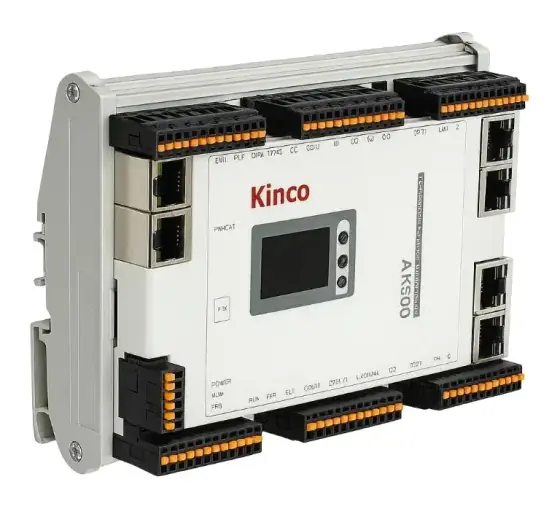
- Kinco AK motion controller: 54 mm wide CODESYS EtherCAT controller for up to 32 synchronised axes on a 1 ms cycle.
- Kinco RP20 remote I/O: slim I/O system with an EtherCAT coupler and up to 256 points.
- Leadshine EL8 AC servo drives: 400 W to 2 kW EtherCAT drives with 3.5 kHz bandwidth and gantry synchronisation.
- Leadshine EL7S / EL7 AC servo drives: 400 W to 22 kW, in EtherCAT and PROFINET (EL7-PN) variants.
- Kinco FD5P PRO AC servo drives: to 7.5 kW with RS485, EtherCAT CoE or PROFINET variants.
- ADVANCED Motion Controls FlexPro: 10–90 V DC drives with EtherCAT, CANopen or EtherNet/IP and STO as standard.
Related guides
- How to select a motion controller or PLC
- How to select an HMI and remote I/O
- How servo drives work and how to select a servo drive
- Our motion controllers and servo drives overviews
Frequently asked questions
Which is faster for motion control, EtherCAT or PROFINET?
On published figures, both reach very short cycles. The EtherCAT Technology Group designs for cycle times of 100 µs or less with distributed-clock jitter well under 1 µs. PROFINET IRT has a standard minimum of 250 µs and can go down to 31.25 µs with suitable hardware, also with jitter under 1 µs. In practice, most servo axes run at 250 µs to 2 ms on either network, so ecosystem and controller usually decide.
What is the difference between IRT and CIP Sync?
They synchronise drives in different ways. PROFINET IRT reserves a scheduled time slot in every cycle for isochronous data and needs IRT-capable devices and switches (Conformance Class C) along the path. EtherNet/IP's CIP Sync uses IEEE 1588 Precision Time Protocol so each device's clock is aligned, and CIP Motion messages carry timestamps telling each drive where to be and when.
What drive profile does each network use?
EtherCAT drives usually use CANopen over EtherCAT (CoE) with the CiA 402 profile, or Servo over EtherCAT (SoE). PROFINET uses PROFIdrive, standardised in IEC 61800-7, with application classes from speed control to clock-synchronised position control. EtherNet/IP uses the CIP Motion drive profile for torque, velocity or position control of servo and variable-speed drives.
Does EtherNet/IP motion need special switches?
For high-precision motion, yes. Cisco and Rockwell's converged plantwide Ethernet design guide says CIP Motion axes need switches with IEEE 1588 transparent or boundary clocks, plus QoS. Without them, the guide advises keeping network loading below 20% and restricting large packets. Plain unmanaged switches add timing errors that grow with traffic.
Can one machine use EtherCAT inside and PROFINET or EtherNet/IP to the plant?
Yes, and it is common. The machine's motion controller masters EtherCAT for drives and I/O, and appears to the line controller as a PROFINET or EtherNet/IP device, either through a second network port or a gateway. That keeps short, deterministic motion cycles inside the machine while fitting the customer's plant standard.
Which network supports safety over the fieldbus?
All three do, with different protocols. EtherCAT uses Safety over EtherCAT (FSoE), suitable up to SIL 3 and standardised in IEC 61784-3. PROFINET uses PROFIsafe and EtherNet/IP uses CIP Safety. The drive, the safety controller and the network must all support the same protocol, so check that before choosing drives.
Sources
- EtherCAT Technology Group: EtherCAT technology overview
- PROFIBUS & PROFINET International: PROFIdrive and encoder profiles
- PI North America: PROFINET IRT, isochronous real time
- ODVA: CIP Motion
- Cisco and Rockwell Automation: Converged Plantwide Ethernet design guide, chapter 8 (CIP Motion)
- CAN in Automation: CiA 402 series, CANopen device profile for drives and motion control
- Motion Control Tips: What is cyclic synchronous control (position, velocity, torque)?
Figures are summarised from the sources above and from manufacturers' published data on the date shown. Always confirm against the current datasheet for your exact part.