
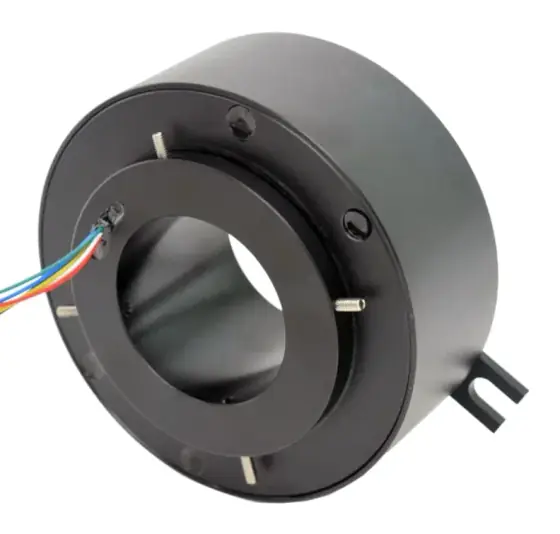
In short:Pick a capsule slip ring when nothing has to pass through the centre and space is tight; a through-bore ring when a shaft, cable or fluid line must run through the axis; and a pancake (platter) ring when the axial height is very limited but there is room radially. Bore size and ring diameter then set the speed limit, wear and price.
The short answer
Three questions settle the format:
- Does anything have to pass through the centre of rotation? If no, a capsule slip ring is the smallest and usually cheapest choice. If yes, go to question 2.
- Is axial height the tight dimension? If you have length to spare, a through-bore slip ring (a drum of rings around a hollow centre). If length is very tight and you have room radially, a pancake slip ring.
- How fast, and how many circuits? Larger diameters mean higher surface speed, which lowers the speed rating and life. Check both before settling on the bore.
The rest of this guide explains why, with figures, and works through three machines. For how the contacts themselves work, see how slip rings work.
Drum vs platter: the underlying geometry
There are only two ways to arrange the rings. Moog describes them as the drum, with rings side by side along the axis “somewhat like bolt threads”, which is the most common approach, and the platter, with rings concentric on a flat face “like grooves” (Moog, How to specify).
- Capsule and through-bore slip rings are both drums. The capsule has a solid centre; the through-bore drum is built around a hollow one.
- Pancake slip rings are platters, with or without a through-hole.
This matters because of how each grows:
- A drum adds circuits by getting longer. Diameter stays the same, so every ring has the same surface speed.
- A platter adds circuits by getting wider. Each new ring sits at a larger radius, so outer rings run faster, travel further per revolution and wear more than inner ones.
Capsule vs through-bore vs pancake: comparison table
| Capsule | Through-bore | Pancake (platter) | |
|---|---|---|---|
| Ring arrangement | Drum, solid centre | Drum, hollow centre | Concentric rings on a flat face |
| Centre passage | None | Shaft, cables, pipes or rotary union | Optional through-hole |
| Tight dimension it suits | Overall size | Bore needed, length available | Axial height |
| Circuit growth | Longer body | Longer body | Larger diameter |
| Surface speed | Lowest (small diameter) | Higher, rises with bore | Highest on outer rings |
| Typical speed rating | Highest; small capsules to thousands of rpm | Moog typically 250 rpm | Usually lowest |
| Mounting | Flange or body, stator restrained | Clamps to the shaft, stator restrained | Flat, square face; axial runout matters |
| Relative cost | Lowest | Rises with bore | Often custom |
| Typical uses | CCTV pan heads, small turntables, robot end effectors, instruments | Indexing tables, process drums, packaging machines, wind turbines | Medical imaging, radar pedestals, low-profile turntables |
Speed figures from Moog’s product guide and FAQ.
Capsule slip rings: when to use them
A capsule is a sealed, self-contained cartridge: rotor, rings, brushes and bearings in one body, leads out of each end. Moog describes its compact capsules as economical, with up to 56 contacts; its smallest example, the SRA-73540, has a 0.44 × 0.64 in (about 11 × 16 mm) footprint and 6 or 12 circuits at 2 A (Moog product guide).
Use a capsule when:
- The axis is free at one end (the end of a shaft, the top of a turntable spindle).
- Circuits are mainly signal, data and low power.
- Space is tight or the price per unit matters, for example in volume OEM products.
- Speed is high: small diameter means low surface speed. Moog lists fibre brush capsules to 10,000 rpm without cooling.
Limits: current per circuit is modest on small bodies, and nothing can pass through. If you need a shaft through the axis, a capsule is the wrong format however attractive the price.
Through-bore slip rings: when to use them
A through-bore ring is the default when the rotating axis already carries something: a drive shaft, a cable bundle to an encoder, a coolant pipe or a rotary union. Moog’s examples run from ½ in to 4 in bores (about 13 to 100 mm) with 6 to 48 circuits, typically at 250 rpm (Moog product guide).
The bore drives everything. Larger bores mean larger ring diameters, so:
- Surface speed rises. v = π × D × n / 60. A 40 mm ring at 250 rpm slides at 0.52 m/s; a 120 mm ring at 250 rpm slides at 1.57 m/s, three times further per revolution.
- Speed rating falls. Moog lists its large-bore drum and platter designs at 120 to 180 rpm.
- Friction torque, weight and price rise.
So specify the smallest bore that does the job. Measure what must pass through, add clearance for assembly, and resist rounding up to the next catalogue size “for margin”.
For bores above a few hundred millimetres, look at large-diameter slip rings and open frameless designs.
Pancake slip rings: when to use them
Moog’s guidance is to use a pancake when length is tightly constrained but diameter is less restrictive (Moog, How to specify). Typical cases are low-profile turntables, rotating gantries and pedestals where the slip ring has to sit in a few millimetres of height under a platter or bearing.
Trade-offs to plan for (engineering rules of thumb):
- Each ring sees a different surface speed and different sliding distance, so life is set by the outermost ring.
- Circuit count is limited by radial space. Each ring and its insulating barrier consume a band of radius; 30 circuits on a platter take far more diameter than 30 on a drum.
- Axial runout loads the brushes directly, because the brushes press on the face. A wobbling platter changes contact force every revolution. Mount it to a flat, square, stiff face.
- Open designs need protection. Many pancake rings are supplied as separate rotor and stator platters with little or no housing, so the machine has to keep dust and liquids off the contact faces; check the published IP rating.
- Speed is usually the lowest of the three formats for the same outside diameter.
Speed, life and the surface speed rule
Moog states that almost any slip ring runs to 100 rpm and that the typical limit is about 250 to 1,000 rpm, depending on size, materials and environment (Moog FAQ). Life is quoted in revolutions: tens of millions for typical instrumentation rings and more than 100 million for wind turbine designs.
Because wear follows sliding distance, compare formats on surface speed, not rpm. A rule of thumb for early layout: if a larger bore doubles the ring diameter, expect roughly double the wear per revolution, and expect the maker’s rpm rating to fall. Contact material shifts the picture too: Moog’s wind white paper shows fibre brush contacts outlasting their test at 124 million revolutions (Moog white paper).
Mounting each type
- Capsule: fix the rotor flange or shaft to the rotating part; restrain the stator with a tab or pin in a slot so it can float slightly. Rigidly fixing both ends to misaligned parts loads the capsule’s bearings.
- Through-bore: clamp the rotor to the shaft with the collar or set screws; restrain the stator with an anti-rotation arm. Keep shaft runout within the maker’s limit.
- Pancake: mount rotor and stator platters parallel and concentric on machined faces; set the axial gap to the maker’s figure.
Specify lead exit direction (axial or radial) on both sides; Moog’s specification sheet asks for it (Moog, How to specify).
Worked example: three machines, three formats
1. CCTV pan head. Continuous pan at up to 30 rpm, 8 circuits (camera power, heater, PTZ control) plus 100 Mbit/s Ethernet. Nothing passes through the axis. Envelope 40 mm diameter.
- Capsule. A gold-contact capsule around 25 to 35 mm OD fits, and at 30 rpm a 25 mm ring slides at only 0.04 m/s.
2. Packaging indexing table. 300 mm table at 40 rpm. A 32 mm air line and an encoder cable run up the centre. 18 circuits including 3 × 6 A servo power and EtherCAT. Length available below the table: 150 mm.
- Through-bore. Allow the 32 mm line plus clearance and choose a bore around 38 to 50 mm, not 100 mm. At 40 rpm a 60 mm ring slides at 0.13 m/s. Combine with a single-channel rotary union in the bore, or specify a combined unit.
3. Low-profile inspection turntable. Rotates at 10 rpm, needs a 60 mm clear hole for a camera’s optical path, but only 20 mm of axial height under the platter. 10 circuits.
- Pancake with a through-hole. Outer ring at about 140 mm diameter slides at 0.07 m/s at 10 rpm, so wear is not the issue; flatness and axial runout of the mounting are. Ask for the published thickness and runout tolerance.
Products in our range to consider
These are available through our supply network:
- AR/BR/CR Series capsule slip rings: gold-to-gold capsules from 5.5 to 35.5 mm OD, up to 76 circuits and 300 rpm.
- HR Series Faston type slip ring: small power and signal ring, 32 to 46 mm OD, with quick-connect terminals.
- ER Series through-bore slip ring: standard bores from 12.7 to 100 mm, up to 15 A per circuit and 300 rpm.
- PR/PSR Series pancake slip ring: flat disc rings 6 to 51 mm thick, bores up to 500 mm, to 100 rpm.
- Large size slip ring: through holes quoted up to 1,000 mm for heavy plant.
- Ethernet slip ring: solid-shaft and through-bore forms with 100M or Gigabit channels.
Checklist
Send these to our engineers, or enter them in the spec builder:
- What, if anything, must pass through the axis, with its diameter
- Maximum envelope: diameter, length and any keep-out zones
- Circuit list: current, voltage and function per circuit; data protocols
- Speed, continuous or oscillating, and required life in revolutions
- Mounting: shaft size, runout, how the stator will be restrained
- Lead exit direction and length, connectors on each side
- Environment: IP rating, temperature, vibration, washdown
- Any fluid channels needed alongside the electrical circuits
Next steps: how to select a slip ring type, how to specify a slip ring, and the slip rings hub.
Frequently asked questions
What is the difference between a capsule and a through-bore slip ring?
A capsule slip ring is a compact, self-contained unit with a solid centre, its own bearings and leads at each end, fitted at the end of a shaft or inside a housing. A through-bore slip ring has a hollow centre so a drive shaft, cable bundle, pipe or rotary union can pass through the axis. Through-bore rings are larger for the same circuit count, which raises surface speed and cost.
What is a pancake slip ring?
A pancake or platter slip ring arranges its rings concentrically on a flat disc, like grooves on a record, with brushes pressing axially on the face. Moog's guidance is to use it when length is tightly constrained but diameter is less restricted. It can have a through-hole or a solid centre. Each ring sits at a different radius, so circuit count is limited by the radial space available.
Which slip ring type runs fastest?
Generally the smallest diameter, because wear depends on surface speed. Small capsules are the usual starting point for high speed, and Moog lists fibre brush capsules to 10,000 rpm without cooling. Through-bore rings in Moog's range are typically rated about 250 rpm, and large-bore platter and drum designs 120 to 180 rpm. Pancake rings are normally the slowest because their outer rings are large.
How many circuits can a capsule slip ring carry?
Catalogue capsules run from a handful of circuits to several dozen. Moog's compact capsules reach 56 contacts, and the AR/BR/CR capsule range available through our supply network goes up to 76 circuits. Current per circuit is usually modest, from about 2 A on the smallest units to 10 or 15 A on larger bodies, so heavy power circuits push you to a bigger ring.
How should a slip ring stator be mounted?
Fix the rotor to the rotating part and restrain the stator against rotation with a tab, pin or fork that allows a little radial float, rather than a rigid second fixing. Rigidly fixing both ends of a capsule to misaligned parts loads its bearings and shortens life. Through-bore rings clamp to the shaft with a collar or set screws, and pancake rings need a flat, square mounting face.
Sources
- Moog: How to specify a slip ring
- Moog: Slip ring product guide
- Moog: Slip ring frequently asked questions
- Moog: High reliability slip ring design for wind turbines (white paper)
Figures are summarised from the sources above and from manufacturers' published data on the date shown. Always confirm against the current datasheet for your exact part.