
In short:A ball screw is the cheaper, slightly more efficient choice for moderate loads and smooth motion. A planetary roller screw carries several times the dynamic load in the same diameter, tolerates shock far better and lasts much longer under heavy duty, so it wins for high-force, high-duty or impact-loaded axes and wherever the envelope is tight.
How ball screws and roller screws differ
Both turn rotation into linear motion through rolling contact, which is why both are far more efficient than a sliding Acme or trapezoidal lead screw. The difference is the rolling element.
A ball screw carries load through steel balls that roll in a helical groove between screw and nut, then recirculate through a return path in the nut. Ball diameter and the number of loaded balls limit capacity, and the balls touch each other, which limits speed and acceleration.
A planetary roller screw replaces the balls with threaded rollers arranged around the screw like planet gears. Each roller has many thread flanks engaged with both the screw and the nut. Tolomatic’s overview puts it simply: more contact points and a larger contact radius, so less stress on each contact (Tolomatic). There is no recirculation, so the rollers do not collide.
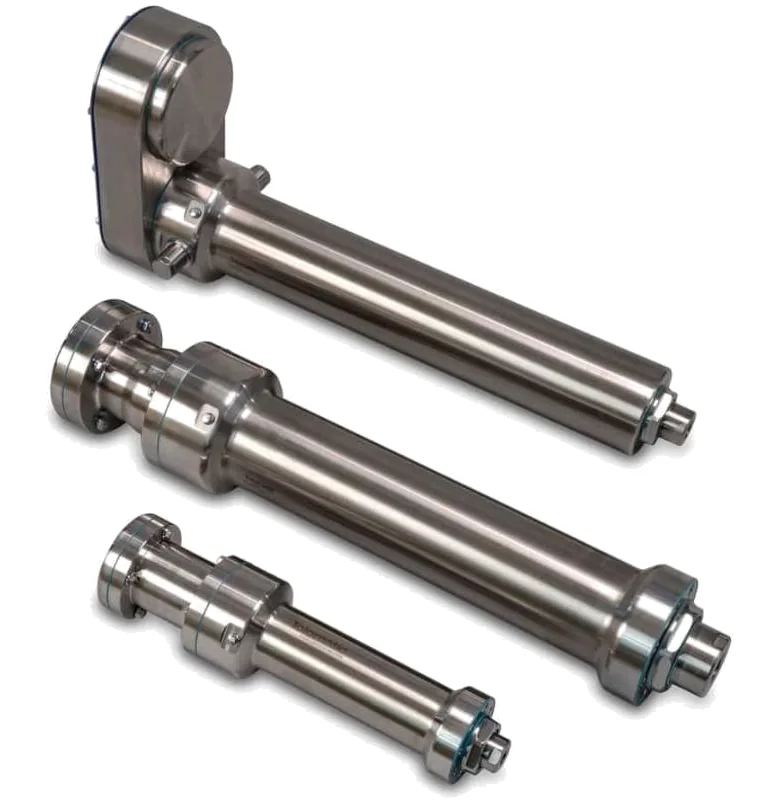
An inverted roller screw puts the rollers inside a threaded nut that is also the motor rotor, with the extending rod carrying the thread. It allows very compact integrated actuators, such as the Exlar GTX.
Ball screw vs roller screw: comparison table
| Factor | Ball screw | Planetary roller screw |
|---|---|---|
| Dynamic load rating, 20 mm × 5 mm lead | About 10.8–13.4 kN (two catalogue examples) | 73.3 kN (Tolomatic) |
| Relative life at the same load and size | Baseline | Many times longer (life scales with C³) |
| Shock and impact | Moderate | Very high |
| Acceleration | Moderate | High |
| Rigidity | Average | Very high |
| Efficiency | 85–95% | 75–90% |
| Speed | Limited by ball recirculation (DN limit) | Typically higher; Tolomatic lists 5,200 rpm for its 20 mm size |
| Fine leads | Widely available | Available, fewer options (e.g. 4 mm at 15 and 20 mm sizes) |
| Space for a given load | Moderate | Minimal |
| Upfront cost | Lower | Higher |
| Availability | Very wide range of sizes, leads and grades | Fewer suppliers and sizes; longer lead times |
Sources: ball nut ratings from HIWIN R20-05K4 data (DamenCNC) and Helix ECN 20×5 (Helix Linear); roller screw ratings, speeds and leads from Tolomatic; efficiency, rigidity and impact ratings from Moog. Dynamic ratings from different manufacturers are not always calculated on identical bases, so always compare using each supplier’s own rating method.
L10 life: the formula and why the cube matters
The basic rating life of both screw types is (THK):
L10 = (C / Fm)³ × 10⁶ revolutions
- C is the basic dynamic load rating (N)
- Fm is the cubic mean axial load (N)
- L10 is the life that 90% of a group of identical screws will reach before the first sign of rolling contact fatigue
The cubic mean load over a cycle with loads Fᵢ over distances ℓᵢ is:
Fm = ( Σ Fᵢ³ × ℓᵢ / Σ ℓᵢ )^(1/3)
THK notes that if the load changes direction, you calculate the mean for each direction separately and use the larger. To convert to distance, L_s (km) = L10 × lead (mm) / 10⁶; to hours, divide revolutions by 60 × average rpm.
Two corrections matter in practice:
- Load factor for vibration and impact. THK gives a factor fw from 1 to 1.2 for very smooth, slow duty up to 2 to 3.5 for strong impact at speeds over 2 m/s, and uses it to reduce calculated life. Some suppliers apply the factor to the load before cubing, which is more conservative. Use the method of the supplier whose rating you are using.
- Static load check. THK’s minimum static safety factor C0 / F_max is 2 without vibration or impact and 5 with it. A screw can pass on L10 and fail on a single overload.
Because life goes with the cube of C, a roller screw’s several-fold load rating turns into a life difference of one or two orders of magnitude at the same load, or a much smaller screw for the same life.
Critical speed and maximum rpm
A long, slender screw is a rotating beam with a natural frequency. Run it near that frequency and it whips. A widely used estimate (Engineers Edge):
nc = f × dr / L² × 10⁷ (rpm)
- dr = root diameter (mm), L = unsupported length between bearings (mm)
- f = 3.4 fixed-free, 9.7 supported-supported, 15.1 fixed-supported, 21.9 fixed-fixed
The standard practice is to run at no more than 80% of the critical speed (MiSUMi). Some catalogues’ factors already include that margin; if you are unsure, apply the 80% yourself. Separately, check the nut’s own limit: for ball screws this is usually a DN value (nominal diameter × rpm) set by ball recirculation, and for roller screws a maximum rpm per size.
Critical speed often decides lead selection on long strokes: a coarser lead gives the same linear speed at fewer rpm. Rotating-nut designs, where the screw is fixed and the nut turns, avoid whip altogether on very long axes.
Lead accuracy
Lead accuracy is the difference between the actual and nominal travel per revolution, accumulated along the screw. ISO 3408 and DIN 69051 define it by classes, with JIS equivalents. In THK’s data, rolled ball screws in grade C7 allow ±50 µm per 300 mm of travel, while precision-ground grade C5 limits fluctuation to 18 µm in any 300 mm (THK). Grades C3 and finer are for machine tools and metrology.
Ground roller screws are also made to precision lead grades, but the choice is narrower and suppliers quote their own classes, so state the lead deviation per 300 mm you need rather than a grade name. For most OEM machines with a servo loop closed on the motor encoder, a C5 or C7 equivalent is adequate; where accuracy matters, measure the screw and use drive-side lead compensation, or add a linear encoder.
Shock and side loads
Roller screws are rated very high for impact resistance; ball screws average (Moog). In practice:
- Use a roller screw for pressing, staking, forming, clamping or anything that sees impact or jams.
- On any screw, limit jam force with the drive’s torque limit and keep it below the static rating divided by the safety factor.
- Neither screw type should carry side load. Guide the load on linear bearings and use a rod-end or clevis that allows misalignment.
Worked example: life of a clamping axis
Duty: a servo-driven clamp on an assembly machine.
- Approach: 200 mm at 1.0 kN (tooling weight and friction)
- Clamp: 20 mm at 8.0 kN
- Return: 220 mm at 0.8 kN
- 6 cycles a minute, 16 hours a day, 250 days a year. Target life 5 years.
- Maximum approach speed 250 mm/s. Smooth motion, but an occasional part misload causes a jam.
Cubic mean load: Fm = ((1.0³ × 200 + 8.0³ × 20 + 0.8³ × 220) / 440)^(1/3) = ((200 + 10,240 + 113) / 440)^(1/3) = (24.0)^(1/3) ≈ 2.88 kN
Notice how the 20 mm clamp stroke dominates: 97% of the cubed sum comes from 4.5% of the travel.
Required life:
- Cycles: 6 × 60 × 16 × 250 × 5 = 7.2 million
- Travel: 7.2 × 10⁶ × 0.44 m = 3,168 km
- With a 5 mm lead: 3,168 × 10⁶ mm / 5 mm = 6.34 × 10⁸ revolutions
Required dynamic rating: C = Fm × (L10 / 10⁶)^(1/3) = 2.88 × (634)^(1/3) = 2.88 × 8.59 ≈ 24.7 kN before any load factor. With a 1.2 factor applied to the load for a conservative check, about 29.7 kN.
Option A, 20 mm × 5 mm ball screw (C = 13.4 kN, C0 = 32.7 kN):
- L10 = (13.4 / 2.88)³ × 10⁶ ≈ 1.0 × 10⁸ revolutions ≈ 500 km ≈ 1.1 million cycles, under a year
- Static safety factor at 8 kN: 32.7 / 8 = 4.1, which passes THK’s minimum of 2 for smooth duty but not the 5 recommended where impacts occur
The ball screw would need to grow to a much larger diameter to reach 25–30 kN, adding inertia and nut size.
Option B, 20 mm × 5 mm roller screw (C = 73.3 kN):
- L10 = (73.3 / 2.88)³ × 10⁶ ≈ 1.6 × 10¹⁰ revolutions, more than 25 times the target
- Even a 15 mm × 5 mm roller screw (C = 53.6 kN, Tolomatic) gives (53.6 / 2.88)³ × 10⁶ ≈ 6.4 × 10⁹ revolutions, ten times the target, in a smaller package than Option A
Speed check: 250 mm/s with a 5 mm lead is 3,000 rpm. That is within Tolomatic’s 5,200 rpm limit for its 20 mm roller screw. For a 600 mm unsupported, fixed-supported shaft with an assumed 17 mm root diameter, nc ≈ 15.1 × 17 / 600² × 10⁷ ≈ 7,100 rpm; 80% of that is about 5,700 rpm, so 3,000 rpm is comfortable.
Motor torque at the clamp (T = F × lead / (2π × η), η = 0.8 for a roller screw): 8,000 × 0.005 / (2π × 0.8) ≈ 8.0 Nm. See our linear actuator sizing guide for the full motor sizing.
Decision: a roller screw. It meets life with a large margin, survives jams, and fits in a smaller envelope than the ball screw it replaces. Off-the-shelf roller screw actuators in this class include the Tolomatic RSA-HT and Exlar GTX and FTX. If the clamp force were 3 kN instead of 8 kN, the cubic mean would drop to about 1.25 kN and a ball screw actuator such as the Tolomatic ERD range or, for DC mobile equipment, the Thomson Electrak HD, would be worth evaluating first.
Checklist
Send these to our engineers, or enter them in the spec builder:
- Force for each segment of the cycle, and the distance travelled at each force
- Peak, jam and impact forces, and how often they occur
- Speed and acceleration for each segment
- Stroke, and the unsupported screw length and end bearing arrangement
- Cycle rate, hours per day, days per year and required life
- Positioning accuracy and repeatability at the load
- Orientation, and whether the axis must hold load with power off
- Side loads and how the load is guided
- Envelope limits and mounting style
- Environment: temperature, contamination, washdown, IP rating
- Lubrication and maintenance access
For more on the wider family, see our linear actuators overview and hydraulic to electric actuator conversion guide.
Frequently asked questions
Why does a roller screw carry more load than a ball screw?
A planetary roller screw transmits load through threaded rollers, each with many thread flanks in contact with the screw and nut, so there are far more contact points with a larger contact radius than the balls in a ball nut. Stress per contact is lower, so dynamic load rating is higher. Tolomatic lists 73.3 kN for a 20 mm, 5 mm lead roller screw, against roughly 11 to 13 kN for typical 20 mm, 5 mm lead ball nuts.
How do I calculate ball screw or roller screw life?
Use L10 = (C / Fm)³ × 10⁶ revolutions, where C is the dynamic load rating and Fm the cubic mean axial load over the cycle. Multiply revolutions by lead for distance. L10 is the life that 90% of identical screws will reach. Apply your supplier's load factor for vibration and impact, and check the peak load separately against the static rating.
What is the critical speed of a screw?
It is the shaft speed at which the screw resonates as a rotating beam. A common estimate is nc = f × dr / L² × 10⁷ rpm, with root diameter dr and unsupported length L in millimetres and f between 3.4 (fixed-free) and 21.9 (fixed-fixed). Run below about 80% of it unless your supplier's factors already include that margin, and also check the nut's DN or speed limit.
Is a roller screw more efficient than a ball screw?
Usually slightly less. Moog gives roller screws 75 to 90% and ball screws 85 to 95%, against about 40% for an Acme screw. In practice the difference is small next to motor and gearbox losses, and a roller screw's ability to use a smaller frame or avoid a gearbox often outweighs it. Both are efficient enough to back-drive, so vertical axes need a brake.
Are roller screws more expensive than ball screws?
Yes, for the same diameter a roller screw costs more to make and buy. Moog notes ball screws have the lower upfront cost while roller screws can be the better long-term investment through longer life. Compare like with like: a roller screw often replaces a much larger ball screw, or avoids replacing one several times over the machine's life.
When is a ball screw the better choice?
Choose a ball screw for moderate forces, smooth motion profiles, long strokes where cost per metre matters, and applications needing very fine positioning from standard precision-ground stock. Ball screws are made in huge volumes in many diameters, leads and accuracy grades, with short lead times. If the calculated life is comfortable and there is no shock, a ball screw is usually the economic answer.
Sources
- Moog: Planetary roller screws catalogue
- Tolomatic: Roller screw technical overview
- THK: Ball screw selection, axial load, life and static safety factor (A15-46)
- THK: Ball screw lead accuracy (A15-11)
- MiSUMi: Ball screw allowable rotational speed and axial load
- Engineers Edge: Ball screw critical speed calculator
- HIWIN R20-05K4 ball nut data (DamenCNC listing)
- Helix Linear: ECN 20x5 ball nut data
Figures are summarised from the sources above and from manufacturers' published data on the date shown. Always confirm against the current datasheet for your exact part.