
Linear actuators
Electric rod and rodless actuators that turn rotary motor motion into controlled linear force and position. Tell us the application and we'll specify the right product, and the parts around it, for your machine.
Engineering support · Product sourcing · Procurement
Get help selecting and sourcing linear actuators
Send your part number or describe the application. We’ll review the requirement and help with product selection, sourcing, pricing and lead times.
- Exact parts and engineer-checked alternatives
- Manufacturer-direct options where available
- Standard, modified and custom solutions
No obligation to buy. Have a datasheet, drawing or nameplate photo? Reply to your confirmation email to attach it.
Need help choosing? Build a specification →Need help choosing? Open the specification builder
Spec builder
Specify linear actuators
Select every part you need, answer the questions an applications engineer would ask, and see your summary before we ask for any details.
- 1Products
- 2Performance
- 3Environment
- 4Volumes
- 5Your spec
What an electric linear actuator does
An electric linear actuator converts the rotation of a motor into straight-line motion with controlled force, speed and position. In most industrial units a screw does the conversion: the motor turns a ball, roller or lead screw, and a nut drives a thrust rod or a carriage. Belt-driven units swap the screw for a toothed belt to get long strokes at high speed.
They replace pneumatic cylinders where you need more than two end positions, and hydraulic cylinders where you want to get rid of pumps, valves, hoses and leaks. On an OEM machine the choice usually comes down to four things: the force profile, the stroke and speed, how many hours or kilometres it must last, and the environment it lives in.
Types of linear actuator compared
| Type | Typical drive | Strengths | Watch out for |
|---|---|---|---|
| Electric rod (screw) | Ball or lead screw, inline or parallel motor | Sealed, cylinder-like, good thrust, easy pneumatic swap | Needs external guidance for side loads |
| Roller screw rod | Planetary roller screw | Highest thrust density, long life under heavy or shock load | Higher purchase cost |
| Rodless screw | Ball screw, carriage on integral guide | Carries load on the carriage, stiff, precise | Screw whip limits speed on long strokes |
| Rodless belt | Steel-reinforced toothed belt | Long strokes, high speed | Lower stiffness and thrust than screws |
| Integrated-motor | Servo motor built around the screw | Short, no coupling or belt, fewer parts | Motor heat goes into the actuator body |
| Hygienic stainless | Stainless rod or integrated actuator | Washdown, food-grade materials, IP69K options | Cost; check heat dissipation in sealed bodies |
| Linear stepper | Hybrid stepper with lead screw | Compact, simple open-loop positioning at low force | Limited speed and duty; no position feedback unless added |
Rod actuators
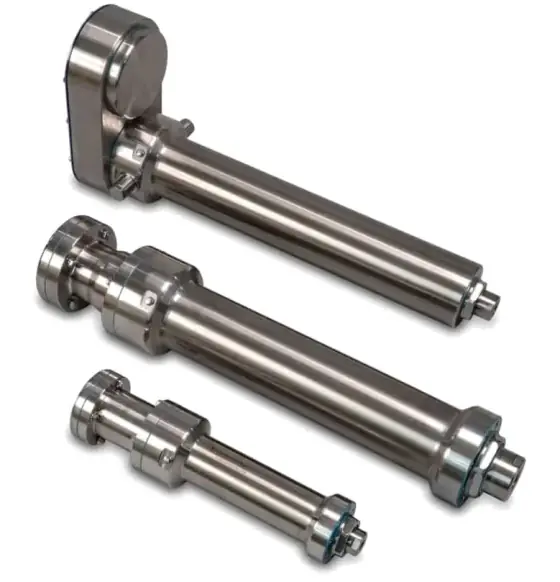
Rod actuators look and mount like cylinders, so they are the usual route for replacing pneumatics. Examples include Tolomatic ERD, a stainless-tube unit aimed at cylinder replacement, and the general-purpose Tolomatic RSA-ST. For mobile and outdoor equipment on 12, 24 or 48 VDC, self-contained units such as the Thomson Electrak HD carry their control electronics onboard.
Roller screw and high-force actuators
A planetary roller screw spreads load over many threaded rollers rather than balls, so it carries more force and lasts longer in the same diameter. An Exlar engineering article gives an example where the roller screw’s expected life was about 15 times that of a comparable ball screw (Design World). Series such as Tolomatic RSX and Exlar FTX are built for press-fit, forming and hydraulic replacement duties. See ball screw vs roller screw for the full comparison.
Rodless screw and belt actuators
Rodless units guide and carry the load on their own carriage. Screw versions such as Tolomatic MXE or Thomson WM give stiffness and precision. Belt versions such as Tolomatic B3W or Thomson WH cover long, fast transfer strokes where a long screw would whip.
Integrated-motor and hygienic actuators
Putting the servo motor around the screw removes the coupling, belt and separate motor housing, so the axis gets shorter. Exlar GTX combines a servo motor with an inverted roller screw in 60, 80 and 100 mm frames. For washdown areas, look at hygienic stainless designs such as Tolomatic IMA-S, Tolomatic RSH or Exlar GTF.
Linear steppers
A hybrid stepper with a built-in lead screw is the simplest way to get short, precise strokes in lab, medical and instrument equipment. Captive types such as the DINGS’ captive linear stepper include anti-rotation, so they work like a miniature electric cylinder.
Replacing hydraulic or pneumatic cylinders
Hydraulic force is pressure times area. A 63 mm bore at 100 bar produces about 31 kN (π × 31.5² mm² × 10 N/mm²). That figure is the cylinder’s capacity, not the job’s requirement. Tolomatic notes that hydraulic cylinders are often oversized, sometimes by two to three times, and suggests three ways to find the real force: meter the pressure down until the cylinder only just does the work, fit a load cell, or test with a prototype servo actuator and work back from current (Tolomatic).
The same paper warns that the reduced-pressure method only finds peak force. If you assume that peak acts over the whole stroke, you will oversize the actuator or underestimate its life. Map force against position, and record speed and dwell for each move. Our hydraulic to electric actuator guide goes through it step by step.
For pneumatics the problem is usually the reverse: the cylinder runs at whatever force the regulator gives, so measure what the process needs and add margin for friction and acceleration.
How to size a linear actuator
1. Force
Total thrust = process force + friction + gravity component (m·g·sin θ) + acceleration force (m·a). Work it out for every segment of the move, including dwell under load.
2. Motor torque from thrust
For a screw: T = F × L / (2π × η), where L is the lead in metres and η the screw efficiency. Ball screws are typically better than 90% efficient; lead screws range from about 20% to 80% depending on helix angle and nut material (Thomson).
Worked example: 5,000 N on a 10 mm lead ball screw at 90% efficiency needs 5,000 × 0.010 / (2π × 0.9) ≈ 8.8 Nm at the screw, before bearing and seal losses.
3. Speed
Screw speed (rev/s) = linear speed / lead. At 250 mm/s on a 10 mm lead, the screw turns at 25 rev/s, or 1,500 rpm. Check this against the screw’s critical speed for the unsupported length; longer strokes allow lower maximum speeds. A coarser lead raises speed but needs more torque for the same force.
4. Duty and RMS load
Motor and screw heating follow the RMS (root mean square) force over the cycle, not the peak. A press that peaks at 30 kN for 0.5 s in a 10 s cycle has a much lower RMS force than one that holds 30 kN. Use the RMS figure for motor and thermal checks and the peak for the structural check.
5. Life
Ball screw life follows the bearing-style rule L10 = (C / Fm)³ × 10⁶ revolutions, where C is the dynamic load rating and Fm the cubic-mean axial load. Multiply by the lead to get travel. With C = 20 kN and Fm = 4 kN, L10 = 125 million revolutions; on a 10 mm lead that is about 1,250 km. THK applies a load factor of 1.0 to 3.5 depending on vibration, shock and speed (THK), so a shock-loaded axis can lose most of its calculated life. Life falls with the cube of load, so a modest increase in load has a large effect.
6. Side load and guidance
Rod actuators are designed for axial load. Any side load, moment or misalignment shortens screw and bearing life. Use a guided version such as Tolomatic GSA or external guides, or switch to a rodless unit that carries the load on its carriage.
7. Environment
Specify the IP rating, temperature range, washdown chemicals and any ATEX zone. Hygienic applications need more than a high IP code: they also need crevice-free surfaces and food-grade lubricant.
Common mistakes
- Sizing from hydraulic system pressure. It usually leads to an actuator two or three times larger than needed.
- Ignoring back-driving. Ball and roller screws can back-drive. Vertical axes need a brake.
- Using peak force for life. Use the force profile and the cubic-mean load.
- Forgetting critical speed. Long strokes at high speed need a coarser lead, a larger screw, or a belt.
- Side-loading a rod. Any side load should be carried by a guide, not by the rod.
- Mismatching duty. Low-cost DC actuators often have duty limits of 15–25%; check the datasheet conditions.
What to send an engineer for a quote
- Force profile: peak, continuous and holding force, and direction (push, pull or both)
- Stroke, move distances, speeds or move times, dwell times and cycles per hour
- Orientation and moving mass, plus any side loads or moments
- Required life in cycles, kilometres or years at a stated duty
- Accuracy and repeatability needed
- Supply voltage, motor preference and control interface (fieldbus, I/O, analogue)
- Environment: IP rating, temperature, washdown, hazardous area
- Envelope limits, mounting style, and any existing cylinder you are replacing (bore, pressure, mounts)
For a structured walk-through, see how to size a linear actuator, or add the details to the spec builder below and our specialist engineering and supply partners will propose a suitable unit.
Guides
Where linear actuators are used
What we need to know to specify linear actuators
These are the questions an applications engineer works through first. Approximate answers are fine: ranges narrow the options quickly, and we confirm the details with you.
- Force: Under 500 N, 0.5–5 kN, 5–25 kN, 25–100 kN, Over 100 kN
- Stroke: Under 100 mm, 100–300 mm, 300–1,000 mm, Over 1,000 mm
- Speed: Under 50 mm/s, 50–250 mm/s, 250–1,000 mm/s, Over 1 m/s
- Duty: Occasional, Up to 50%, Continuous
- Replacing: New design, Hydraulic cylinder, Pneumatic cylinder
We also ask about the environment (washdown, outdoor, subsea, ATEX, vacuum, shock and EMC), annual quantities and timescale, because these decide whether a standard, modified or custom design is the best fit.
154 series compared
Series from 32 manufacturers, grouped by type. Figures are the highest published for each series. Open a series for the full specification and, for brands outside our supply network, the alternatives that meet or exceed it.
Rod actuator (25)
| Brand | Series | Force | Stroke | Speed |
|---|---|---|---|---|
| Tolomatic | ERD (incl. ERD-SS1 / ERD-SS2 stainless options) | 2,224 N | 610 mm | 1,016 mm/s |
| Tolomatic | RSA-ST (standard thrust) | 17,917 N | 1,524 mm | 3,124 mm/s |
| Tolomatic | GSA Guided Screw Actuator | 4,226 N | 914 mm | 3,124 mm/s |
| Motion Control Products | SRB Linear Servo Actuator | 49,033 N | 1,000 mm | 1,250 mm/s |
| Thomson | Electrak HD | 16,000 N | 1,000 mm | 71 mm/s |
| Thomson | Electrak XD | 25,000 N | 1,200 mm | 75 mm/s |
| Thomson | Electrak 10legacy | 6,800 N | 610 mm | 61 mm/s |
| Thomson | Warner Linear B-Track K2 | 12,460 N | 610 mm | 73 mm/s |
| Thomson | PC Series precision linear actuators | 6,000 N | 1,200 mm | 1,660 mm/s |
| Kollmorgen | EC Series electric cylinders (EC1-EC5)discontinued | 25,000 N | 1,500 mm | 1,330 mm/s |
| Kollmorgen | N2 Series electric cylindersdiscontinued | — | — | — |
| Oriental Motor | EAC Series electric linear cylinders (AZ) | 500 N | 300 mm | — |
| LINAK | LA36 | 6,800 N | 1,200 mm | 160 mm/s |
| LINAK | LA37 | 15,000 N | 600 mm | 10 mm/s |
| LINAK | LA33 | 5,000 N | 600 mm | 70 mm/s |
| LINAK | LA25 | 2,500 N | 600 mm | 25 mm/s |
| LINAK | LA76 | 6,800 N | 1,200 mm | 142 mm/s |
| Ewellix | EMA-80 | 31,000 N | 1,500 mm | 160 mm/s |
| Ewellix | CAHB | 10,000 N | 700 mm | 60 mm/s |
| Ewellix | CAR / CAT | 4,000 N | 700 mm | 193 mm/s |
| Ewellix | CAHM | 50,000 N | 700 mm | 74 mm/s |
| Festo | ESBF | 17,000 N | 1,500 mm | 1,350 mm/s |
| SMC | LEY | 12,000 N | 1,000 mm | 1,200 mm/s |
| THK | EC (Economy cylinder) | 266 N | 300 mm | 450 mm/s |
| Parker Hannifin | ETH | 114,000 N | 2,000 mm | 1,333 mm/s |
Rodless screw actuator (22)
| Brand | Series | Force | Stroke | Speed |
|---|---|---|---|---|
| Tolomatic | B3S Screw-Drive Rodless | 12,010 N | 4,547 mm | 1,524 mm/s |
| Tolomatic | BCS Rodless Screw (BCS/MCS) | 11,700 N | 3,048 mm | — |
| Tolomatic | MXE Screw-Drive Rodless (MXE-S / MXE-P) | 19,127 N | 3,411 mm | — |
| Motion Control Products | LE Ballscrew Linear Actuator (semi-sealed) | 2,050 N | 1,450 mm | 1,600 mm/s |
| Motion Control Products | LEC Ballscrew Linear Actuator (fully sealed) | 945 N | 1,250 mm | 1,250 mm/s |
| Motion Control Products | BLM Built-in Linear Module | — | 1,250 mm | 1,600 mm/s |
| Thomson | WM (POWERLINE) linear units | 12,000 N | 11,000 mm | 2,500 mm/s |
| Festo | EGC-BS-KF | 3,000 N | 3,000 mm | 2,000 mm/s |
| SMC | LEFS | — | 1,200 mm | 1,500 mm/s |
| SMC | LEJS | — | 1,500 mm | 1,800 mm/s |
| HIWIN | KK | — | 1,511 mm | 1,480 mm/s |
| THK | SKR | — | 1,490 mm | 3,000 mm/s |
| THK | KR | — | 1,490 mm | 1,480 mm/s |
| THK | GL | — | 2,720 mm | — |
| igus | drylin SAW / SLW | — | 750 mm | — |
| IAI | ROBO Cylinder RCP6 | — | 1,100 mm | 1,440 mm/s |
| IAI | ROBO Cylinder RCS4 | — | 1,100 mm | 2,200 mm/s |
| NSK | Monocarrier MCM/MCH | — | — | — |
| NSK | Toughcarrier TCH | — | — | — |
| Rollon | TH | — | 4,175 mm | — |
| Rollon | TT | — | 3,000 mm | — |
| SCHUNK | Beta universal linear axis | 6,000 N | 5,120 mm | 1,250 mm/s |
Rodless belt actuator (14)
| Brand | Series | Force | Stroke | Speed |
|---|---|---|---|---|
| Tolomatic | B3W Belt-Drive Rodless | 1,446 N | 14,579 mm | 5,080 mm/s |
| Tolomatic | MXB Belt-Drive Rodless (MXB-U / MXB-S / MXB-P) | 1,859 N | 10,516 mm | 5,080 mm/s |
| Motion Control Products | LB Belt-Drive Linear Actuator | — | 3,050 mm | 2,000 mm/s |
| Motion Control Products | LBC Belt-Drive Linear Actuator (cleanroom) | — | 3,050 mm | 2,000 mm/s |
| Thomson | WH (SPEEDLINE) linear units | 5,000 N | 11,000 mm | 10,000 mm/s |
| Festo | EGC-TB-KF | 2,500 N | 8,500 mm | 5,000 mm/s |
| SMC | LEJB | — | 3,000 mm | 3,000 mm/s |
| Parker Hannifin | HLR | 900 N | 3,500 mm | 5,000 mm/s |
| Parker Hannifin | OSP-E | 3,120 N | 5,675 mm | 5,000 mm/s |
| igus | drylin ZLW | — | 3,000 mm | 5,000 mm/s |
| Rollon | ELM Plus | — | — | — |
| Rollon | ROBOT Plus | — | — | — |
| Rollon | Uniline | — | — | 7,000 mm/s |
| Rollon | SAB | — | — | 15,000 mm/s |
Compact actuator (12)
| Brand | Series | Force | Stroke | Speed |
|---|---|---|---|---|
| Motion Control Products | G-Series Leadscrew Linear Actuator | 6,000 N | 400 mm | — |
| Motion Control Products | GT44 Linear Actuator | 6,000 N | 400 mm | 6 mm/s |
| Motion Control Products | GD Geared Linear Actuator | 2,000 N | 300 mm | 40 mm/s |
| Motion Control Products | LA55Z High Speed Compact Linear Actuator | 250 N | 1,000 mm | 150 mm/s |
| Thomson | Electrak MD | 2,000 N | 300 mm | 52 mm/s |
| Thomson | Electrak 1 / Electrak 1SP | 340 N | 150 mm | 75 mm/s |
| Thomson | Electrak 050 (E050) | 510 N | 200 mm | 48 mm/s |
| Thomson | Max Jac | 800 N | 300 mm | 60 mm/s |
| Thomson | WhisperTraklegacy | 4,000 N | 500 mm | 11 mm/s |
| LINAK | LA14 | 750 N | 130 mm | 45 mm/s |
| THK | ES (Economy slider) | 266 N | 600 mm | 600 mm/s |
| IAI | RCD micro cylinder | — | — | 300 mm/s |
Iron-core linear motor (11)
| Brand | Series | Peak force | Continuous force | Speed |
|---|---|---|---|---|
| Akribis Systems | AJM | 1,409.1 N | 446.8 N | 5 m/s |
| Akribis Systems | AKM | 12,884.3 N | 6,190.1 N | 5 m/s |
| Akribis Systems | AQM | 1,243 N | 506 N | 5 m/s |
| Kollmorgen | IC / ICD Ironcore DDL | 13,448 N | 8,211 N | 13.5 m/s |
| Yaskawa | SGLF / SGLFW2 iron-core linear | 7,560 N | 2,520 N | — |
| Yaskawa | SGLT / SGLTW twin-magnet linear | — | — | — |
| HIWIN | LMFA | 20,827 N | 7,917 N | 7.4 m/s |
| Schaeffler | L1 linear motors (IDAM) | 5,171 N | 3,259 N | 27 m/s |
| ETEL | LMS | 4,170 N | 1,030 N | — |
| Tecnotion | TL iron core linear motors | 3,200 N | 1,680 N | — |
| Tecnotion | TB iron core linear motors | 4,000 N | 1,900 N | — |
Linear stage (11)
| Brand | Series | Force | Stroke | Speed |
|---|---|---|---|---|
| Tolomatic | TRS Twin Profile Rail Stage | 12,590 N | 2,200 mm | 1,270 mm/s |
| Tolomatic | TKS Dual Profile Rail Bearing | 14,501 N | 2,438 mm | 1,016 mm/s |
| Aerotech | PRO190LM direct-drive linear stage | — | 600 mm | 2,000 mm/s |
| Aerotech | ANT130XY two-axis nanopositioning stage | — | 160 mm | 350 mm/s |
| Aerotech | PRO165SL ball-screw linear stage | — | 400 mm | — |
| HIWIN | LMSSA | 2,048 N | 2,700 mm | 5,000 mm/s |
| SCHUNK | LDN linear motor axis | 500 N | 2,700 mm | 4,000 mm/s |
| PI (Physik Instrumente) | H-850 hexapod | — | 100 mm | 8 mm/s |
| PI (Physik Instrumente) | H-811 miniature hexapod | — | — | — |
| PI (Physik Instrumente) | V-551 linear-motor stage | 180 N | 230 mm | 500 mm/s |
| PI (Physik Instrumente) | L-417 high-load linear stage | — | 813 mm | 300 mm/s |
Roller screw actuator (10)
| Brand | Series | Force | Stroke | Speed |
|---|---|---|---|---|
| Tolomatic | RSA-HT (high thrust) | 58,000 N | 1,524 mm | 3,124 mm/s |
| Tolomatic | RSX Extreme Force | 445,000 N | 1,500 mm | 760 mm/s |
| Tolomatic | SWA/B Resistance Spot Welding and GSWA | 24,500 N | 457 mm | 610 mm/s |
| Exlar | FTX Series | 177,900 N | 1,200 mm | 1,500 mm/s |
| Exlar | FTP Series (press actuator) | 355,800 N | 900 mm | 401 mm/s |
| Exlar | KX Series | 15,600 N | 1,200 mm | 833 mm/s |
| Exlar | FT Serieslegacy | 177,900 N | 1,219 mm | 1,506 mm/s |
| Bosch Rexroth | EMC-HP electromechanical cylinder | 250,000 N | 1,500 mm | 830 mm/s |
| Ewellix | EMA-100 | 80,000 N | 2,000 mm | 890 mm/s |
| Ewellix | SRSA / SVSA / SLSA | — | — | — |
Integrated-motor actuator (10)
| Brand | Series | Force | Stroke | Speed |
|---|---|---|---|---|
| Tolomatic | IMA Integrated Motor Actuator | 30,600 N | 457 mm | 1,334 mm/s |
| Exlar | GTX Series | 30,784 N | 450 mm | 1,270 mm/s |
| Exlar | GTW Series (weld gun actuator) | 30,784 N | 300 mm | 1,270 mm/s |
| Exlar | GSX Series | 51,278 N | 457 mm | 1,016 mm/s |
| Exlar | Tritex II T2X (AC linear actuator) | 24,020 N | 457 mm | 953 mm/s |
| Exlar | Tritex TTX Series | 11,800 N | 450 mm | 847 mm/s |
| Exlar | Tritex TDX (Tritex II DC linear actuator)legacy | 5,293 N | 457 mm | 847 mm/s |
| SEW-EURODRIVE | CMSB / CMS electric cylinders | 24,000 N | 1,200 mm | 500 mm/s |
| IAI | ELECYLINDER | 6,000 N | 2,800 mm | — |
| SCHUNK | ELP compact linear axis | — | 40 mm | — |
Ironless linear motor (8)
| Brand | Series | Peak force | Continuous force | Speed |
|---|---|---|---|---|
| Akribis Systems | AUM | 16,200 N | 1,980 N | 5 m/s |
| Akribis Systems | ACR | — | — | — |
| Akribis Systems | AWM | 3,845.3 N | 769.1 N | 5 m/s |
| Kollmorgen | IL Ironless DDL | 1,600 N | 262 N | — |
| Schaeffler | ULIM ironless linear motors (IDAM) | 1,932 N | 669 N | 24.2 m/s |
| ETEL | ILM+ | 3,150 N | 464 N | — |
| Tecnotion | UM ironless linear motors | 400 N | 116 N | — |
| Tecnotion | UXX ironless linear motors | 4,200 N | 846 N | — |
Linear stepper actuator (7)
| Brand | Series | Force | Stroke | Speed |
|---|---|---|---|---|
| DINGS' | Captive Linear Stepper Actuator (Electric Cylinder) | 2,400 N | 63.5 mm | — |
| DINGS' | Non-captive Linear Stepper Actuator | 2,400 N | — | — |
| DINGS' | External Linear Stepper Actuator | 2,400 N | 500 mm | — |
| DINGS' | Kaptive Linear Stepper Actuator | 2,400 N | — | — |
| DINGS' | Stepper Ball Screw Linear Actuator | 1,600 N | — | — |
| Thomson | MLA motorized lead screw actuator (stepper motor linear actuators) | — | — | — |
| Nanotec | L / LS stepper linear actuators | 1,316.6 N | — | 325.1 mm/s |
Tubular linear motor (7)
| Brand | Series | Peak force | Continuous force | Speed |
|---|---|---|---|---|
| FAULHABER | LM linear DC-servomotors | — | 9.2 N | 3.4 m/s |
| LinMot | P01-23 (incl. P01-23 HP) | 138 N | 46 N | 7.3 m/s |
| LinMot | P02-23 S (P02-23Sx80F-HP) | 67.1 N | 24 N | 7.3 m/s |
| LinMot | P01-37 (incl. P01-37 S and HP) | 308 N | 96 N | 6.7 m/s |
| LinMot | P01-48 (incl. P01-48 HP) | 1,020 N | 408 N | 4.1 m/s |
| LinMot | P10-54 | 871 N | 270 N | 7.1 m/s |
| LinMot | P10-70 | 2,720 N | 890 N | 6.1 m/s |
Piezo motor (5)
| Brand | Series |
|---|---|
| Piezo Motion | RBS Rotary Piezo Motor |
| Piezo Motion | RAS Rotary Piezo Motor |
| PI (Physik Instrumente) | P-845 preloaded PICMA piezo actuators |
| PI (Physik Instrumente) | P-235 PICA Power preloaded piezo actuators |
| PI (Physik Instrumente) | PILine ultrasonic piezo motors and stages |
Hygienic stainless actuator (4)
| Brand | Series | Force | Stroke | Speed |
|---|---|---|---|---|
| Tolomatic | RSH Hygienic Rod Actuator | 35,330 N | 1,219 mm | 500 mm/s |
| Tolomatic | IMA-S / IMA-ST Stainless Integrated Actuator | 11,120 N | 457 mm | 497 mm/s |
| Motion Control Products | LA Stainless Steel In-line Actuator (Maritime, LA35M X2) | 2,300 N | 400 mm | 30 mm/s |
| Exlar | GTF Series | 30,784 N | 450 mm | 1,270 mm/s |
Voice coil motor (3)
| Brand | Series | Peak force | Continuous force | Speed |
|---|---|---|---|---|
| Akribis Systems | AVM Standard | 340.3 N | 95.6 N | — |
| Akribis Systems | AVM High-Force (AVM-HF) | 4,715.2 N | 1,111.4 N | — |
| Akribis Systems | AVA | 79 N | 26.32 N | — |
Linear-rotary motor (2)
| Brand | Series | Peak force | Continuous force | Speed |
|---|---|---|---|---|
| LinMot | PR01 linear-rotary motors | 1,024 N | 255 N | 3.9 m/s |
| LinMot | PR02 linear-rotary motors | 572 N | 220 N | 3.9 m/s |
Magnet-free linear motor (1)
| Brand | Series | Peak force | Continuous force | Speed |
|---|---|---|---|---|
| Motion Control Products | MMF4 / MMD Magnet-free Track Linear Motor Modules | 1,124 N | 456 N | — |
Inline actuator (1)
| Brand | Series | Force | Stroke | Speed |
|---|---|---|---|---|
| Motion Control Products | LA In-line Linear Actuators | 6,000 N | 1,000 mm | 120 mm/s |
Linear motors (1)
| Brand | Series | Peak force | Continuous force | Speed |
|---|---|---|---|---|
| LinMot | MagSpring M01 | — | 60 N | — |
Summarised from manufacturers' published data. Always confirm against the current datasheet; an engineer will check the fit before recommending anything.
Brands
Engineer support
Talk to an engineer about linear actuators
Tell us what you need, whether it is this part, an equivalent or a complete axis built around it. An engineer will review your requirements and reply, normally within one working day.
- Reviewed by an engineer, not an autoresponder
- Like-for-like and better-fit alternatives
- Standard, modified and custom options
Prefer to configure it? Use the spec builder.
From component to working requirement
Applications and engineering services
Explore selection questions, replacement routes and complete motion packages. Keep the application requirements alongside the product specifications.
Electric actuators for presses and assembly
An electric press needs a force-versus-position and time description. Peak thrust alone does not size the actuator, motor, structure or control system.
Precision motion for laboratory positioning
A laboratory positioning requirement should specify the result at the sample or tool. Resolution, repeatability and absolute accuracy are different requirements.
Motion components for pick-and-place machines
A pick-and-place cycle includes gripping, travel, settling and release. The motor and mechanics must be sized for the actual profile and changing axis loads.