
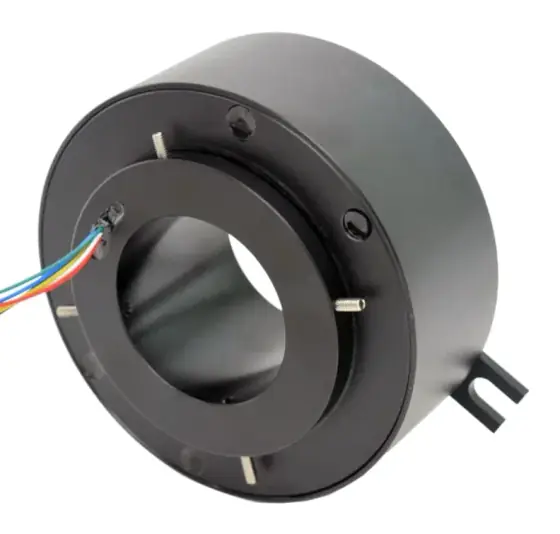
In short:Choose a contact slip ring for power, mixed circuits and moderate data at the lowest cost; it is the only practical way to pass kilowatts. Choose contactless (capacitive or optical) transmission for high-rate or real-time data where brush wear, debris or maintenance are unacceptable, and inductive coupling for control power up to a few hundred watts. Many machines end up with a hybrid.
The short answer
Use a contact slip ring when the rotor needs real power (motors, heaters, anything above a few hundred watts), a mix of power, I/O and moderate-rate data, or the lowest cost. Use contactless transmission when the data path must not wear or shed debris, when you need high-rate or real-time Ethernet at high revolutions per year, or when the joint must run in conditions brushes dislike. When the machine needs both kilowatts and dependable fieldbus, the usual answer is a hybrid: contact rings for power, a contactless channel for data.
If you are new to the technology, start with how slip rings work.
How contact and contactless slip rings differ
A contact slip ring passes current through brushes sliding on rotating rings. Moog describes the contact surfaces as almost always gold or silver alloys, with contact resistance varying by about 10 to 20 mΩ as the brush slides (Moog FAQ). It is passive: no supply, no electronics, no configuration.
A contactless slip ring bridges an air gap instead:
- Capacitive coupling for data. Rotating and stationary electrodes form a capacitor; transceivers on each side send the signal across. Moog’s Rotocap and SPINNER’s couplers both work this way (Moog product guide, SPINNER datasheet).
- Inductive coupling for power, sometimes with data modulated on top. A rotary transformer with one winding on each side transfers energy across the gap (SPINNER).
- Optical transmission through a fibre optic rotary joint for very high bandwidth with no electrical connection at all.
The key practical point: a contactless unit is active electronics. It needs a supply on both sides, adds a small latency, and has to be designed for your protocol.
Contact vs contactless slip rings: comparison table
| Factor | Contact slip ring | Contactless (capacitive / inductive) |
|---|---|---|
| Power transfer | Limited only by size; Moog makes units above 1,000 A and 25 kV | Inductive catalogue units typically to about 300–350 W |
| Data rate | Gigabit Ethernet on designed rings; serial to about 1.25 Gbit/s in smaller rings | 100 Mbit/s to 1 Gbit/s typical; Moog Rotocap to 2.5 Gbit/s |
| Real-time Ethernet | Passive, protocol-agnostic if the rings meet the cable spec | Only on channels designed for it; check protocol support |
| Wear on the transmission path | Brush and ring wear; life quoted in revolutions | None on the gap; bearings still wear |
| Debris | Metal-graphite sheds conductive dust; fibre and gold produce very little | None from the transmission path |
| Maintenance | Cleaning or brush replacement on some designs | Maintenance-free transmission path |
| Supply needed | No | Yes, on both sides |
| Circuit count | Dozens to hundreds of mixed circuits | A few data channels plus one power channel per unit, typically |
| Bore | From capsule (no bore) to very large bores | Hollow shafts to 360 mm offered by SPINNER |
| Cost | Lower for a given circuit count | Higher; transceivers on each side |
Sources: Moog FAQ, Moog product guide, SPINNER, Power & Motion.
Data transmission: where contactless wins
Data is the strongest case for going contactless. Every brush bounce or film on a ring is a potential bit error, and errors on a fieldbus show up as dropped frames, watchdog trips and nuisance stops.
What makers publish:
- SPINNER quotes up to 1 Gbit/s for Ethernet-based systems, a 100 Mbit/s real-time mode for deterministic buses, a bit error rate below 10⁻¹², and optional error-free operation to 3,000 rpm in either direction (SPINNER).
- Moog’s Rotocap capacitive units carry 100 Mbit/s up to 2.5 Gbit/s at up to 150 rpm and list PROFINET, Sercos III, Powerlink, EtherCAT and Mechatrolink III (Moog product guide).
Read the channel type, not the headline rate. SPINNER’s BN 637424 datasheet marks its Gigabit channel as “not for real-time ethernet applications”; real-time protocols run on its 100BASE-TX channels, and CAN runs on a repeater channel at up to 500 kbit/s (SPINNER datasheet). If your network is EtherCAT or PROFINET IRT, say so, and give the cycle time.
Contact rings carry Ethernet well too, provided they are built as controlled-impedance pairs and tested to the cable category. Moog’s contact rings are optimised for Gigabit Ethernet and HD video (Moog FAQ). The difference is how the performance holds up as the brushes wear. See Ethernet through slip rings.
Power transmission: where contact still wins
For power, sliding contacts remain the default. Moog says contact slip ring power is limited only by physical size (Moog FAQ). Inductive catalogue products are far smaller:
- SPINNER: 24 V DC at up to 300 W, regulated and short-circuit protected (SPINNER).
- MESA: rated to 350 W across gaps up to 10 mm, with 5 to 50 W more typical (Power & Motion).
Kilowatt contactless power is possible but less mature. Windpower Engineering reported a capacitive design transferring from about 1 W to several kW per channel across 0.08 to 0.10 mm plate gaps, then in beta testing (Windpower Engineering). Treat kilowatt contactless power as a custom engineering project, not a catalogue item.
Power circuits are also forgiving of contact noise: 20 mΩ of variation on a 10 A feed is 0.2 V. That is why a hybrid works so well. The brushes do the job they are good at, and the data rides on a path that does not care about brush condition.
Wear, life and maintenance
Contact life depends on materials, speed and diameter. Moog gives typical instrumentation rings tens of millions of revolutions and wind turbine designs more than 100 million (Moog FAQ). Its wind white paper describes a metal-graphite design that needs no maintenance for 50 million revolutions or five years, then a debris clean every two years, and a fibre brush design that ran 124 million revolutions in test without reaching end of life (Moog white paper).
Contactless transmission removes brush wear but not every wear part. Bearings, seals and electronics remain. SPINNER’s combined contactless and slip ring unit BN 637424 quotes a minimum life of 20 million revolutions and a maximum of 200 rpm (SPINNER datasheet). Compare whole-assembly figures.
Convert your duty first: revolutions per year = rpm × 60 × operating hours. Continuous 60 rpm, 24/7, is 31.5 million revolutions a year. At that rate a ring rated for 20 million revolutions is a service item; at 5 rpm, 8 hours a day, the same ring lasts decades.
Environment and installation
- Debris-sensitive sites (cleanrooms, optics, food zones): metal-graphite brushes shed conductive dust by design. Gold or fibre brushes produce very little; contactless produces none from the transmission path.
- Harsh media: MESA states its inductive modules operate underwater, in vacuum, in ultra-clean settings and under grease or mud (Power & Motion). Always confirm the IP rating of the housing: SPINNER’s BN 637424 is IP60, Moog’s Rotocap IP64.
- Air gap and runout: contactless couplers need the gap held within the maker’s limit. Put the unit on a stiff, concentric mounting, not on the end of a long overhung shaft.
- Supply and earthing: the rotor-side transceiver needs power, usually from a contact ring or an inductive channel. Plan the screen and earth path.
- Bore: both types come in through-bore forms; SPINNER offers hollow shafts to 360 mm.
Worked example: robot cell turntable
Duty: a two-station turntable rotating continuously at 60 rpm, 24 hours a day, 7 days a week. On the table: two servo axes drawing 3 kW in total at 400 V AC, a 24 V DC supply for sensors and I/O (about 150 W), and PROFINET IRT to a remote I/O block and the drives.
Revolutions: 60 × 60 × 24 × 365 = 31.5 million a year.
Option A, all contact: power rings, 24 V rings and Ethernet-rated data rings. A ring with a 20 million revolution life reaches it in under eight months. A fibre brush design with life beyond 100 million revolutions gets to about three years. Either way, the data rings are the circuits most likely to misbehave first as the contacts age.
Option B, all contactless: 3 kW is ten times the 300 W inductive limit published by SPINNER. Not viable from catalogue products.
Option C, hybrid: contact power rings for the 3 kW servo feed and the 24 V supply (both tolerant of contact noise), plus a capacitive data channel rated for real-time Ethernet. Check the unit lists PROFINET on the channel you will use, and that its speed rating covers 60 rpm with margin. The 150 W, 24 V load could alternatively go inductive, leaving only the servo power on brushes.
Verdict: Option C. Plan a service interval for the power brushes from the maker’s life figure at 31.5 million revolutions a year, and ask for the bit error rate and latency of the data channel.
Products in our range to consider
These are available through our supply network:
- ER Series through-bore slip ring: bores 12.7 to 100 mm, up to 15 A per circuit, published life of 20 million revolutions.
- Ethernet slip ring: 1 to 8 Gigabit or 1 to 12 100M channels with power circuits.
- AR/BR/CR Series capsule slip rings: gold-to-gold capsules for low-noise signal and data, up to 76 circuits.
- High speed slip ring: built for 800 to 15,000 rpm, mainly test rigs.
- FR Series fibre optic rotary joint: contactless optical channels, up to 50 fibres and 2,000 rpm.
- Fibre Optic Integrated Electrical Slip Ring: optical data with contact power and signal circuits in one hybrid unit.
Things that catch engineers out
- Assuming “1 Gbit/s” means “real-time ready”. Check the protocol list for the specific channel.
- Forgetting the rotor-side supply for a contactless transceiver.
- Sizing inductive power on average load and missing inrush or motor start current.
- Comparing brush life with bearing life. A contactless unit is only as long-lived as its bearings and electronics.
- Running power and data on adjacent contact rings without screened or spare rings between them.
Checklist
Send these to our engineers, or enter them in the spec builder:
- Power circuits: voltage, continuous and peak current, number of phases, inrush
- Data: protocol, rate, cycle time, and whether real-time (EtherCAT, PROFINET IRT, Sercos III)
- Signal and I/O circuits, and any low-level analogue
- Speed, direction, continuous or oscillating, and operating hours a year
- Required life and acceptable service interval
- Bore and envelope; mounting stiffness and runout
- Environment: IP rating, temperature, debris sensitivity, washdown, vacuum
- Supply available on each side for contactless electronics
- Whether a hybrid (contact power, contactless data) is acceptable
See also how to select a slip ring type, how to specify a slip ring and the slip rings hub.
Frequently asked questions
What is a contactless slip ring?
It is a rotary joint that transfers data or power across a small air gap without sliding contacts. Data usually crosses by capacitive coupling between rotating and stationary electrodes, or optically; power crosses by inductive coupling through a rotary transformer. There is no brush wear on the transmission path, although the unit still has bearings and electronics on both sides that need power and have a rated life.
Can a contactless slip ring transmit power?
Yes, but at modest levels in most catalogue products. SPINNER offers inductive transmission of 24 V DC at up to 300 W, and MESA's inductive modules are rated to 350 W with 5 to 50 W more typical. That covers sensors, I/O and controllers on the rotor. Kilowatt motor feeds are still normally passed through contact power rings, often in a hybrid unit with contactless data.
Does contactless data work with EtherCAT and PROFINET?
Yes, if the unit is built for real-time Ethernet. Capacitive couplers are active electronics, and not every channel suits deterministic protocols: SPINNER's BN 637424 datasheet marks its Gigabit channel as not for real-time Ethernet, while its 100BASE-TX channels list PROFINET, EtherCAT, Sercos III, POWERLINK and EtherNet/IP. Name your protocol and cycle time when you ask for a quote.
Are contactless slip rings maintenance-free?
The transmission path does not wear, so there are no brushes to replace or debris to clean, and makers describe the data interfaces as maintenance-free. The bearings still wear, seals still age and the electronics have a service life. SPINNER's combined contactless and slip ring unit, for example, quotes a minimum life of 20 million revolutions. Ask for the life figure of the whole assembly.
Is a contactless slip ring faster than a contact slip ring?
For data, usually yes. Moog says smaller contact rings handle serial data to about 1.25 Gbit/s, while its Rotocap capacitive units carry up to 2.5 Gbit/s. For rotational speed, contactless data links avoid brush wear at speed, and SPINNER offers error-free operation up to 3,000 rpm as an option. Contact designs reach high speeds too, but life falls as surface speed rises.
Which is cheaper, contact or contactless?
A contact slip ring is normally the lower-cost option for a given circuit count, because it is passive and highly standardised. Contactless units add transceivers on both sides and need their own supply. The comparison changes over the machine's life if a contact ring would need regular replacement or cleaning, or if downtime for service is expensive, so compare total cost at your revolutions per year.
Sources
- SPINNER: Contactless rotary joints for industry
- SPINNER: Rotary joint BN 637424 datasheet
- Moog: Slip ring product guide
- Moog: Slip ring frequently asked questions
- Moog: High reliability slip ring design for wind turbines (white paper)
- Power & Motion: Virtual slip rings transmit power or signals across air gaps
- Windpower Engineering: Noncontacting slip rings capable of kW-level power (Paul Dvorak)
Figures are summarised from the sources above and from manufacturers' published data on the date shown. Always confirm against the current datasheet for your exact part.