
In short: a slip ring is specified by its circuits, not its catalogue page. List every circuit with its current, voltage and signal type, then add the speed and duty cycle, the shaft arrangement and space envelope, the environment, the life you need and your annual quantity. With those seven inputs a supplier can tell you whether a standard series fits, or whether a modified or custom design will cost less over the life of the machine.
1. Start with the motion
Describe how the rotating part actually moves. Continuous rotation in one direction, oscillation through a limited angle and occasional indexing all load the contacts differently. Give the maximum speed and the speed it runs at most of the time, plus the hours per day and days per year. A turntable that indexes a few times a minute and a camera head that rotates continuously can use very different designs, even with the same circuit count.
If the rotation is limited to less than a full turn, a cable carrier or a clock spring may be cheaper. A slip ring earns its place when rotation is continuous or when cable wind-up would limit the machine.
2. Build the circuit list
This is the most important input, and the most common reason a first quote misses. For each circuit, state:
- What it carries: mains power, DC power, motor phases, brake, sensor signal, encoder, fieldbus, Ethernet, video or RF.
- Current: continuous and peak, including motor inrush.
- Voltage: the working voltage and the isolation test voltage you need between circuits and to the housing.
- Grouping: which circuits are twisted pairs, which need shielding, and where the shield and protective earth should be carried.
Add one or two spare circuits. Adding a ring after tooling is expensive; a spare costs little at design stage. Keep power and sensitive signals on separate ring groups, and say so in the specification, because physical separation inside the ring is one of the most effective ways to control noise.
3. Signals and data: name the protocol
“Data” is not enough. Every sliding contact adds a small, varying resistance as it rotates, and how much that matters depends on the signal. Analogue sensor signals, encoder feedback, CAN, PROFIBUS, EtherCAT and Ethernet each have different tolerances. Precious-metal contacts, such as gold-on-gold, are normally used for low-level signals because they keep that variation low.
For Ethernet, specify the speed. 100BASE-TX uses two twisted pairs, while 1000BASE-T Gigabit Ethernet uses all four, so a Gigabit ring needs more channels and tighter impedance control. Manufacturers offer slip rings designed and tested for 10/100/1000BASE-T Ethernet and HD-SDI video, for example in CCTV and pan-tilt camera heads (Moog AC7195 example).
When bandwidth is very high, a contacting ring may not be the right tool. CT scanners, for instance, move image data across the rotating gantry with non-contacting optical or RF links at gigabit rates, while power still crosses on contacting rings (Moog). For video, sonar or long tethers, consider a fibre optic rotary joint, alone or combined with an electrical slip ring.
4. Speed, life and maintenance
Contact wear depends on the sliding speed at the contact, which rises with both rpm and ring diameter. That is why a large-bore ring and a small capsule at the same rpm can have very different rated lives. Manufacturers quote life in revolutions: published air-traffic-control rotary joints, for example, are rated for 20 to 50 million revolutions minimum (source).
Tell the supplier the life you need in operating hours and the speed profile, and ask what maintenance the design assumes. High-current rings often use metal-graphite brushes, which can need periodic inspection; precious-metal signal contacts are usually designed to run maintenance-free for their rated life. Very high speeds, such as instrumented test rigs on powertrains, need purpose-built designs (Michigan Scientific example).
5. Shaft arrangement and space envelope
Decide how the ring mounts before you fix the circuit count, because the envelope often decides the type:
- Capsule: solid shaft, smallest package, best for low-current circuits.
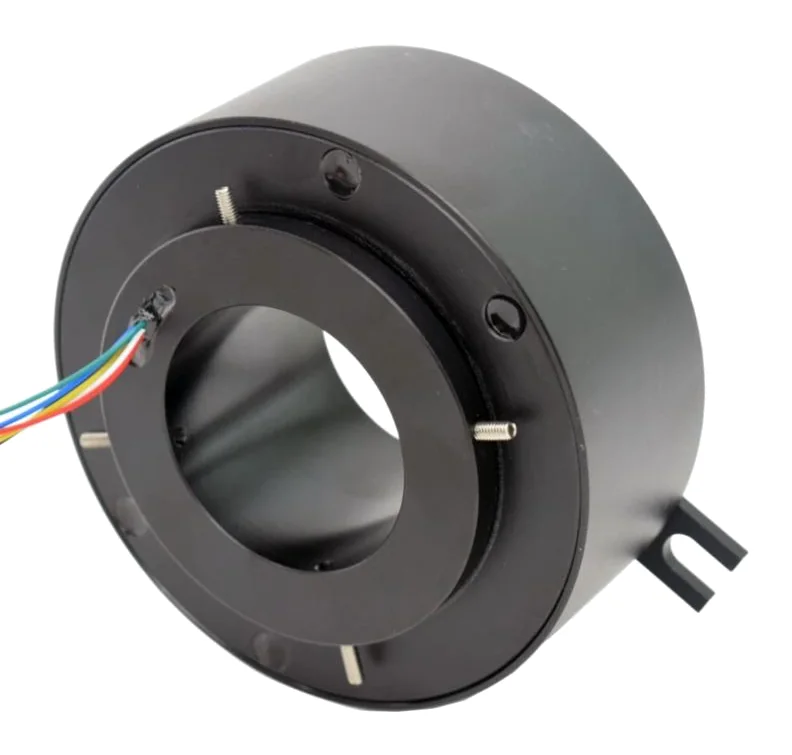
- Through-bore: hollow centre for a shaft, pipe, cables or a rotary union.
- Pancake: flat, for installations with little axial height.
- Large-diameter: bespoke rings for gantries, turrets and platforms; CT gantry rings reach bores of about 1.27 m (Moog).
Give the maximum outside diameter and length, the bore, how the rotor and stator are fixed and stopped from turning, and the run-out you can hold. State whether you want flying leads, connectors or terminals, and the lead length on each side.
6. Environment and protection
Specify the ingress protection with an IP code to IEC 60529. The first digit covers solids and dust, the second covers water. IP69K, for high-pressure, high-temperature washdown, is defined separately in ISO 20653. Then add:
- Operating and storage temperature, humidity and any condensation.
- Shock and vibration, with the test standard if one applies, for example MIL-STD-810 for defence equipment (Moog COTS slip ring test data).
- EMC requirements, especially near motor drives.
- Hazardous areas (ATEX or IECEx zone), subsea depth and whether a pressure-compensated design is needed, or food contact and cleaning chemicals.
7. Other media and the rest of the axis
If air, vacuum, hydraulic oil or coolant must also cross the rotation, a combined slip ring and rotary union avoids two separate assemblies. The same applies to RF and fibre. Finally, look at what drives the rotation. The motor, gearbox, encoder and drive are often designed around the same bore and cable route as the slip ring. Specifying them together avoids clashes and gives you one point of contact. The spec builder lets you add them to the same specification.
Slip ring specification checklist
| Parameter | What to give | Why it matters |
|---|---|---|
| Motion | Continuous or oscillating, max and typical rpm, hours per year | Sets contact material, size and rated life |
| Power circuits | Number, continuous and peak current, voltage | Sizes rings and brushes, sets isolation |
| Signal circuits | Number and type, pairs and shields | Decides contact material and ring grouping |
| Data | Protocol and speed, e.g. 1000BASE-T, EtherCAT, HD-SDI | Needs controlled-impedance rings or fibre |
| Mechanical | Bore, max OD and length, mounting, anti-rotation, leads or connectors | Decides capsule, through-bore or pancake |
| Environment | IP code, temperature, shock, vibration, EMC, ATEX or subsea | Sets sealing, materials and testing |
| Other media | Air, fluid, RF or fibre channels | May need a combined rotary assembly |
| Life and service | Required life, maintenance access | Confirms the design meets your warranty |
| Commercial | Prototype date, annual quantity, target cost | Decides standard, modified or custom |
Frequently asked questions
What information do I need to get a slip ring quote?
A circuit list (each circuit’s current, voltage and signal type), the maximum and continuous speed, the shaft or bore arrangement, the space envelope, the environment and IP rating, the required life and the annual quantity. Approximate figures are enough to start; an engineer will confirm the details.
Can Ethernet run through a slip ring?
Yes. Ethernet-rated slip rings use controlled-impedance, paired ring designs so the data passes reliably. 100BASE-TX uses two pairs and 1000BASE-T uses four, so Gigabit Ethernet needs more rings and tighter design than Fast Ethernet. Tell the supplier the protocol, not just “data”.
When should I use a fibre optic rotary joint instead?
When bandwidth, distance or electrical noise immunity matters more than the convenience of copper: high-definition video, sonar and seismic data, and long tethers are typical. Fibre optic rotary joints can be combined with an electrical slip ring in one assembly.
What is the difference between a capsule and a through-bore slip ring?
A capsule slip ring has a solid shaft and is the most compact option for low-current circuits. A through-bore slip ring has a hollow centre so a shaft, pipe, cables or a rotary union can pass through the middle, which suits turntables, robot bases and large machinery.
How long does a slip ring last?
Life is quoted in millions of revolutions and depends on contact materials, speed, current, temperature and cleanliness. Give the supplier your speed and duty cycle so they can quote a rated life and any maintenance interval.