
Servo and stepper motors
Housed servo and stepper motors for positioning, indexing and speed control. Tell us the application and we'll specify the right product, and the parts around it, for your machine.
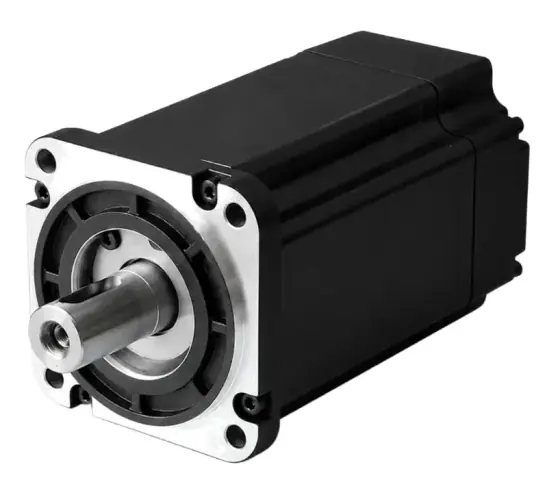
In short:Use a stepper for low-cost, low-to-medium speed positioning where torque at speed and efficiency matter less; use a servo where you need torque across a wide speed range, high dynamics or continuous duty. Size either one from the torque-speed curve, RMS torque and inertia ratio, with margin.
Where servo and stepper motors fit
Housed servo and stepper motors are the default for positioning, indexing and speed control on production machines. They drive screws, belts, gearboxes and rotary tables, and they are where most OEM engineers start before considering frameless motors or direct-drive linear motors.
The basic choice is simple. A stepper is the lowest-cost way to position a load at low to moderate speed. A servo costs more and needs tuning, but gives torque across a much wider speed range, peak torque in reserve and closed-loop confirmation of position. Closed-loop steppers and integrated servos fill the gap between the two.
Motor types compared
| Type | Feedback | Typical strengths | Limitations |
|---|---|---|---|
| AC servo (mains-fed) | Absolute or incremental encoder, resolver | Wide speed range, high peak torque, continuous duty | Cost, tuning, separate drive and cables |
| Low-voltage DC servo | Encoder | 24–96 VDC safety and battery systems, AGVs, robots | Higher current for the same power |
| Integrated servo | Encoder, drive on motor | Less cabling and cabinet space | Shared heat, lower power range |
| Hybrid stepper (open loop) | None | Low cost, high low-speed torque, simple | Torque falls with speed, can stall unnoticed, runs hot |
| Closed-loop stepper | Encoder | No lost steps, cooler, faster settling | Top speed still limited |
| Integrated stepper | Optional encoder | Compact, fieldbus or pulse control on the motor | Limited to smaller frames |
AC servo motors
Mains-fed brushless servo motors from 50 W to several kW cover most machine axes. Ranges are usually offered in low, medium and high inertia versions. Low inertia suits fast indexing on stiff mechanics; higher inertia tolerates larger loads and less rigid couplings. Examples include Kinco SMK, Siemens SIMOTICS S-1FK2, Allen-Bradley Kinetix VPL and SANMOTION R2. Food and pharmaceutical machines use stainless washdown motors such as Kinetix VPH or SIMOTICS S-1FS2.
Low-voltage DC and integrated servo motors
Battery-powered AGVs, cobots and distributed machines often run at 24–60 VDC. Low-voltage servo ranges such as Leadshine ELVM or Kinco SMC low-voltage suit them. Integrated motor-plus-drive units such as Leadshine iSV2 and Kinco iSMK take the drive out of the cabinet and connect over CANopen, Modbus or pulse/direction.
Hybrid and closed-loop steppers
Two-phase hybrid steppers with a 1.8° step are the workhorse, for example the Leadshine CM series or SANMOTION F2. Five-phase versions such as SANMOTION F5 use a finer 0.72° step for lower vibration. Closed-loop motors such as Leadshine CS-M add an encoder; integrated versions such as Novanta Liberty MDrive put drive and control on the motor.
Servo vs stepper: what actually differs
Parker’s comparison puts numbers on the trade-offs (Parker):
- Torque at speed. In Parker’s example, a stepper’s torque had fallen by almost half at 1,200 rpm and its usable top speed was about 1,200–3,000 rpm. The servo held near-constant torque to about 3,600 rpm, with typical top speeds of 5,000–7,500 rpm.
- Peak torque. Servos can deliver about three times rated torque for short periods. A stepper’s holding torque is its ceiling.
- Heat and efficiency. Open-loop steppers draw full current whether the load needs it or not, so they run hot. Servos draw only what the load requires.
- Resonance. Steppers have mid-range resonance bands, typically between about 60 and 300 rpm, which microstepping and anti-resonance features help with.
- Stall behaviour. An open-loop stepper that stalls loses position silently. An encoder, on a closed-loop stepper or a servo, detects it.
The servo vs stepper guide covers the decision in more depth.
How to size a servo or stepper motor
1. Build the move profile
For each segment (accelerate, constant speed, decelerate, dwell), work out the torque: load torque (friction, gravity, process force reflected through the mechanism) plus acceleration torque, T = J_total × α. Include motor rotor inertia, coupling, gearbox and load reflected to the motor shaft.
2. Check peak torque against the curve
Plot each torque and speed point on the motor’s torque-speed curve. For a servo, the peak (usually during acceleration) must fall inside the intermittent zone at that speed. For a stepper, every point must sit below the pull-out torque curve for your drive voltage and current, with margin. Higher supply voltage generally extends a stepper’s torque to higher speeds.
3. Check RMS torque for heating
RMS torque is the constant torque that would heat the motor the same as the real cycle:
T_rms = √[(Ta²·ta + Tc²·tc + Td²·td + Th²·th) / t_total]
It must sit inside the servo’s continuous zone (Motion Control Tips). Include holding torque during dwell on vertical axes.
4. Apply margin
Oriental Motor gives reference safety factors of about 2 for 2- and 5-phase steppers, and 1.5–2 on servo rated and RMS torque (Oriental Motor). It also suggests running steppers at 50% duty or less for temperature reasons.
5. Check the inertia ratio
Load-to-motor inertia ratio affects tuning, overshoot and settling. Most sizing guides aim for 10:1 or less (Motion Control Tips). Oriental Motor publishes a reference limit of 30:1 for its steppers and up to 50 times rotor inertia for its servo motors. Stiff, direct-coupled mechanics tolerate higher ratios than belts or long shafts.
A gearbox divides reflected inertia by the square of the ratio. Worked example: a 20 kg·cm² load on a 0.5 kg·cm² motor is 40:1 direct. Through a 3:1 gearbox the load reflects as 20 / 9 ≈ 2.2 kg·cm², giving a ratio of about 4.4:1, and the motor needs a third of the torque. The gearbox adds its own inertia and backlash, so see gearboxes for the trade-offs.
6. Choose feedback
Incremental encoders are cheapest but need homing after power-up. Absolute encoders (single- or multi-turn) know position at switch-on, which matters on robots and axes that cannot be homed safely. Resolvers suit high-temperature or high-shock duty. The absolute vs incremental encoder guide explains the options.
7. Check the frame and mounting
NEMA frame sizes (NEMA ICS 16) define the stepper faceplate in tenths of an inch: NEMA 17 ≈ 42 mm, NEMA 23 ≈ 57 mm, NEMA 34 ≈ 86 mm. Servo motors are usually specified by metric flange size (40, 60, 80, 130 mm and so on). Neither standard fixes shaft diameter, pilot or length across manufacturers, so check the drawing before you swap brands.
Common mistakes
- Sizing a stepper on holding torque. Holding torque is a standstill figure; what matters is torque at your running speed.
- Ignoring the drive. Stepper torque curves depend on drive voltage and current. Servo peak torque is limited by the drive’s peak current.
- Leaving out reflected inertia. Couplings, pulleys and gearboxes often add more inertia than expected.
- Only checking the peak. A motor that passes the peak check can still overheat on RMS.
- No brake on vertical axes. Neither motor type holds a load safely without power.
- Overlooking cable length and EMC. Long motor cables on servo drives may need filters or chokes; check the drive manual.
What to send an engineer for a quote
- Move profile: distance, time or speed, acceleration, dwell, cycles per minute
- Load: mass or inertia, mechanism (screw lead, pulley diameter, gear ratio), friction and process forces, orientation
- Accuracy, repeatability and settling time required
- Supply voltage (mains AC or DC bus) and preferred drive or controller
- Control interface: EtherCAT, CANopen, PROFINET, Modbus, pulse/direction or analogue
- Feedback needs: absolute or incremental, multi-turn, safety functions such as STO
- Environment: IP rating, temperature, washdown, vibration
- Mounting constraints: frame size, shaft, brake, connector orientation
Add these to the spec builder below and our supply network will propose matched motor and drive combinations; see also servo drives and motion controllers.
Guides
Where servo and stepper motors are used
What we need to know to specify servo and stepper motors
These are the questions an applications engineer works through first. Approximate answers are fine: ranges narrow the options quickly, and we confirm the details with you.
- Continuous torque: Under 1 Nm, 1–5 Nm, 5–20 Nm, Over 20 Nm
- Speed: Under 500 rpm, 500–3,000 rpm, Over 3,000 rpm
- Supply: 24–48 V DC, 230 V AC, 400 V AC
- Feedback: Open loop (stepper), Incremental encoder, Absolute encoder, Resolver
- Frame size: NEMA 17/23, NEMA 34/42, 60–80 mm, 100 mm and above
We also ask about the environment (washdown, outdoor, subsea, ATEX, vacuum, shock and EMC), annual quantities and timescale, because these decide whether a standard, modified or custom design is the best fit.
151 series compared
Series from 43 manufacturers, grouped by type. Figures are the highest published for each series. Open a series for the full specification and, for brands outside our supply network, the alternatives that meet or exceed it.
AC servo motor (54)
DC servo motor (21)
| Brand | Series | Rated torque | Peak torque | Speed |
|---|---|---|---|---|
| Kinco | SMK Series Low-Voltage DC Servo Motors | — | — | — |
| Kinco | SMC Series Low-Voltage DC Servo Motors | — | — | — |
| Kinco | SMH Series Low-Voltage DC Servo Motor (SMH110D) | 4 Nm | — | — |
| Leadshine | ELVM Series Low-Voltage DC Servo Motors | 6.4 Nm | 16 Nm | 6,000 rpm |
| FAULHABER | BX4 | 0.1 Nm | — | 29,000 rpm |
| FAULHABER | BXT | 0.13 Nm | — | 10,000 rpm |
| FAULHABER | BP4 | 0.16 Nm | — | 34,500 rpm |
| WITTENSTEIN alpha | cyber dynamic motor | — | 2.97 Nm | 23,000 rpm |
| Beckhoff Automation | AM8100 | — | — | — |
| maxon | EC-i | — | — | — |
| maxon | EC flat / ECX FLAT | — | — | 6,000 rpm |
| Sanyo Denki | SANMOTION T (DC servo) | — | — | — |
| Sanyo Denki | SANMOTION K (DC servo) | 1.91 Nm | 16.7 Nm | 5,000 rpm |
| Oriental Motor | BLV Series brushless DC motors | — | — | 4,000 rpm |
| Portescap | 22ECS Ultra EC slotless BLDC | 0.05 Nm | — | 60,000 rpm |
| Portescap | 40ECP slotless BLDC | 0.12 Nm | 1.1 Nm | 30,000 rpm |
| Portescap | Athlonix 22N78 coreless brush DC | 0.02 Nm | — | 10,000 rpm |
| Portescap | 35GLT high-performance brush DC | 0.16 Nm | 1.49 Nm | 10,000 rpm |
| ElectroCraft | RapidPower Xtreme (RPX) | — | 3.15 Nm | — |
| ElectroCraft | RapidPower (RP) | 2.1 Nm | 7.73 Nm | — |
| ElectroCraft | RapidPower Plus (RPP) | 4 Nm | 16 Nm | 5,000 rpm |
Hybrid stepper motor (21)
Integrated servo motor (11)
| Brand | Series | Rated torque | Peak torque | Speed |
|---|---|---|---|---|
| Leadshine | iSV2 Integrated Low-Voltage Servo Motors | 2.39 Nm | 7.2 Nm | 4,000 rpm |
| Kinco | iSMK Series Integrated DC Servo Motors (iSMK40/60/80) | — | — | — |
| Kinco | MD Series Integrated Servo Motors (MD60/MD80) | 2.39 Nm | — | — |
| Kinco | iSMD Integrated Servo Motors (iSMD60D/80D) | — | — | — |
| WITTENSTEIN alpha | premo SP / TP / XP Line servo actuators | — | 450 Nm | 375 rpm |
| Beckhoff Automation | AMP8000 | — | 37.2 Nm | — |
| maxon | IDX | 3.75 Nm | — | 8,000 rpm |
| Schneider Electric (Lexium) | Lexium 32i integrated servo drive | — | — | — |
| B&R Industrial Automation | ACOPOSmotor (8DI) | — | — | — |
| Synapticon | ACTILINK-S | 3.2 Nm | 13 Nm | 4,500 rpm |
| Nanotec | PD4-E / PD6 smart servo motors | — | — | — |
Smart servo actuator (10)
| Brand | Series | Rated torque | Peak torque | Speed |
|---|---|---|---|---|
| ROBOTIS DYNAMIXEL | DYNAMIXEL X Series (XM, XH, XD, XC, XL) | — | 12.9 Nm | 456 rpm |
| ROBOTIS DYNAMIXEL | DYNAMIXEL XW Series | — | 11.2 Nm | — |
| ROBOTIS DYNAMIXEL | DYNAMIXEL-P Series (PH, PM) | 44.7 Nm | — | — |
| ROBOTIS DYNAMIXEL | DYNAMIXEL-Y Series (YM070, YM080) | 26 Nm | 61.4 Nm | 32.2 rpm |
| ROBOTIS DYNAMIXEL | DYNAMIXEL MX Serieslegacy | — | 8.4 Nm | — |
| Feetech | STS series (TTL serial bus) | — | 19.6 Nm | 170 rpm |
| Feetech | SMS series (RS485 serial bus) and Modbus-RTU servos | — | 25.5 Nm | 60 rpm |
| Feetech | SCS series (TTL serial bus) | — | 3.9 Nm | — |
| Feetech | HLS series (constant-force TTL serial bus) | — | 5.9 Nm | 110 rpm |
| Feetech | FU series (CAN bus) | — | 3.4 Nm | — |
Integrated stepper motor (9)
| Brand | Series | Holding torque | Current |
|---|---|---|---|
| Leadshine | Leadshine iEM Series | 3.5 Nm | 7 A |
| Leadshine | Leadshine iEM-RS Series | 2.3 Nm | — |
| Leadshine | Leadshine iCS Series | 3.5 Nm | 7 A |
| Leadshine | Leadshine iCS-RS Series | 2.3 Nm | — |
| Novanta | Novanta IMS Liberty MDrive (LMD / LMH) | 6.5 Nm | 3.5 A |
| Trinamic (Analog Devices) | PANdrive PD42-1241 | 0.8 Nm | 3 A |
| Trinamic (Analog Devices) | PANdrive PD-1243-IOLINK | 0.27 Nm | 1.2 A |
| Trinamic (Analog Devices) | PANdrive PD57/60-1378 | — | — |
| Lin Engineering | Silverpak 23C / 23CE integrated stepper | 2.01 Nm | 3 A |
Coreless DC motor (7)
| Brand | Series |
|---|---|
| Motion Control Products | D-Series DC Coreless Motors (Precision and Standard) |
| FAULHABER | SR (precious-metal commutation) |
| FAULHABER | CR (graphite commutation) |
| FAULHABER | CXR (graphite commutation) |
| maxon | EC-max |
| maxon | DCX |
| maxon | RE |
Stainless servo motor (5)
| Brand | Series | Rated torque | Peak torque | Speed |
|---|---|---|---|---|
| Siemens | SIMOTICS S-1FS2 | 14 Nm | — | — |
| Allen-Bradley | Kinetix VPH Hygienic Servo Motors | 18.67 Nm | 73.5 Nm | 8,000 rpm |
| Allen-Bradley | Kinetix VPS Stainless-steel Servo Motors | — | — | — |
| Allen-Bradley | Kinetix MPS Stainless-steel Servo Motors (MP-Series) | — | 27.1 Nm | — |
| B&R Industrial Automation | 8JS stainless steel servo motors (8JSB / 8JSQ) | — | — | — |
Closed-loop stepper motor (4)
| Brand | Series | Holding torque | Current |
|---|---|---|---|
| Leadshine | Leadshine CS-M Series | 12 Nm | 6 A |
| Leadshine | Leadshine ES2-MH Series (3-phase high voltage) | 20 Nm | 6 A |
| Sanyo Denki | SANMOTION Model No. PB (closed-loop stepping system) | 6.1 Nm | 3 A |
| Oriental Motor | AlphaStep AZ Series closed-loop stepper motors | 4 Nm | — |
Drone outrunner motor (2)
Slotless BLDC motor (1)
| Brand | Series |
|---|---|
| DINGS' | Slotless DC Brushless Motors (ZWWC) |
AC induction motor (1)
| Brand | Series |
|---|---|
| Motion Control Products | AC Induction Motors |
Geared PMDC motor (1)
| Brand | Series |
|---|---|
| Motion Control Products | ZYT PMDC Brushed Motors with MCP2/MCP4 Gearboxes |
Brushed DC motor (1)
| Brand | Series |
|---|---|
| DINGS' | DINGS ZYT Brushed DC Motors |
Brushed DC servo motor (1)
| Brand | Series | Rated torque | Peak torque | Speed |
|---|---|---|---|---|
| Motion Control Products | BDS Series DC Brushed Servomotors (82BDS, 102BDS) | 4.3 Nm | 22 Nm | 5,000 rpm |
Servo wheel drive (1)
| Brand | Series | Rated torque | Peak torque | Speed |
|---|---|---|---|---|
| Kinco | iWMC Integrated Servo Wheel | 40 Nm | 99 Nm | — |
Servo motors (1)
| Brand | Series | Rated torque | Peak torque | Speed |
|---|---|---|---|---|
| Sanyo Denki | SANMOTION S (AC spindle motor system) | — | — | — |
Summarised from manufacturers' published data. Always confirm against the current datasheet; an engineer will check the fit before recommending anything.
Brands
Frequently asked questions
What is the main difference between a servo and a stepper motor?
A stepper moves in fixed steps and usually runs open loop: it produces high torque at low speed, but that torque falls as speed rises and it draws full current even when lightly loaded. A servo runs closed loop from an encoder, delivers near-constant torque up to rated speed, can give about three times rated torque for short peaks, and only draws the current the load needs.
What is a closed-loop stepper and when should I use one?
A closed-loop stepper adds an encoder to a hybrid stepper so the drive can detect and correct lost steps and, on many drives, reduce current when the load is light. It runs cooler and settles faster than an open-loop stepper while keeping the stepper's strong low-speed torque and simple tuning. It still has the stepper's limited top speed, so it suits short, frequent moves rather than high-speed axes.
What inertia ratio should a servo motor have?
Most sizing guides aim for a load-to-motor inertia ratio of 10:1 or less, and highly dynamic axes may need 5:1 or lower. Modern drives can control higher ratios on stiff mechanics, and some manufacturers publish limits of 30 to 100 times rotor inertia for particular motors. A gearbox reduces reflected load inertia by the square of the ratio, which is usually the simplest fix.
What does NEMA 17, 23 or 34 mean?
NEMA frame sizes describe the motor's square faceplate in tenths of an inch: NEMA 17 is about 1.7 in (roughly 42 mm), NEMA 23 about 2.3 in (57 mm) and NEMA 34 about 3.4 in (86 mm). The numbers fix the mounting face, not torque, length or shaft details, which vary between manufacturers. Always check the drawing for shaft diameter, pilot and hole pattern.
Is an integrated servo motor worth it?
Integrated servo motors put the drive, and often a controller, on the back of the motor. They save cabinet space and cabling, which helps on AGVs, conveyors and distributed machines running from 24 to 48 VDC. The trade-offs are that motor and drive heat share one housing, a failure means replacing both together, and power ranges are usually lower than for separate motor and drive.
How much torque margin should I allow?
Oriental Motor recommends a safety factor of about 2 for open-loop steppers and 1.5 to 2 for servo rated and RMS torque. Parker suggests about 50% extra torque for open-loop steppers to cover mid-range resonance. Steppers need more margin because a stall loses position without warning; servos have peak torque in reserve and report faults.
Sources
- Comparison of motor technologies: servo, stepper, stepper with encoder (Parker)
- Selecting a motor: selection points (Oriental Motor)
- How do I determine what gear ratio I need for my servo system? (Motion Control Tips)
- How to calculate continuous and peak torque values for servo applications (Motion Control Tips)
- NEMA ICS 16-2001 Motion/Position Control Motors, Controls and Feedback Devices (ANSI webstore)
Figures are summarised from the sources above and from manufacturers' published data on the date shown. Always confirm against the current datasheet for your exact part.
Spec builder
Specify servo and stepper motors
Select every part you need, answer the questions an applications engineer would ask, and see your summary before we ask for any details.
- 1Products
- 2Performance
- 3Environment
- 4Volumes
- 5Your spec
Engineer support
Talk to an engineer about servo and stepper motors
Tell us what you need, whether it is this part, an equivalent or a complete axis built around it. An engineer will review your requirements and reply, normally within one working day.
- Reviewed by an engineer, not an autoresponder
- Like-for-like and better-fit alternatives
- Standard, modified and custom options
Prefer to configure it? Use the spec builder.