
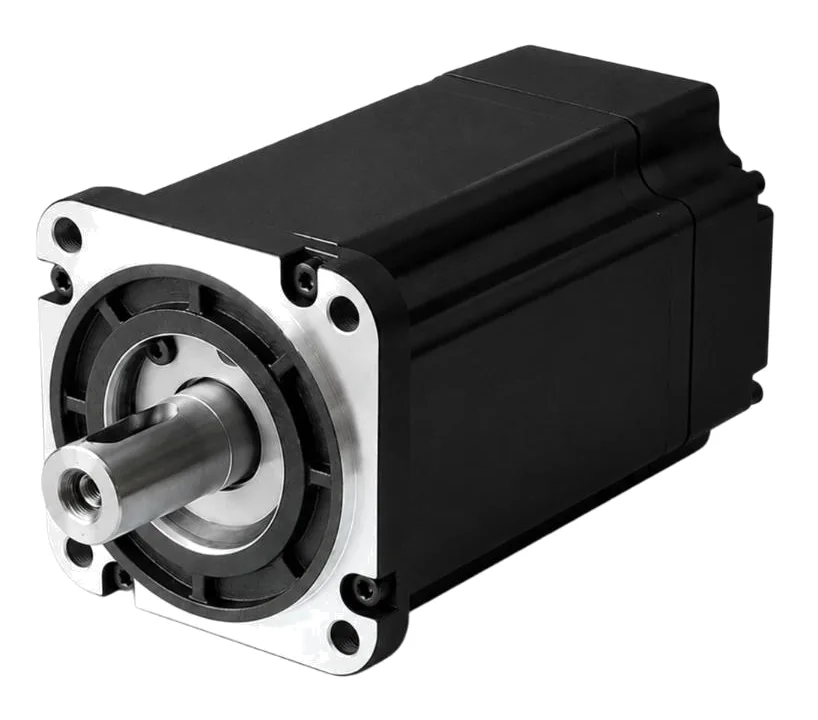
In short:Choose a stepper for low-to-moderate speeds (roughly under 1,000 rpm), modest inertia and simple point-to-point moves where cost matters; a closed-loop stepper removes the risk of silently lost steps. Choose a servo when you need torque at higher speeds, short-term peak torque well above continuous, high throughput, tight coordination or the ability to ride through disturbances.
How steppers and servos actually differ
A hybrid stepper motor has a toothed rotor and stator that give, on a standard two-phase motor, 200 full steps per revolution (1.8°). The drive pushes a set current through the windings and switches it in sequence; the rotor follows. There is no feedback in the classic open-loop arrangement. If the load demands more torque than the motor can make at that speed, the rotor slips a step, and the controller never knows.
A servo motor is a brushless permanent-magnet motor with an encoder. The drive closes current, velocity and position loops on that feedback, sending only the current needed to follow the commanded profile. It can draw well above its continuous rating for short bursts, and if a disturbance knocks it off position it corrects.
A closed-loop stepper (sometimes sold as “easy servo” or “hybrid servo”) puts an encoder on a stepper and closes the loop in the drive. It keeps the stepper’s high low-speed torque and low cost, but stops silent step loss.
Torque-speed: where steppers run out
This is the single most important difference:
- Steppers make their highest torque at standstill and low speed, then fall away as speed rises because winding inductance limits how fast current can change. Kollmorgen puts the practical drop above about 1,000 rpm (Kollmorgen).
- Servos hold roughly constant continuous torque, and a much higher peak torque, up to their rated speed, typically 2,000 to 4,000 rpm or more.
- At very low speed (under about 15 rpm) a stepper can out-torque a servo of the same frame size, though modern servos have closed much of that gap.
A stepper’s torque at speed depends heavily on supply voltage: the same motor on a 48 V drive will hold torque to a noticeably higher speed than on 24 V. Never size from holding torque. Read the pull-out torque curve for the specific motor, drive and voltage, at the highest speed in your move.
Resonance and smoothness
Steppers have two resonance problems:
- Low-speed resonance around the motor’s natural frequency, which microstepping largely smooths out.
- Mid-range instability, typically around 1,200 to 3,000 full steps per second (6 to 15 rev/s, or 360 to 900 rpm on a 200-step motor). The rotor oscillates at 50 to 150 Hz, the oscillation grows over several cycles, and it can stall the motor in 0.1 to 1 second. Microstepping does not cure it; drives with electronic damping do (Dover Motion).
If your move profile passes through or cruises in that band, specify a drive with anti-resonance control or a closed-loop stepper, and test with the real load. Servos do not have this problem, but they do “hunt” by a few encoder counts at standstill; higher-resolution feedback reduces it.
Heat, efficiency and holding
An open-loop stepper drive pushes rated current through the windings all the time, including at standstill, so the motor runs warm even when holding a light load. Idle current reduction cuts this, but it also cuts holding torque. A servo uses only the current the load needs (Kollmorgen). Oriental Motor rates servos as more energy-efficient, and closed-loop steppers as better than open-loop ones (Oriental Motor).
For battery-powered equipment, sealed enclosures or anything that holds position for long periods, that difference matters more than the price tag.
Inertia, sizing margin and tuning
Inertia ratio (load inertia reflected to the motor ÷ rotor inertia) governs how well either motor controls the load. Kollmorgen’s guidance:
- Steppers: generally below 30:1, up to around 200:1 with slow acceleration and advanced microstepping.
- Servos: 1:1 to 20:1 or higher with modern high-resolution feedback and stiff mechanics; direct-drive servos run at 200:1 to 300:1 and above.
Belts, long shafts and couplings add compliance, which pushes you towards the lower end.
Sizing margin: size an open-loop stepper at about twice the continuous requirement, because it cannot recover from lost synchronism. Size a servo on RMS torque over the profile for its continuous rating, and on the peak for its peak rating (Kollmorgen).
Tuning: a stepper needs little more than current and microstep settings. A servo needs loop tuning, though modern drives auto-tune well. Budget commissioning time for servos on compliant or variable loads.
Cost
Open-loop steppers typically save more than 20 to 30% of initial cost over a comparable servo solution, and use simpler, cheaper cabling. Closed-loop steppers close much of that gap (Kollmorgen). Look at total cost too: a servo that lets you skip a gearbox, or run a machine faster, can pay for itself.
Servo vs stepper: decision guide
| Your requirement | Lean towards |
|---|---|
| Speeds mostly under ~1,000 rpm, moderate acceleration | Stepper |
| Speeds above ~1,000 rpm, or torque needed at speed | Servo |
| Simple point-to-point, adjustment or set-up axes | Stepper |
| High throughput, tight multi-axis coordination | Servo |
| Load or friction varies, or disturbances must be rejected | Servo |
| Lost steps would scrap product or crash tooling, but budget is tight | Closed-loop stepper |
| Long holds at standstill, heat-sensitive or battery-powered | Servo or closed-loop stepper |
| Peak torque well above continuous for short bursts | Servo |
| Very low speed with high torque, no gearbox | Stepper, or a direct-drive servo |
| Cruise speed in 360–900 rpm band on a 1.8° motor | Closed-loop stepper or a drive with anti-resonance; test |
| Lowest cost and simplest commissioning | Open-loop stepper |
| Mains-powered axes above a few hundred watts | Servo (steppers typically run below 75 V) |
Worked example: a belt-driven pick axis
Axis: horizontal toothed belt axis. Moving mass (carriage plus payload) 3.0 kg. Move 300 mm in 0.5 s, then dwell 0.5 s, 60 moves a minute. Pulley pitch radius 15 mm (94.2 mm per revolution). Friction coefficient of the guide about 0.1.
Move profile (trapezoidal, one-third accelerate, cruise, decelerate):
- Peak speed v = 1.5 × 0.30 / 0.5 = 0.90 m/s
- Acceleration a = 0.90 / 0.167 = 5.4 m/s²
- Motor speed = 0.90 / 0.0942 = 9.55 rev/s ≈ 573 rpm
Forces:
- Inertial: 3.0 × 5.4 = 16.2 N
- Friction: 0.1 × 3.0 × 9.81 = 2.9 N
Load torque at the pulley (T = F × r):
- Accelerating: (16.2 + 2.9) × 0.015 = 0.29 Nm
- Cruising: 2.9 × 0.015 = 0.044 Nm
- Decelerating: (−16.2 + 2.9) × 0.015 = −0.20 Nm
Reflected load inertia: m × r² = 3.0 × 0.015² = 6.75 × 10⁻⁴ kg·m² (plus pulleys, small here). Add rotor acceleration torque: motor angular acceleration is a / r = 360 rad/s².
Stepper option. Assume a NEMA 23 hybrid stepper with rotor inertia around 0.5 × 10⁻⁴ kg·m² (check the actual datasheet):
- Rotor torque: 0.5 × 10⁻⁴ × 360 = 0.018 Nm, so peak ≈ 0.31 Nm
- With the 2× stepper margin, the motor needs about 0.62 Nm on its pull-out curve at 573 rpm, at the supply voltage you will use
- Inertia ratio 6.75 / 0.5 ≈ 14:1, inside Kollmorgen’s 30:1 stepper guidance
- But 573 rpm is 9.5 rev/s, squarely in the 6–15 rev/s mid-range band. Cruising there is asking for instability.
Verdict for this duty: a closed-loop NEMA 23 stepper on a 48 V drive with anti-resonance control, checked against its pull-out curve at 573 rpm. It handles the torque, detects any slip, scales current down during the dwell, and costs less than a servo. Examples include Leadshine’s CS-M closed-loop motors with CS-D drives, or an integrated unit such as the Leadshine iCS or Novanta Liberty MDrive.
Now tighten the cycle to 0.3 s per move:
- v = 1.5 × 0.30 / 0.3 = 1.5 m/s; motor speed = 1.5 / 0.0942 ≈ 955 rpm
- a = 1.5 / 0.1 = 15 m/s²; force = 3.0 × 15 + 2.9 = 47.9 N; torque = 0.72 Nm
- Rotor torque at 1,000 rad/s² ≈ 0.05 Nm; peak ≈ 0.77 Nm
- Stepper requirement with 2× margin: about 1.5 Nm at 955 rpm, right where stepper torque is falling away. You would be pushed to a NEMA 34 with far more rotor inertia, which makes the problem worse.
Servo for the faster cycle. Allowing 0.05 Nm for rotor inertia, the torques are 0.77 Nm accelerating, 0.044 Nm cruising and (−45 + 2.9) × 0.015 − 0.05 ≈ −0.68 Nm decelerating. RMS over the 0.6 s cycle (0.1 s each of accelerate, cruise and decelerate, then 0.3 s dwell):
- T_rms = √((0.77² × 0.1 + 0.044² × 0.1 + 0.68² × 0.1) / 0.6) ≈ 0.42 Nm
- Peak ≈ 0.77 Nm at under 1,000 rpm
A 200 W class servo with around 0.64 Nm continuous and roughly three times that as peak covers this with margin; confirm the rotor inertia keeps the ratio within the drive maker’s guidance for a belt axis. Candidates include the Leadshine ELM range with EL8 drives, the Kinco SMH range, or for 24–48 V machines the Kinco iSMK integrated DC servos.
Common mistakes
- Sizing a stepper from holding torque. Holding torque is a standstill figure; the pull-out curve at your speed and voltage is what counts.
- Running a stepper drive at a lower voltage than the curve was measured at. The torque at speed drops sharply.
- Cruising in the mid-range band without anti-resonance control, then blaming the mechanics for random stalls.
- Choosing the smallest servo that meets RMS torque and ending up with a high inertia ratio on a compliant belt axis that will not tune.
- Forgetting the dwell in the servo RMS calculation, or forgetting gravity on vertical axes, which loads the motor during the dwell too.
- Assuming a closed-loop stepper fixes a torque shortfall. It detects and corrects position error, but it cannot make torque the motor does not have at that speed.
Checklist
Send these to our engineers, or enter them in the spec builder:
- Move distance, move time, dwell and moves per minute
- Moving mass or load inertia, and the transmission (belt, screw, gearbox, direct)
- Friction, gravity and any process forces
- Required positioning accuracy and repeatability, and whether lost steps are acceptable
- Maximum speed and the speed you spend most time at
- Supply available: 24/48 V DC or mains AC
- Holding requirement at standstill, and whether a brake is needed
- Control interface: pulse/direction, Modbus, CANopen, EtherCAT, EtherNet/IP
- Environment: temperature, IP rating, enclosure ventilation
- Volume and cost target per axis
For the wider family, see servo and stepper motors and servo drives.
Frequently asked questions
What is the main difference between a servo and a stepper motor?
A stepper moves in fixed steps, typically 200 per revolution, by switching current through its windings, and runs open loop: the drive assumes the rotor follows. A servo is a brushless motor with an encoder, and the drive continuously corrects position, speed and torque from that feedback. The servo delivers torque only as needed and can briefly give several times its continuous torque; the stepper runs at set current all the time.
At what speed does a stepper motor lose torque?
Stepper torque falls steadily with speed because winding inductance limits how fast current can build in each step. Kollmorgen puts the practical fall-off above about 1,000 rpm, while a comparable servo holds torque to roughly 2,000 to 4,000 rpm or more. A higher drive supply voltage extends stepper torque to higher speeds, so always read the pull-out curve at your actual voltage.
What is stepper motor mid-range resonance?
It is an instability in which the rotor oscillates around its intended position and can stall the motor within a fraction of a second. Dover Motion places it typically at around 1,200 to 3,000 full steps per second, which is 6 to 15 revolutions per second on a 200-step motor. Microstepping alone does not cure it; drives with electronic anti-resonance damping, or closed-loop control, do.
Is a closed-loop stepper as good as a servo?
It sits in between. A closed-loop stepper adds an encoder so the drive detects and corrects lost position, can reduce current when lightly loaded, and runs cooler and quieter than open loop. It still has the stepper's torque fall-off at speed and limited peak torque. Kollmorgen notes closed-loop steppers can approach servo cost while often being outperformed by lower-priced servos.
Why do steppers get hot when they are not moving?
An open-loop stepper drive keeps rated current flowing through the windings to hold position, so the motor dissipates heat even at standstill. Most drives offer idle current reduction to lower this. A servo at standstill draws only the current needed to resist the load. Closed-loop steppers can also scale current with load, which reduces heating noticeably.
How much margin should I use when sizing a stepper?
Kollmorgen's guidance is to size steppers at about twice the continuous torque requirement, because an open-loop stepper cannot recover once it loses synchronism. Check that margin on the pull-out torque curve at the highest speed in your move, at your actual supply voltage, and keep the load-to-rotor inertia ratio within the drive maker's recommendation, typically below about 30:1.
Sources
- Kollmorgen: Servo or stepper? Selection guide (WP-000286)
- Dover Motion: Midrange resonance
- Oriental Motor: Stepper motor vs servo motor
Figures are summarised from the sources above and from manufacturers' published data on the date shown. Always confirm against the current datasheet for your exact part.