
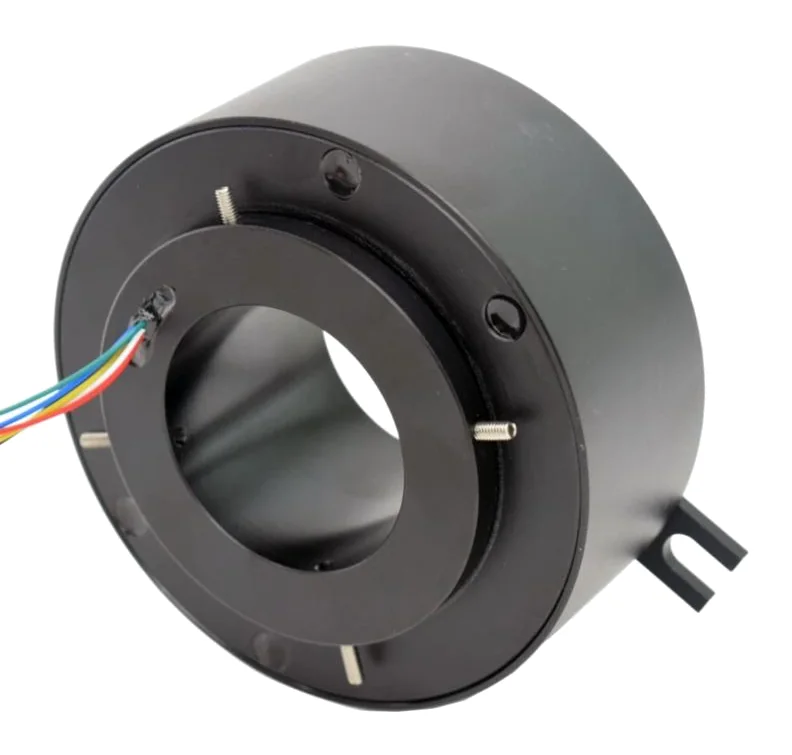
What the slip ring has to handle
- Power circuits for onstage lighting and equipment
- Data for lighting control, audio and video, typically Ethernet or fibre
- Large through-bore, low-profile construction under the stage
- Quiet operation during performances
- Fibre optic rotary joints (multimode or singlemode)
- Low speed with frequent start-stop
Typical figures
| Data | Rotary data transmission up to 1 Gbps |
|---|---|
| Fibre | 1 to 9+ channel fibre rotary joints; multimode G50/125 and G62.5/125, singlemode E9/125 |
| Ingress protection | IP54 to IP68 across fibre rotary joint range |
Example figures from the published sources listed below. Your requirement may differ; an engineer will confirm against your duty cycle.
Recommended slip ring types
Standards to consider
- BS 7909 - temporary electrical systems for entertainment (UK)
- IEC 60204-1 - electrical equipment of machines (stage machinery)
The complete system
A slip ring rarely works alone. For stage revolves & entertainment it is usually specified together with:
- revolve drive
- VFD or servo drive
- absolute encoder
- brake
- show-control system
Specifying these together avoids mismatched connectors, cable routes and feedback interfaces, and gives you one point of contact for the whole axis.
Common problems to design out
- Data dropouts on show-control networks
- Noise from brushes during quiet scenes
- Contact wear from repeated rehearsal cycles
Frequently asked questions
Can a stage revolve carry Ethernet or DMX?
Yes. Revolve systems use rotary data transmission up to 1 Gbps, and fibre rotary joints are common for bandwidth and noise immunity.
What fibre types do stage rotary joints support?
Both multimode (50/125 and 62.5/125 um) and singlemode (9/125 um) fibre joints are available. Channel counts run from a single fibre to more than nine, so lighting, audio and video networks can share one joint.
Why use a pancake slip ring on a revolve?
A revolve has very little depth beneath the stage floor but needs a large central opening. Flat pancake or contact-plate designs keep installation height low while leaving that bore free for cabling.