
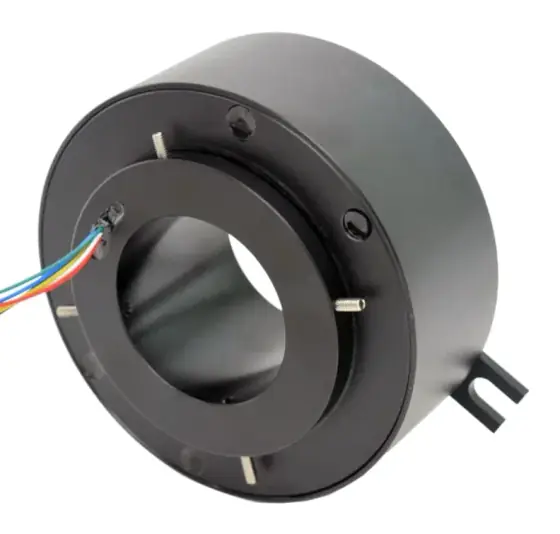
In short:Get the hazardous area classification first: zone, gas or dust group and required temperature class come from the site's DSEAR or ATEX assessment, not from the slip ring supplier. Then choose a slip ring whose certified marking covers all three, usually flameproof (Ex d) for sparking brush contacts in Zone 1, and plan certified cable entries and installation to IEC 60079-14.
Why slip rings need special treatment in hazardous areas
A slip ring transfers power and signals through sliding contacts. Those contacts can produce small sparks, especially on power circuits, during switching or as brushes wear, and the friction generates heat. In a potentially explosive atmosphere both are ignition sources. That is why an explosion-proof slip ring does not try to make the contacts spark-free; it puts them inside a certified protection concept that stops any ignition inside reaching the atmosphere outside.
Common applications include rotating equipment in oil and gas, chemical and pharmaceutical plant, paint and solvent handling, fuel handling, grain and powder processing, and cable reels or slewing equipment in hazardous areas.
This guide explains the terms accurately enough to write a specification. It is not a substitute for the site’s hazardous area classification or for a competent person’s review of the installation.
The decisions, in order
- Hazardous area classification from the site: zone, gas or dust group, required temperature class.
- Equipment protection level and category that the zone requires.
- Protection concept for the slip ring: usually flameproof (Ex d), sometimes pressurised (Ex p), with Ex e or Ex i for connections and signals.
- Certification route the market needs: ATEX (EU), UK regulations (GB), IECEx, or several.
- Electrical and mechanical requirements: circuits, current, voltage, speed, bore, envelope.
- Installation: certified cable entries, earthing, and installation and inspection to the IEC 60079 series.
Step 1: get the area classification from the site
Zoning is the user’s job, not the supplier’s. In Great Britain the Dangerous Substances and Explosive Atmospheres Regulations 2002 (DSEAR) require the employer to classify places where explosive atmospheres may occur into zones (HSE):
| Zone (gas, vapour, mist) | Zone (dust) | Explosive atmosphere is… |
|---|---|---|
| Zone 0 | Zone 20 | present continuously, for long periods or frequently |
| Zone 1 | Zone 21 | likely to occur occasionally in normal operation |
| Zone 2 | Zone 22 | not likely in normal operation; if it occurs, only for a short period |
Ask the site or end customer for three facts, in writing:
- Zone where the slip ring will sit.
- Gas group (IIA, IIB or IIC) or dust group (IIIA, IIIB or IIIC) of the substances present.
- Required temperature class, set by the lowest auto-ignition temperature of those substances.
If any of these is missing, the specification is not ready.
Step 2: match EPL, category, gas group and temperature class
Each zone needs equipment of a matching protection level. WEG’s guide summarises the mapping (WEG), consistent with HSE’s category table (HSE):
| Zone | Equipment protection level (EPL) | ATEX/UK category |
|---|---|---|
| 0 / 20 | Ga / Da | 1G / 1D |
| 1 / 21 | Gb / Db | 2G / 2D |
| 2 / 22 | Gc / Dc | 3G / 3D |
Higher levels cover lower ones: Gb equipment may be used in Zone 2, but not in Zone 0.
Gas groups. WEG lists IIA (propane), IIB (ethylene) and IIC (acetylene, hydrogen) as representative gases. Equipment marked IIC also covers IIB and IIA; IIB covers IIA. A slip ring marked IIB is not acceptable where hydrogen or acetylene is present.
Dust groups. IIIA (combustible flyings), IIIB (non-conductive dust) and IIIC (conductive dust). A gas marking (II) says nothing about dust; dust zones need a III marking.
Temperature classes. The marked class is the maximum surface temperature. The equipment’s class must be lower than the ignition temperature of the substances present (HSE):
| Class | T1 | T2 | T3 | T4 | T5 | T6 |
|---|---|---|---|---|---|---|
| Maximum surface temperature | 450 °C | 300 °C | 200 °C | 135 °C | 100 °C | 85 °C |
A T4 unit satisfies a T3 requirement; a T3 unit does not satisfy T4. Surface temperature depends on current, speed and ambient temperature, so the marking only holds within the certified ambient range and ratings.
Reading a marking
WEG explains a typical marking, Ex db IIB T4 Gb (WEG):
- Ex: explosion-protected equipment
- db: flameproof enclosure, protection level b
- IIB: gas group IIB (also IIA)
- T4: 135 °C maximum surface temperature
- Gb: suitable for Zone 1 (and Zone 2)
ATEX and UK markings add the equipment group and category, for example II 2G, ahead of the Ex code.
Step 3: choose the protection concept
| Concept | Standard | How it protects | Typical zones | Fit for slip rings |
|---|---|---|---|---|
| Flameproof, Ex d | IEC 60079-1 | Enclosure contains an internal explosion; flame paths cool escaping gas | 1, 2 | The usual choice: the sparking contacts sit inside the flameproof housing |
| Pressurised, Ex p | IEC 60079-2 | Clean air or inert gas keeps the enclosure above surrounding pressure, with purge and monitoring | 1 or 2 (by variant) | Used for large assemblies or where a flameproof housing would be impractical; needs a supply and control system |
| Increased safety, Ex e | IEC 60079-7 | Prevents arcs, sparks and hot surfaces in normal operation | 1 (Ex ec: 2) | For terminal boxes, not for the sliding contacts themselves |
| Intrinsic safety, Ex i | IEC 60079-11 | Limits circuit energy below what can ignite the atmosphere | 0, 1, 2 (by level) | For low-power signal and sensor circuits, with certified barriers or isolators |
| Dust protection by enclosure, Ex t | IEC 60079-31 | Keeps dust out of the enclosure and limits surface temperature | 21, 22 | Needed for dust zones |
| Non-electrical, Ex h | ISO 80079-36/-37 | Constructional safety, ignition source control or liquid immersion | By category | Covers mechanical ignition risks such as bearings and seals in some designs |
Protection-type and zone information from WEG and R. STAHL.
Flameproof (Ex d) in practice. The housing is heavy, machined to tight flame-path gaps and must not be modified. Drilling an extra entry, changing a gasket, or fitting a non-certified gland can void the certification. That is why flameproof slip rings are bigger and heavier than their safe-area equivalents, and why the circuit count and bore must be fixed before the housing is certified.
Pressurised (Ex p) in practice. Pressurisation needs a reliable purge gas supply, a purge cycle before power-on, and monitoring that disconnects power if pressure is lost. It suits large hybrid assemblies in an existing purged cabinet, but adds system cost and complexity.
Intrinsically safe signals. Low-energy instrumentation circuits passing through the slip ring can be made intrinsically safe with barriers in the safe area. The slip ring and cabling then become part of the intrinsically safe loop, and the loop’s documentation must account for them.
Step 4: certification and responsibilities
| Party | Responsibility |
|---|---|
| Site operator or employer | Risk assessment, area classification, selecting equipment of the right category, safe installation, inspection and maintenance (DSEAR in GB) |
| Slip ring manufacturer | Designing, assessing and marking the product, with the involvement of a notified or approved body where the category requires; supplying the certificate, declaration of conformity and instructions |
| Machine builder or integrator | Selecting components whose marking covers the zone; installing them to the instructions; assessing the assembly as a whole, including non-electrical ignition sources |
| Installer | Installation to IEC 60079-14 and inspection to IEC 60079-17, by competent people |
Which certificate?
- EU: ATEX (Directive 2014/34/EU), CE marked.
- Great Britain: the Equipment and Protective Systems Intended for Use in Potentially Explosive Atmospheres Regulations 2016, UKCA marked. GOV.UK guidance notes that recognition of CE marking on the GB market was extended by legislation in effect from 1 October 2024 (GOV.UK). Check the current position when you place the order.
- International: IECEx. The IECEx scheme states that ATEX is what is required to sell Ex products in the EU, and advises users to check that a certificate is current on the IECEx online system (IECEx).
Ask the supplier for the certificate itself, not only a datasheet line. Check the certificate number, the exact marking, the certified ambient temperature range, any “X” special conditions of use, and that the model and circuit configuration you are buying is covered.
Worked example: a rotating mixing vessel in a solvent area
Requirement: A rotating vessel in a solvent handling area needs a slip ring for a 400 V motor supply to an agitator (three phases plus earth, 32 A), four 24 V sensor circuits and an RS485 link. The vessel shaft is 60 mm diameter and turns at 20 rpm. The site’s DSEAR assessment gives Zone 1, gas group IIB, temperature class T3 required, ambient −20 to +40 °C.
EPL and category: Zone 1 needs Gb (category 2G) or better.
Protection concept: the 32 A power rings will spark in normal service, so a flameproof enclosure is the practical choice. Pressurisation would need a purge supply on a rotating vessel, which adds complexity here.
Check a candidate’s marking: the ER-EX explosion-proof slip ring in our range is published as Ex d IIB T4 Gb.
- Gb covers Zone 1. ✔
- IIB covers the site’s IIB gases. ✔ (It would fail if the area contained hydrogen, IIC.)
- T4 (135 °C) is lower than the T3 (200 °C) limit. ✔
- Speed: published to 50 rpm, above 20 rpm. ✔
- Bore: published from 42 to 180 mm, so a 60 mm shaft fits. ✔
- Circuits: up to 17 circuits published; this needs 4 power, 4 sensor and 2 data (RS485 pair), 10 in total, plus spares. ✔
- Current: published up to 100 A per circuit, with 10 to 400 A options. ✔
Still to confirm on the certificate: that the configured model (60 mm bore, 10–12 circuits) is covered, the certified ambient range includes −20 to +40 °C, any special conditions, and the type and size of certified cable entries. The installation then goes to IEC 60079-14 with certified glands, and the RS485 link must be suitable for the noise of an adjacent power ring.
Products in our range to consider
- Explosion-proof slip ring (ER-EX): flameproof unit published as Ex d IIB T4 Gb, up to 17 circuits, 10 to 400 A options, bores 42 to 180 mm, IP65 to IP68.
- ER Series through-bore slip ring: the safe-area through-bore range, bores 12.7 to 100 mm, for the non-hazardous part of the same machine.
- Waterproof slip ring: IP64 to IP68 sealing for wet, non-hazardous areas such as washdown and harbour equipment.
- BHR Series frameless carbon brush slip ring: heavy-current rings to 500 A per circuit for offshore cranes and drilling platforms in safe areas or inside certified enclosures.
- QR Series pneumatic/hydraulic rotary joint: air and fluid passages, for example a purge or instrument air supply across rotation.
Hazardous-area suitability depends on the certificate for the exact configuration; our engineers confirm it at quotation.
What else the build needs
- Motor and drive certified for the zone, or the motor in the zone and the drive in the safe area. See servo and stepper motors and servo drives.
- Gearing with its own ignition hazard assessment (surface temperature, lubrication). See gearboxes.
- Feedback devices certified for the zone, or intrinsically safe circuits. See encoders.
- Certified cable glands, barriers and isolators, and armoured or suitably protected cables.
- Controller in the safe area, with any interlocks the protection concept needs. See motion controllers.
- Fluid passages if the rotating part also needs air or liquid. See how to select a rotary union.
Things that catch engineers out
- No area classification yet. The supplier cannot choose a zone for you.
- Gas group too low. IIB equipment in a hydrogen (IIC) area.
- Temperature class confused. A higher T-number means a cooler surface; T4 is cooler than T3.
- Zone 0 expected from Ex d. Flameproof equipment is Gb, not Ga.
- Gas marking assumed to cover dust. Dust zones need a III marking.
- Modifying a flameproof housing, adding entries or using uncertified glands.
- Configuration not on the certificate. A different bore or circuit count may need its own assessment.
- Special conditions (X) ignored, such as a limited ambient range or cable type.
- Mechanical ignition sources forgotten: bearings, seals and couplings around the slip ring.
Checklist
Send these to our engineers, or enter them in the spec builder:
- Zone (0, 1, 2, 20, 21, 22), from the site’s assessment
- Gas group (IIA, IIB, IIC) and/or dust group (IIIA, IIIB, IIIC)
- Required temperature class and ambient temperature range
- Certification required: ATEX, UK, IECEx or other national schemes
- Preferred protection concept, if the site has one (Ex d, Ex p)
- Circuits: number, current and voltage per circuit, signal and data types
- Intrinsically safe circuits and their entity parameters, if any
- Speed (rpm), duty and direction
- Shaft or bore size, envelope, mounting
- Cable entry type, size and number; gland and cable specification
- IP rating, corrosion and offshore requirements
- Quantities and timing
For the wider family, see our slip rings overview and rugged and military slip rings.
Frequently asked questions
What does ATEX mean for a slip ring?
ATEX refers to the EU rules for equipment used in potentially explosive atmospheres. Great Britain has its own equivalent regulations from 2016, with UKCA (often called UKEX) marking, and currently also recognises CE marking. For a slip ring, it means the unit has been assessed and marked for a specific equipment group, category, gas or dust group and temperature class, and may only be used in zones those markings permit.
What do the markings on an explosion-proof slip ring mean?
Take Ex db IIB T4 Gb. Ex means explosion-protected; db is flameproof enclosure; IIB is the gas group, which also covers IIA; T4 means the maximum surface temperature is 135 °C; Gb is the equipment protection level for Zone 1, which also covers Zone 2. A unit marked this way is not suitable for Zone 0 or for IIC gases such as hydrogen.
Can an explosion-proof slip ring be used in Zone 0?
Normally not. Zone 0 requires equipment protection level Ga (category 1), and a flameproof enclosure on its own is rated Gb, suitable for Zones 1 and 2. A slip ring has sliding contacts that can spark, which is why designs for hazardous areas rely on containing ignition rather than preventing it. Where a rotating interface is needed in Zone 0, the usual answer is to locate it outside that zone.
What is the difference between Ex d and Ex p?
Ex d (flameproof, IEC 60079-1) lets gas into the enclosure but makes it strong enough to contain an internal explosion and cools the escaping gas through flame paths, so it cannot ignite the surroundings. Ex p (pressurisation, IEC 60079-2) keeps flammable gas out by holding the enclosure above surrounding pressure with clean air or inert gas, with purge and monitoring controls.
Who is responsible for ATEX zoning?
The employer or site operator. Under DSEAR in Great Britain, the user must assess the risks, classify hazardous areas into zones and select equipment of the right category. The slip ring manufacturer is responsible for designing, assessing and marking the product correctly. The machine builder must choose components whose markings match the zone and integrate them without invalidating the certification.
Is IECEx certification enough to sell into the UK or EU?
No, not on its own. IECEx is an international certification scheme to IEC standards, and many customers ask for it, especially outside Europe. The IECEx scheme itself states that ATEX is what is required to sell Ex products in the EU; in Great Britain the equivalent is the 2016 UK regulations. Many products carry both, and IECEx test reports can support the ATEX or UK assessment.
Sources
- HSE: ATEX and explosive atmospheres, definitions (zones and equipment categories)
- HSE: Hazardous area classification and control of ignition sources (temperature classes)
- WEG: Guide to explosive atmospheres (EPLs, gas groups, protection types, marking)
- R. STAHL: Ex marking of non-electrical equipment
- GOV.UK: Equipment and protective systems intended for use in potentially explosive atmospheres regulations 2016, statutory guidance
- IECEx: FAQs from Ex equipment manufacturers, purchasers and users
Figures are summarised from the sources above and from manufacturers' published data on the date shown. Always confirm against the current datasheet for your exact part.