
Typical requirements
| Battery bus | 24 V or 48 V nominal; one 600 kg AMR uses a 47.7 V Li-ion pack |
|---|---|
| Travel speed | Up to about 2 m/s for AMRs in mixed traffic (published 600 kg class) |
| Integrated drive wheel torque | About 3.6–40 Nm rated, up to 99 Nm peak at the wheel (published 150–180 mm wheel units) |
| Wheel drive reduction | Around 9:1 to 11:1 for integrated hub units; higher for small wheels |
| Low-voltage servo motors | About 50 W to 3 kW on 24–60 V DC |
| Lift actuator force | Up to about 16–25 kN for heavy-duty 24/48 V DC ball-screw actuators |
| Ingress | IP52–IP54 typical indoors; IP65 or above for wash-down or outdoor yards |
Machinery we specify motion for
- AGV traction and steering
- Autonomous forklifts
- AMR drive modules
- Lift-top and tugger modules
- Trailer-loading vehicles
- Conveyors and sorters
- Postal and parcel sorting systems
- Shuttles and stacker cranes
- Pick-and-place stations
What intralogistics asks of motion components
Automated guided vehicles (AGVs), autonomous mobile robots (AMRs), shuttles and the conveyors and sorters around them have one thing in common: they run for long shifts, start and stop constantly, and work near people. For mobile machines add a second constraint. Every watt comes out of a battery, usually at 24 V or 48 V, so efficiency is run time and current is cable size.
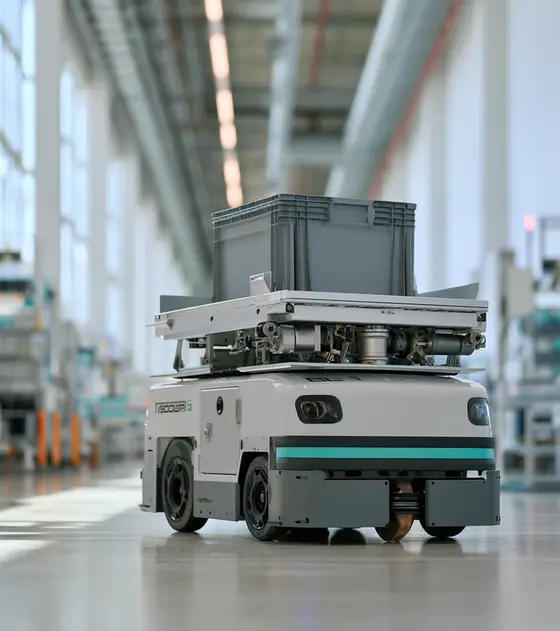
A published example gives the scale. The MiR600 carries up to 600 kg at up to 2.0 m/s on a 47.7 V, 1.63 kWh Li-ion pack, for about 8 h 20 min at maximum payload. It rolls on 200 mm drive wheels, is rated IP52, and lists ISO 3691-4 with 13 safety functions to ISO 13849-1.
Low-voltage servo wheel drives
Most AMRs and many AGVs use differential drive: two driven wheels, each with its own servo motor, reducer, brake and encoder, plus castors. There are three ways to build it.
| Approach | What it is | When it fits |
|---|---|---|
| Integrated wheel unit | Motor, reducer, brake, encoder, drive and tyre in one hub | Robots up to about a tonne, short development time |
| Low-voltage servo motor plus gearbox | Separate motor and planetary or right-angle gearhead driving a wheel | Custom wheel sizes, heavier AGVs, specific safety feedback |
| Integrated servo motor (drive on the motor) | Motor and drive in one body, separate gearbox | Conveyors, shuttles, lift and turntable axes |
Integrated units. The Kinco iWMC combines servo motor, drive, 9:1 or 11:1 reducer, brake and polyurethane tyre on 24–60 V DC with CANopen. Its three sizes (150, 165, 180 mm wheels) give 3.6–40 Nm rated and up to 99 Nm peak at the wheel, for robots carrying up to 1 tonne, at 1.9–3.9 m/s.
Separate components. Low-voltage brushless servo motors such as the Kinco SMC low-voltage range (50 W–3 kW, 24–48 V DC, IP65) or the Leadshine ELVM (33 W–2 kW, up to 300% overload) pair with compact drives like the Kinco FD1 or Leadshine ELD2 (24–70 V DC, up to 60 A continuous and 180 A peak, STO SIL3 on the larger models). A low-backlash planetary such as the Apex AB/ABR or a right-angle unit makes up the reduction. See servo and stepper motors, servo drives and gearboxes.
Low-voltage drives carry high currents. A 1 kW axis on 48 V draws over 20 A, and peaks can be several times that. Check the drive’s peak current duration, the contactor and fuse ratings, and the regenerative energy when the robot brakes downhill; batteries accept charge but a full one may not, and many drives need an external brake resistor.
How to size an AGV drive wheel: a worked example
Vehicle 800 kg loaded, two driven 180 mm wheels, top speed 1.5 m/s, acceleration 0.5 m/s², worst ramp 2%. Assume a rolling resistance coefficient of 0.015 for illustration; ask your wheel supplier for the real value on your floor.
- Rolling resistance: 0.015 × 800 × 9.81 = 118 N.
- Acceleration: 800 × 0.5 = 400 N (as a rule of thumb, add 5–10% for rotating wheels, rotors and gears).
- Gradient: 0.02 × 800 × 9.81 = 157 N.
- Peak force (accelerating up the ramp): 675 N, so 338 N per wheel. At 0.09 m radius that is about 30 Nm per wheel.
- Continuous on the ramp at speed: (118 + 157) / 2 × 0.09 = about 12 Nm per wheel.
- Wheel speed: 1.5 / (π × 0.18) × 60 = 159 rpm. With 11:1 reduction the motor turns about 1,750 rpm.
- Power: about 1 kW total at the end of acceleration, around 21 A from a 48 V pack before losses.
- Traction: if half the vehicle weight sits on the drive wheels, the wheels need a friction coefficient of at least 675 / 3,924 = 0.17. Wet or dusty floors can cut this sharply, which is why drive wheels are often sprung to keep load on them.
Those figures sit inside the published range of integrated wheel units. Next, build a duty cycle (moves per hour, dwell, charging) to get RMS torque and battery energy per shift. Caster Concepts also notes that polyurethane wheel load ratings fall with speed because the tread heats as it deforms, so check the tyre rating at your speed and duty, not just static load.
Lift, tow and top-module actuators
Mobile robots often carry a lift top, a tugger hitch, a roller conveyor top or a turntable.
- Lift tops use a battery-powered linear actuator, screw jacks driven by one motor, or a scissor mechanism. Heavy-duty 12/24/48 V DC actuators such as the Thomson Electrak HD reach 16 kN with a load-holding ball nut and IP67/IP69K static sealing; the Electrak XD reaches 25 kN at 45% duty. Watch duty cycle: lift tops that cycle every minute can exceed a 25% rating. How to size a linear actuator covers force, speed and duty.
- Synchronised lifts with two or four actuators need position feedback on each and a controller that keeps them level.
- Turntables and rotating tops need a slip ring if they rotate continuously; otherwise a cable loop is simpler.
- Conveyor tops use small 24 V roller drives or an integrated low-voltage servo.
Conveyors, sortation and shuttles
Fixed intralogistics uses the same low-voltage building blocks. Integrated servo motors with the drive on the motor, such as the Kinco MD (200–750 W, 24–70 V DC, 16-bit absolute) built for logistics, or the Leadshine iSV2, remove separate drive cabinets and run on a daisy-chained DC bus and fieldbus. For long-travel stacker cranes and shuttle lifts, cable reels and absolute position feedback on the travel axis are common; a robust linear encoder such as the KappaSense FLEXe tolerates dirt and vibration on axes up to 1.9 m. For multi-axis coordination see motion controllers.
Safety: ISO 3691-4 and what it means for components
ISO 3691-4 covers driverless industrial trucks and their systems. The second edition (2023) replaced the 2020 version and added terms such as “active detection field” and “operational stop”. The standard is applied to the whole vehicle, but its clauses shape what you buy:
- Braking: the stopping function must work when power or control is lost, so spring-applied brakes are standard.
- Speed control and overspeed detection: the safety controller needs trustworthy speed feedback, often a second encoder or a safety-rated one.
- Detection of people in the path: scanner fields switch with speed, so the drive and safety controller must know actual speed reliably.
- Safety-related control parts: these are assessed against ISO 13849-1, so ask drive suppliers for STO and other safe functions to IEC 61800-5-2 with stated PL or SIL.
- Stability: load on lift tops and braking forces affect tipping; actuator speed and acceleration are part of that check.
In North America, ANSI/A3 R15.08 covers industrial mobile robots. Battery truck electrical requirements are in EN 1175.
Typical pitfalls
- Sizing on flat floors only and finding the robot stalls on a dock ramp or expansion joint.
- Ignoring traction on wet or dusty floors, so torque is there but the wheel spins.
- Underrating the brake for a loaded vehicle parked on a slope.
- Forgetting regeneration when a heavy vehicle brakes or descends.
- Choosing a lift actuator on force and overrunning its duty cycle.
- Leaving safety feedback until late, then needing a second encoder that will not fit the wheel hub.
Send us your vehicle mass, wheel layout, speeds, gradients and duty, and our engineers can propose wheel drives, lift actuators and controls to match.
AGV drive motors and integrated servo wheels
Mobile robots run their wheel motors from a 24 V or 48 V battery, so pick low-voltage servo motors or integrated wheel units sized for the heaviest load, fastest acceleration and steepest ramp together. Check RMS torque over a real shift, not only peak, and confirm the motor reaches top speed at the lowest battery voltage. Integrated wheels combine motor, reducer, brake, encoder and tyre, which suits robots up to about a tonne; separate motors and gearheads suit heavier AGVs and unusual wheel sizes. Specify a spring-applied brake for slopes and charging, the encoder resolution your navigation needs, and the IP rating for wash-down or outdoor yards.
- AMR differential drive: wheel traction motors
- AGV steering units: steer and drive axes
- Conveyors and shuttles: integrated low-voltage servo motors
- Lift and turntable modules: compact servo axes
- Autonomous forklifts: traction and mast drives
Available through our supply network
All servo and stepper motors →Specify servo and stepper motors for agvs, amrs and intralogistics →
Low-voltage servo drives for AGVs and AMRs
A 1 kW axis on 48 V draws over 20 A continuously and several times that at peak, so low-voltage drives are current-rated devices first. Check peak current and how long the drive sustains it, the contactor and fuse ratings in the battery circuit, and where regenerated energy goes when a loaded robot brakes or descends a ramp: a full battery may not accept it, so a brake resistor may be needed. Ask for Safe Torque Off with a stated SIL or PL, because ISO 3691-4 safety functions rely on it. CANopen or EtherCAT connects drives to the vehicle controller. Two-axis drives save space on differential-drive robots.
- AMR wheel drives: traction and steering control
- AGVs: battery-powered drives with STO
- Lift tops and conveyor tops: compact auxiliary axes
- Shuttles and stacker cranes: low-voltage travel and lift drives
Available through our supply network
All servo drives →Specify servo drives for agvs, amrs and intralogistics →
AGV gearboxes for drive wheels
The wheel gearbox carries the vehicle weight on its output bearing as well as transmitting torque, so radial load capacity matters as much as rated torque. Choose a ratio that puts the motor near its rated speed at top vehicle speed, then check output torque for acceleration up the worst ramp and the emergency stop torque when a loaded vehicle brakes hard. Wheel-drive gearheads with a reinforced output bearing let the wheel mount directly on the gearbox. Right-angle versions keep the drive narrow between wheels. Specify backlash only as tight as positioning needs, IP rating for floor washing, and lubricant for the coldest store the vehicle enters.
- AGV and AMR drive wheels: reduction with wheel bearing support
- Heavy-duty AGVs: high-torque wheel gearing
- Steering units: low-backlash steer reduction
- Conveyor and shuttle drives: compact gearheads
Available through our supply network
All gearboxes and harmonic drives →Specify gearboxes and harmonic drives for agvs, amrs and intralogistics →
Lift and sorter linear actuators
Lift tops, pushers and diverters run on electric linear actuators sized for force, speed and, above all, duty. A lift top that cycles every minute can overrun an actuator rated for intermittent use, so compare the duty profile with the rating before force. For battery-powered lifts, check current draw at full load and holding behaviour with power off, and use position feedback on each actuator when two or four must lift level. On sorters and diverters, electric rod actuators replace pneumatic cylinders with programmable stroke and speed and remove compressed air from the site. Long-travel belt or screw axes suit shuttle and storage-and-retrieval transfer.
- AMR lift tops: payload lifting from the robot battery
- Sorters and diverters: gating, pushing and diverting
- Storage and retrieval systems: long-travel transfer axes
- Pick-and-place stations: guided linear axes
Available through our supply network
All linear actuators →Specify linear actuators for agvs, amrs and intralogistics →
Encoders for wheel, steering and travel feedback
Mobile robots need trustworthy speed and position feedback for navigation and for the safety functions in ISO 3691-4, which often means a second encoder or a safety-rated one. Plan space for it in the wheel hub early. Steering axes need absolute angle at power-up. Fixed systems such as stacker cranes and shuttles benefit from absolute linear feedback on the travel axis instead of counting wheel turns, because wheels slip. Magnetic and inductive linear encoders tolerate dust, vibration and temperature swings in warehouses. Specify resolution, maximum speed, length, interface (SSI, BiSS-C or incremental) and whether the encoder supports the safety functions in your risk assessment.
- AMR wheels: speed feedback for navigation and safety
- Steering units: absolute steer angle
- Stacker cranes and shuttles: absolute travel position
- Lift tops: position of each synchronised actuator
Available through our supply network
All encoders and feedback →Specify encoders and feedback for agvs, amrs and intralogistics →
Motion control for intralogistics
Conveyors, sorters, shuttles and pick-and-place stations need a controller that coordinates many axes, talks to the warehouse management system and reports faults quickly. EtherCAT controllers with IEC 61131-3 programming handle multi-axis sortation and palletising, while remote I/O keeps wiring short along long conveyor runs. Edge gateways collect drive and motor data for maintenance teams. Specify the number of axes and I/O points, cycle time, fieldbuses, the interface to fleet management or WMS, and how the system recovers after an emergency stop with axes at known absolute positions. HMIs at stations help operators clear jams without calling an engineer.
- Sorters: coordinated diverter and conveyor axes
- Palletising and pick-and-place: multi-axis control
- Long conveyor lines: distributed remote I/O
- Logistics sites: remote diagnostics and data collection
Available through our supply network
All controllers and plcs →Specify controllers and plcs for agvs, amrs and intralogistics →
Slip rings for AGV turntables and lift modules
A slip ring belongs on a mobile robot only where a top module rotates continuously: turntables, rotating lift tops and some sensor mounts. For a limited swing, a cable loop is simpler and cheaper. When rotation is unlimited, list the power circuits at battery voltage with their peak current, the signals and any Ethernet or CAN that must cross, and the speed. Through-bore rings leave room for a central lift shaft or cable bundle; compact capsules suit small sensor heads. Specify vibration from uneven floors and dock plates, the IP rating for floor cleaning, and rated life in revolutions for the number of turns per shift.
- AMR turntables: power and signals to a rotating top
- Rotating lift modules: through-bore rings around the lift shaft
- Rotating sensor mounts: compact capsule rings
- Sorter turntables: power and fieldbus across rotation
Available through our supply network
All slip rings →Specify slip rings for agvs, amrs and intralogistics →
Standards to have in view
- ISO 3691-4:2023 (industrial trucks: driverless industrial trucks and their systems)
- ANSI/A3 R15.08-1 and -2 (industrial mobile robots, US)
- EN 1175 (industrial trucks: electrical and electronic requirements)
- ISO 13849-1 (safety-related parts of control systems)
- IEC 61800-5-2 (adjustable speed drives: functional safety, e.g. STO)
- IEC 60529 (IP codes)
Which standards apply depends on the end product and its market. Your engineer will confirm what the component itself needs to meet.