
Typical requirements
| Marine winch slip ring voltage and current (examples) | Up to 7,200 V AC; 7–125 A per pass; up to 1,000 A total (Moog) |
|---|---|
| Winch slip ring speed | Typically 5–100 rpm continuous (Moog marine models) |
| FPSO swivel ratings | Up to 600 signal passes; medium-voltage to 36 kV; high-voltage to 145 kV (Moog) |
| FPSO swivel protection types | Ex d, Ex de or Ex p |
| Ingress for exposed deck equipment | IP66 to IP68 |
| Hybrid slip rings | Up to 52 single-mode or multimode fibres with power (Moog) |
| Deck hatch actuator (example) | 316 stainless, IP67M, 12/24 V DC, up to 2,300 N |
Machinery we specify motion for
- Ship and offshore cranes
- Hose and cable reels
- Marine winches and seismic gun winches
- Marine surveillance and navigation radar
- FPSO turret and swivel systems
- Pod propulsion and steering
- Deck hatches, doors and antenna actuators
- Seismic and oceanographic handling equipment
What marine and offshore service demands
Marine and offshore equipment combines three hard environments: corrosion from salt air and spray, constant vibration and ship motion, and, on production platforms, drilling rigs and FPSOs, explosive atmospheres. Moog lists the scope of the work: floating production systems, ROVs, seismic and oceanographic equipment, shipbuilding and vessel integration, marine pod propulsion and drive and control solutions. Most of these rotate something continuously and need power and data across that rotation, so slip rings matter more here than in almost any other industry.
Where motion components sit on a vessel or platform
| Machine | Motion | Main components |
|---|---|---|
| Ship and offshore crane | Slew, luff, hoist | Slew slip ring, absolute encoders, gearboxes, motors and drives |
| Cable and hose reel | Slow, reversing rotation | Reel slip ring, tension-controlled motor, level-wind |
| Marine winch, seismic gun winch | Rotation under load | High-voltage slip ring, often with fibre and air passages |
| Radar | Continuous antenna rotation | Slip ring with RF or data channels, azimuth encoder |
| FPSO turret | Vessel weathervanes around the turret | Electrical and optical swivel stack, Ex-protected |
| Pod propulsion | Steering rotation of the pod | High-power slip ring and steering drive |
| Hatches, doors, antennas | Short strokes | Stainless sealed linear actuators |
Marine slip rings: winches, reels and cranes
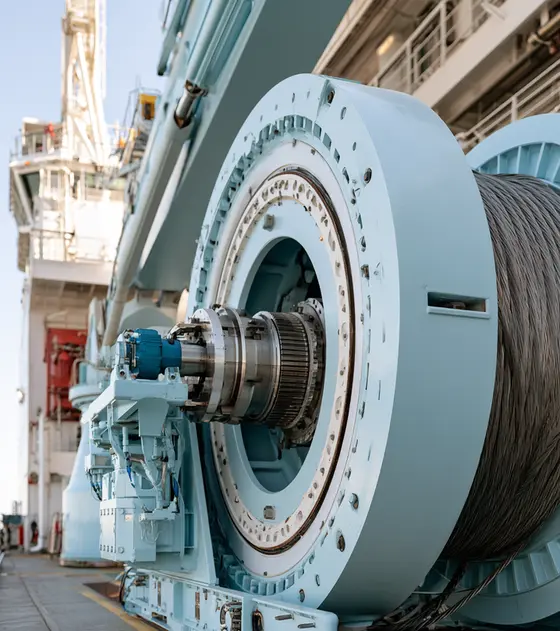
Marine winch slip rings are built for high voltage and current at slow speed. Moog’s winch slip ring comparison runs from the model 180 (7 A per pass, 100 A total, 1,000 V AC, 100 rpm) to the model 129 (125 A per pass, 7,200 V AC, 50 rpm), with the model 159 carrying up to 1,000 A total. Its product guide adds hybrid units with up to 52 single-mode or multimode fibres alongside up to 7.4 kV and 720 A, and a seismic gun winch unit with 23 circuits, 1,000 V DC, 120 A, 100 Mbit/s Ethernet and an air passage at 210 bar, turning at up to 20 rpm.
Tolomatic shows the companion motion on a reel: a cable cylinder guiding cable onto a spool on an ocean oil rig. See marine slip rings, high-current slip rings, slip rings for cable reels, slip rings for cranes and slewing and fibre optic rotary joints.
Radar, FPSO swivels and mooring
Marine radar rotates continuously. Schleifring describes a marine radar slip ring that powers the radar, helps cool the antenna and carries received signals to the ship’s computer, on a radar it says can track more than 1,000 targets at up to 2,000 km. Our pages on slip rings for radar antennas and marine mooring cover the detail.
FPSO turret swivels are the largest rotating joints offshore. Moog’s guide lists low-voltage electrical and optical swivels with up to 600 signal passes at 6 A and 600 V, up to 20 power passes at 200 A and 1 kV, and up to 52 fibre passes; power swivels with up to 50 passes; medium-voltage swivels to 36 kV; and high-voltage swivels to 145 kV. Protection is Ex d, Ex de or Ex p, because the turret sits in a hazardous area.
Deck actuators: electric instead of hydraulic
Hydraulics have long dominated deck machinery, but every hydraulic line on deck is a leak and maintenance point, and a spill at sea is an environmental incident. For hatches, doors, antenna adjusters, level-winds and smaller handling equipment, electric actuators remove the power unit and hoses and need only a cable. Stainless IP67M in-line actuators at 12 or 24 V DC suit yachts and work boats; servo-driven roller-screw actuators carry the heavier loads of deck machinery. The trade-off is that the electric actuator must be sealed, sized for duty and shock, and, in classified areas, certified. See linear actuators and the hydraulic to electric actuator guide.
Environment checklist for marine components
- Ingress: IP66 for deck spray and washdown, IP67 or IP68 where parts can be submerged or sit in bilge areas.
- Materials: 316 stainless or marine-grade coatings, no dissimilar metals in contact, sealed connectors.
- Condensation: heaters or breathers in enclosures that see daily temperature swings.
- Vibration and shock: engine-room vibration, slamming and snatch loads on cranes and winches; ask which tests the supplier has run.
- Temperature: from Arctic decks to engine rooms; check lubricants, seals and electronics at both ends.
- Approvals: classification society requirements, plus Ex certification where the location is zoned.
Pod propulsion and steering
In a podded or azimuthing thruster, the propulsion motor or its drive line sits in a unit that steers through 360°. Power, monitoring signals and sometimes cooling or lubrication services must cross that steering rotation, which is why rotary joints matter here. Moog lists marine pod propulsion among its marine applications and says the highest demands are placed on the reliability of propulsion components. For a component specifier the key inputs are the propulsion power and voltage, the number of monitoring circuits, whether the steering is continuous or limited, the service interval the vessel can accept, and the classification society’s requirements for propulsion machinery.
Hazardous areas on offshore decks
Much of a production platform or FPSO is classified. In Great Britain, HSE explains that DSEAR requires zoning, and equipment for zoned areas must meet the Equipment and Protective Systems Regulations 2016, which implement ATEX Directive 2014/34/EU. R. STAHL’s marking guide maps the zones: Zone 0 needs category 1G (EPL Ga), Zone 1 needs 2G (Gb) and Zone 2 needs 3G (Gc). Internationally, the IECEx scheme certifies equipment by type testing plus factory quality assessment, and a product not on its online certificate system is not IECEx certified. Offshore wind shares many of the same reel, crane and corrosion problems; see renewable energy.
Worked example: specifying a crane slew slip ring
An offshore pedestal crane needs, through its slew:
- 3-phase 690 V power at 150 A for the hoist and luff drives
- 230 V auxiliary power for lights and heaters at 16 A
- 24 V DC control circuits and safety signals
- Gigabit Ethernet for cameras and the crane control network
Steps:
- Power rings: 150 A per phase rules out small precious-metal units; a carbon-brush high-current design is the natural fit.
- Speed: crane slews are slow; confirm the maximum continuous speed in rpm and whether the crane can slew continuously or has limited rotation.
- Data: gigabit Ethernet next to 690 V motor power needs a shielded data section or a fibre channel. Many designers move the camera network to fibre to avoid the problem.
- Environment: IP66 or better for deck spray, heaters for condensation, and materials for salt.
- Zone: if the crane house sits in Zone 2, the slip ring needs at least category 3G equipment or must sit in a protected enclosure; a Zone 1 location needs 2G, for example a flameproof Ex d unit.
- Approvals: the crane will be built to a classification society’s lifting appliance rules, so ask which documentation the society needs for the slip ring.
Typical pitfalls
- Specifying a safe-area part for a classified deck. Check the zone before anything else.
- Running Ethernet next to motor power in the same slip ring without separation.
- Ignoring condensation. A sealed IP68 box with no heater or breather can fill with water from inside.
- Mixed metals in fasteners and housings that corrode at the joint.
- No plan for maintenance at sea. Carbon-brush slip rings are serviceable; make sure the access and spares exist.
What to send an engineer
Send the machine and its location, hazardous-area zone, gas group and temperature class, circuits and data, speed or stroke and force, ingress rating, temperature range, vibration and shock, the classification society and design life. Our engineers can propose slip rings, actuators, motors, encoders and gearboxes to match.
Marine slip rings for cranes, reels and radar
Slip rings are the most marine-specific motion part. Crane slews, cable and hose reels, winches, radar antennas and FPSO turrets all need power and data across continuous rotation. Heavy carbon-brush units carry hundreds of amps at slow speed and are easy to maintain at sea; sealed IP64 to IP68 units suit deck spray and wet machinery; RF and fibre channels serve radar and data-heavy cranes; flameproof units are certified for hazardous areas. Specify each circuit's voltage and current, data, fibre and RF channels, speed, bore, ingress rating, temperature, hazardous-area zone and the vessel's classification requirements.
- Offshore and ship cranes: power, control and Ethernet through the slew
- Cable and hose reels: power and signal at the drum axis
- Marine radar: power and RF or data across the antenna rotation
- Winches: high-voltage power to towed or lowered equipment
- Hazardous decks: flameproof slip rings for classified zones
Available through our supply network
All slip rings →Specify slip rings for marine and offshore →
Actuators for offshore and marine deck equipment
Electric linear actuators open hatches, doors and windows, adjust antennas, guide cable onto drums and replace small hydraulic cylinders on deck machinery. They remove hydraulic lines and the leak risk that comes with them, and need only a cable. For yachts and work boats, 316 stainless IP67M actuators at 12 or 24 V DC suit hatches and doors. For heavier deck machinery, servo-driven roller-screw actuators take over from hydraulics. Specify force, stroke, speed, duty, ingress rating, materials, supply voltage, and the hazardous-area certification if the actuator sits in a classified zone.
- Deck and engine hatches: stainless sealed actuators
- Antenna adjustment: compact DC actuators
- Cable spooling: level-wind guidance onto reels
- Deck machinery: electric replacement for hydraulic cylinders
Available through our supply network
All linear actuators →Specify linear actuators for marine and offshore →
Motors for marine winches and deck machinery
Servo motors drive winches, reels, level-winds, antenna positioners and compact deck machines where controlled speed and tension matter. Large winches use big induction or permanent-magnet motors from specialist marine suppliers; servo motors suit tensioning, spooling and handling systems. Choose sealed IP65 to IP67 bodies, specify a holding brake on any load that can back-drive, and check torque at the lowest speed for tension control, because reels often run slowly while holding full line tension. Confirm the motor's hazardous-area certification separately if it is used in a classified zone.
- Cable reels: tension-controlled drum drives
- Level-winds: synchronised traverse with the drum
- Antenna and camera positioners on deck
- Handling systems: launch and recovery sub-axes
Available through our supply network
All servo and stepper motors →Specify servo and stepper motors for marine and offshore →
Encoders for ship crane slew and reel feedback
Cranes need slew angle and hoist position for load charts, motion limits and collision avoidance; reels need drum position to manage layers and payout. Large-bore absolute encoders fit around the slew axis without homing, and inductive or capacitive designs tolerate condensation, vibration and wide temperatures better than optical ones. Specify bore, resolution, accuracy at the axis, interface, temperature range from -40 °C or below, IP rating and shock and vibration levels. Fit the encoder where it is protected from direct sea spray and cable damage, and ask whether a redundant second channel is needed for the crane's safety functions.
- Ship and offshore cranes: absolute slew angle
- Cable reels: drum position and payout
- Radar and camera pedestals: azimuth feedback
Available through our supply network
All encoders and feedback →Specify encoders and feedback for marine and offshore →
Gearboxes for marine winches and crane drives
Between the motor and a winch drum, slew pinion or reel sits a planetary or right-angle gearbox. Choose on output torque, peak and emergency-stop torque, and radial load on the output shaft, which is high on pinion and drum drives. Stainless bodies and IP65 sealing help on exposed decks. Check lubrication for the full temperature range and the vessel's inclination, and ask for a brake or backstop where a load could back-drive the train. Specify the service factor for shock loads from waves and snatch loads on lifting lines, which a factory duty rating does not cover.
- Crane slew drives: high radial load pinion gearboxes
- Winches and reels: drum reduction
- Deck equipment: stainless gearboxes for corrosive areas
Available through our supply network
All gearboxes and harmonic drives →Specify gearboxes and harmonic drives for marine and offshore →
Servo drives for marine motion systems
Drives for deck machinery must handle ship supplies, vibration and temperature extremes. Extended-environment and vehicle-mount drives with IP65 housings suit mobile and outdoor equipment, and support a wide range of motor feedback and fieldbuses. Specify supply voltage, continuous and peak current, enclosure rating or cabinet location, temperature range, STO where people work near moving equipment, and EMC requirements for bridge and navigation equipment nearby. Energy from lowering loads and paying out reels must go somewhere, so plan braking resistors or a common DC bus early.
- Cable reels and winches: regenerative braking and tension control
- Battery-powered or DC-bus deck equipment
- Positioners: low-voltage servo control
Available through our supply network
All servo drives →Specify servo drives for marine and offshore →
Standards to have in view
- IEC 60529 (IP codes)
- IEC 60092 series (electrical installations in ships)
- IEC 60945 (maritime navigation and radiocommunication equipment: general requirements)
- IEC 60079 series (explosive atmospheres)
- Directive 2014/34/EU (ATEX equipment); in Great Britain the EPS Regulations 2016
- IECEx Certified Equipment Scheme
- Classification society rules for lifting appliances and machinery (for example DNV, Lloyd's Register, ABS)
Which standards apply depends on the end product and its market. Your engineer will confirm what the component itself needs to meet.