
Motion controllers and PLCs
Motion controllers, PLCs and HMIs that coordinate axes and connect them to the rest of the machine. Tell us the application and we'll specify the right product, and the parts around it, for your machine.
In short:If the machine is mostly logic and I/O with simple point-to-point moves, a PLC with motion function blocks is usually enough. If it is mostly synchronised motion, such as camming, interpolation or many coordinated axes, a dedicated motion controller or a PLC with an integrated EtherCAT motion engine is the better fit.
The controller is the brain of the machine. It runs the sequence, reads sensors, drives outputs, talks to the operator through an HMI, and tells each servo drive where to be and when. On a motion-heavy machine, the controller choice also fixes the programming tool, the fieldbus, the drives you can use and, often, who can support the machine in ten years’ time.
This hub covers PLCs, dedicated motion controllers, HMIs and remote I/O, and how to choose between them.
PLC vs dedicated motion controller
The most useful question, as A3’s guidance puts it, is whether the job is primarily machine control or primarily motion control.
| PLC | Dedicated motion controller | PLC with integrated motion (e.g. CODESYS + EtherCAT) | |
|---|---|---|---|
| Strengths | I/O, sequencing, many fieldbuses, long-term support | Tightly synchronised multi-axis profiles, interpolation, cams | Logic and motion in one IEC 61131-3 project and one network |
| Motion capability | Point-to-point, jogging, simple gearing; more with a motion module | Coordinated paths, electronic cams, flying shears, gantry control | PLCopen single-axis, gearing, cams; coordinated groups on capable platforms |
| Weak points | Separate motion module can mean two programs to maintain | Limited onboard I/O, so remote I/O is often needed | Axis count and cycle time limited by CPU; check the vendor’s figures |
| Typical machines | Conveyors, process skids, simple indexing | Converting, printing, CNC-like and robotic cells | Packaging, assembly, pick-and-place, test rigs |
A3 notes that a PLC with a separate motion module brings camming and interpolation but “requires the maintenance of two separate programs”, and that dedicated motion controllers typically need remote I/O beyond about 16 inputs and 16 outputs. PC-based control suits R&D and lab systems, or machines that already need a PC.
Rules of thumb (ours, not a standard):
- Up to a handful of independent positioning axes with lots of I/O: a PLC driving drives that run their own profiles over a fieldbus or pulse/direction.
- Axes that must stay in phase (master/slave gearing, cams, registration): a controller with PLCopen gearing and cam support, ideally over EtherCAT.
- Paths in two or three dimensions (dispensing, cutting, gantries, delta and SCARA robots): a controller with coordinated motion (PLCopen Part 4 or a robotics/CNC package).
IEC 61131-3 and CODESYS
IEC 61131-3 defines five PLC programming languages: Ladder Diagram, Function Block Diagram, Structured Text, Instruction List and Sequential Function Chart (Process Online). Ladder suits interlocks and simple logic; Structured Text suits maths, recipe handling and motion calculations; Sequential Function Chart suits stepwise machine sequences.
CODESYS is a hardware-independent IEC 61131-3 environment used by many controller manufacturers. Its SoftMotion add-on provides certified PLCopen blocks for single and multi-axis motion, a graphical cam editor, virtual axes, and integrated drivers for CANopen and EtherCAT drives, including generic CiA 402 devices. A CNC and robotics package adds path interpolation and kinematics.
Practical consequence: with a CODESYS controller, an OEM can often keep its application code while changing controller hardware, and can use third-party drives that follow CiA 402. Check, though, which CODESYS version, which SoftMotion licence and which drive device descriptions the controller vendor supports.
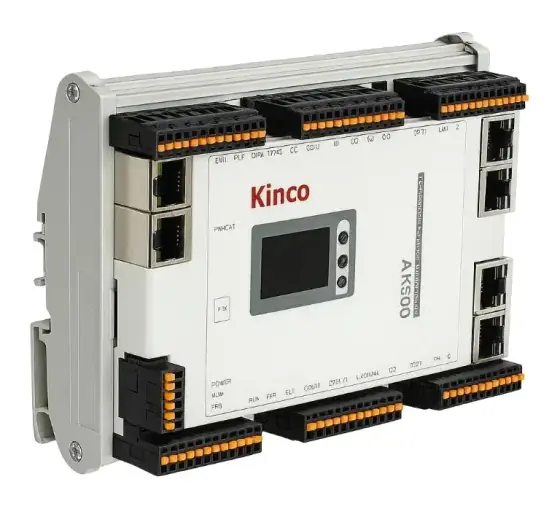
Example CODESYS EtherCAT controllers: Kinco AK and Leadshine MC500. For logic-led machines, compact PLCs such as the Kinco K6S or an all-in-one HMI with built-in PLC such as the Kinco MK can be enough.
PLCopen motion and coordinated motion
PLCopen standardises motion function blocks on top of IEC 61131-3:
- Parts 1 and 2: single and multi-axis blocks such as MC_Power, MC_Home, MC_MoveAbsolute, MC_GearIn and MC_CamIn.
- Part 3: user guidelines and examples.
- Part 4: coordinated motion: axis groups, coordinate transformations, and linear and circular group moves.
- Part 5: homing procedures.
- Part 6: fluid power.
Every PLCopen axis follows the same state machine (Disabled, Standstill, Homing, Discrete Motion, Continuous Motion, Synchronized Motion, Stopping, ErrorStop), so error handling and recovery code looks the same across platforms. PLCopen’s stated aim is that application code becomes less hardware-dependent and scalable across control solutions.
Coordinated motion (Part 4) is different from master/slave gearing. In gearing, a slave axis follows a master. In a coordinated group, the controller plans one path for all axes together, which gives better trajectory planning and means every axis in the group knows when another faults. If your machine draws lines or arcs with the tool, you need group motion, not gearing.
EtherCAT masters and drive networks
Most multi-axis servo systems now use EtherCAT. The controller is the master; drives, I/O and encoders are slaves on one network. Hilscher quotes cycle times of 100 µs or less, jitter below 1 µs, hardware-based distributed clocks, and up to 65,535 devices per segment.
For servo motion the controller usually commands drives in cyclic synchronous position (CSP) mode under the CiA 402 profile, sending a new setpoint every cycle while the drive closes the current, velocity and position loops. KEB points out that vendors may support only part of CiA 402, so confirm the modes and homing methods on both ends.
Choosing a cycle time (rule of thumb): 1 ms is ample for most conveyors, indexing and packaging axes; tightly coupled, high-dynamic axes or interpolated paths benefit from 250 to 500 µs. Shorter cycles cost CPU time, so check the controller’s published axis count at your target cycle time, not its headline maximum.
Alternatives: PROFINET IRT on Siemens platforms, EtherNet/IP with CIP Motion on Rockwell platforms, CANopen for low-cost mobile machines, and pulse/direction outputs for simple stepper or servo axes.
HMIs, remote I/O and gateways
HMIs. Choose on screen size and viewing distance, environmental rating (front-panel IP rating for washdown), communication with your controller, and whether one project can scale across screen sizes. Examples: Kinco HMI MASS (cost-focused), Kinco HMI Green and Kinco HMI Future (higher performance).
Remote I/O. Put I/O near the sensors and valves to cut cabling, and keep it on the motion network so inputs are sampled in the same cycle as the axes, which matters for registration and fast sensing. Example: Kinco RP20 slice I/O with an EtherCAT coupler.
Gateways. Where the machine must report to MES or cloud systems, or bridge legacy serial devices, an IoT gateway such as the Kinco GW01 keeps that traffic off the real-time control network.