
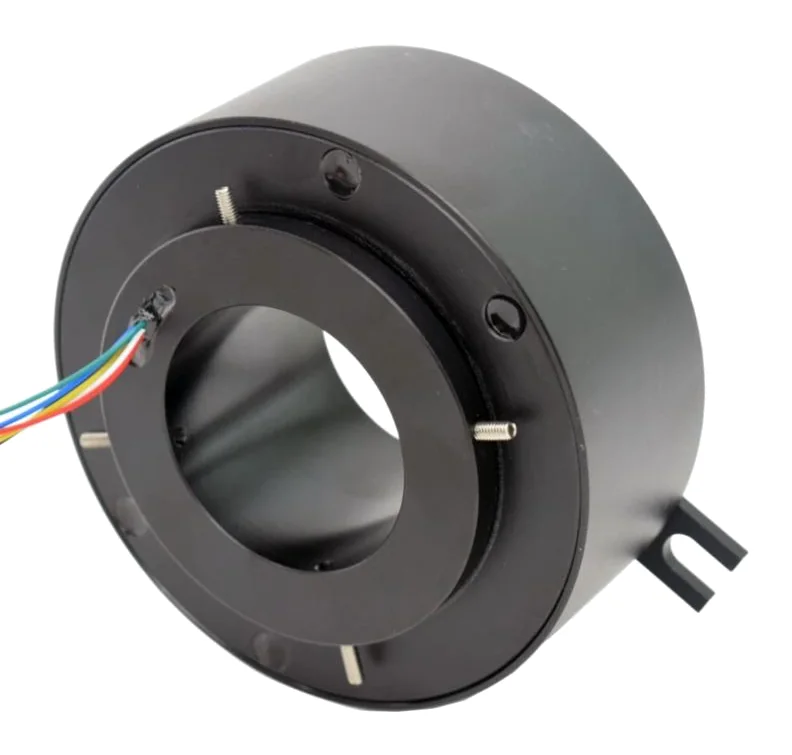
What the slip ring has to handle
- High-voltage power passes for ROV or TMS supplies (up to around 1000 V AC)
- Fibre optic rotary joint for telemetry and video, multimode and/or singlemode
- Fluid-filled, pressure-compensated construction for subsea use
- Corrosion-resistant stainless steel housings
- Shock and vibration tolerance for deck and vessel motion
- Hazardous-area (flameproof) versions where required on oil and gas installations
- Speed matched to winch duty, typically up to around 100 rpm
Typical figures
| Voltage | Up to 1000 V AC (example winch slip ring) |
|---|---|
| Current | Up to 7 A per pass, 100 A total (example) |
| Speed | Slip ring up to 100 rpm continuous; FORJ 100 rpm dry, 60 rpm fluid-filled |
| Fibre | 2 to 21 multimode passes, up to 6 singlemode with a companion joint; insertion loss under 5.5-6.5 dB |
| Pressure | Fluid-filled FORJ tested to 10,000 psi (69 MPa) |
| Temperature | Slip ring -20 C to +55 C; FORJ -40 C to +60 C |
Example figures from the published sources listed below. Your requirement may differ; an engineer will confirm against your duty cycle.
Recommended slip ring types
Standards to consider
- ATEX / IECEx - hazardous-area certification for flameproof winch slip rings on oil and gas sites
- DNV rules for offshore and subsea equipment - commonly applied to ROV and launch-and-recovery systems
The complete system
A slip ring rarely works alone. For rOVs & subsea winches it is usually specified together with:
- winch drum and level-wind
- hydraulic or electric winch drive
- tether management system (TMS)
- fibre optic multiplexer
- encoder for payout
Specifying these together avoids mismatched connectors, cable routes and feedback interfaces, and gives you one point of contact for the whole axis.
Common problems to design out
- Fibre insertion-loss increase or variation with rotation
- Seawater ingress or loss of compensating fluid
- Insulation breakdown on high-voltage passes
- Corrosion of housings and connectors
Frequently asked questions
Why are subsea slip rings oil-filled?
Filling the slip ring with fluid and pressure-compensating it balances internal and external pressure, so the housing does not have to resist full ocean depth. Fluid-filled fibre optic rotary joints have been pressure-tested to 10,000 psi.
Do ROV winches need a fibre optic rotary joint?
Most work-class ROV umbilicals carry telemetry and video on fibre, so a fibre optic rotary joint is fitted alongside the electrical slip ring. Multipass joints with up to 21 multimode channels are available.
How fast can a winch slip ring rotate?
Typical winch slip rings and fibre joints are rated around 100 rpm dry, with fluid-filled fibre joints often limited to about 60 rpm. Higher speeds need case-by-case design.